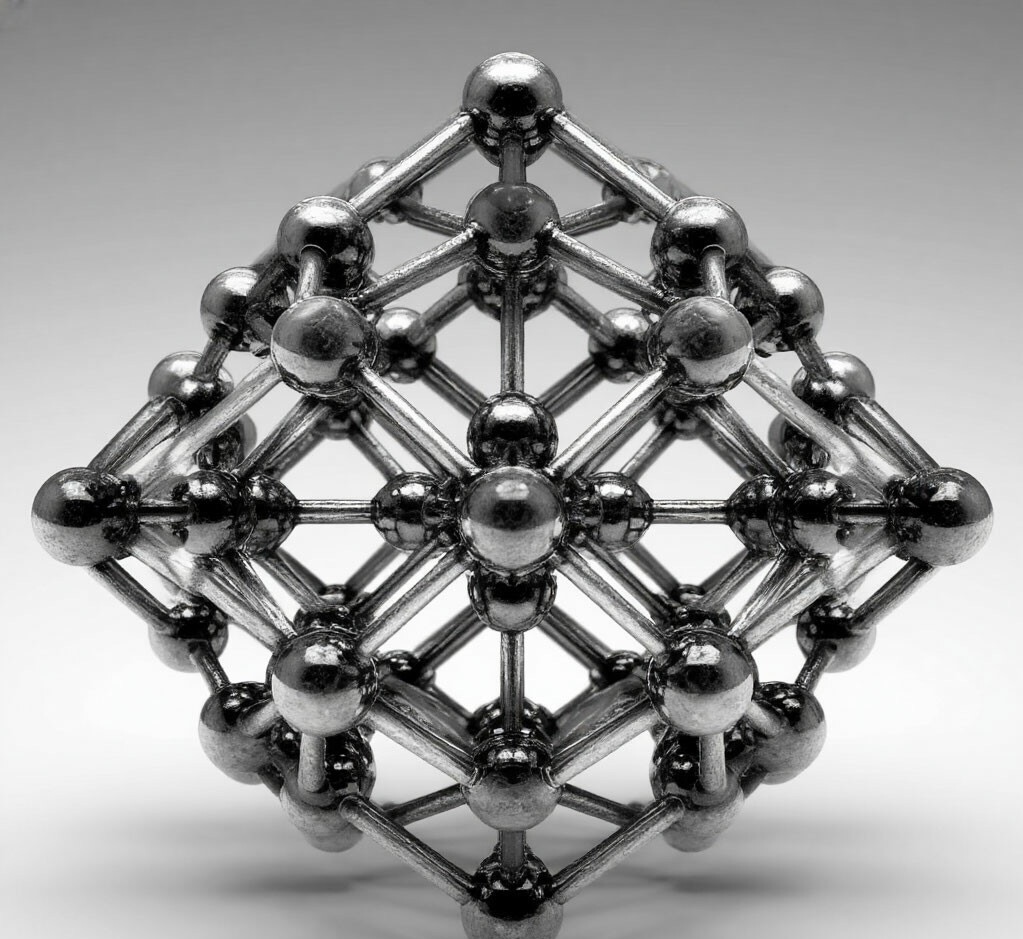
Metals, despite the apparent perfection of their crystal structure, contain numerous “flaws” — defects that affect their properties and service performance. Understanding the nature and types of defects is key to improving product quality, and PZPS pays special attention to this at every production stage.
The concept of a defect in metals
A defect in metals is any deviation from the ideal periodicity of the crystal lattice or a disruption of structural homogeneity. Such disruptions can be natural (for example, under radiation exposure) or technological (plastic deformation, impurity contamination), arising during production, processing, or service of metal products. Defects can form at various levels — from atomic to bulk — and have a significant effect on the physical, chemical, and mechanical properties of the metal.
Defects in metals are classified by the level at which they appear:
- Atomic level. Point defects are disruptions localized within one or several atoms. They include vacancies, interstitial atoms, and impurities.
- Crystal-lattice level. Linear defects are disruptions that extend in one dimension, for example dislocations. Planar (surface) defects are disruptions located in two dimensions, for example grain boundaries or phase boundaries.
- Bulk level. Volume defects are disruptions that occupy a significant volume of the material. They include cracks, pores, and inclusions.
This classification helps systematize the various types of defects and understand their effect on metal properties depending on the scale at which they appear.
Defects at the atomic level
Point defects are microstructural changes in the metal that directly affect its macroscopic properties. They include:
- Vacancies — the absence of atoms at crystal-lattice sites.
- Causes: thermal vibration of atoms, radiation, or impurities.
- Interstitial atoms — atoms located between lattice sites. They create local stresses and impede dislocation slip.
- Causes: plastic deformation, radiation, or diffusion of atoms through the metal surface.
- Impurities — atoms of other elements introduced into the crystal lattice. They can either reduce or improve material quality — for example, by enhancing corrosion resistance, strength, and other properties. They may be:
- intentional — formed as a result of steel alloying;
- accidental — appearing due to material contamination.
Point defects have a substantial effect on the properties of steels and alloys.
Effects of point defects:
- Mechanical properties: defects at the atomic level impede dislocation motion, changing the strength and ductility of the metal.
- Electrical properties: point defects change the concentration of charge carriers, which affects the electrical conductivity of the steel or alloy.
- Thermal properties: defects within one or several atoms disrupt ordered atomic motion, which can reduce thermal conductivity.
Analysis methods:
- X-ray and neutron diffraction make it possible to determine crystal-lattice structure and detect the presence of defects.
- Infrared and Raman spectroscopy help analyze atomic vibrations in the crystal lattice.
- Nuclear magnetic resonance (NMR) makes it possible to analyze the local structure and dynamics of atoms in the metal.
Defects at the crystal-lattice level
Crystal defects are disruptions of the ideal periodicity and regular arrangement of particles in crystals. They affect the ductility, strength, and reliability of metals. They may be linear or planar.
- Dislocations — lines along which the regular arrangement of the crystal lattice is disrupted. They are classed as linear defects. They may be edge, screw, or mixed. Dislocations play an important role in plastic deformation and material strengthening.
- Grain boundaries — regions between grains where the crystal lattice changes orientation. They are classed as both linear and planar defects. They can affect mechanical (strength, hardness, and ductility) and physical (electrical and thermal conductivity) properties of the material.
- Phase boundaries — interfaces between different phases in a material, for example between solid and liquid states or between different crystal modifications. They are classed as planar defects. They affect properties such as strength, ductility, and corrosion resistance.
Effects of crystal-lattice defects on the mechanical and physical properties of metals:
- Strength and ductility — linear defects change the material’s ability to recover after deformation. The more defects there are, the higher the strength and the lower the ductility of the metal.
- Electrical and thermal conductivity — lattice defects can change the electronic structure of the metal and its ability to conduct heat and electricity.
- Corrosion resistance — defects can alter the metal surface, thereby increasing or decreasing its corrosion resistance.
Investigation methods:
- X-ray diffraction analysis (XRD) determines crystal-lattice structure and reveals linear defects.
- Electron microscopy provides high-resolution images of the crystal lattice and reveals any defects in it.
- Electron diffraction makes it possible to study crystal-lattice structure and identify dislocations and grain boundaries.
Volume defects
Cracks, pores, and other structural inhomogeneities have the greatest effect on the physicomechanical properties of a material.
Volume defects include:
- Cracks — ruptures in the material; they may be surface or internal. They arise due to fatigue loading, residual, reactive, and thermal stresses, corrosion damage, and other factors. They reduce material strength and durability.
- Pores — voids in the material formed as a result of gaseous and non-metallic inclusions and other factors. They reduce density, strength, and other mechanical properties and can act as corrosion initiation sites.
- Inclusions — foreign particles that enter the material during manufacture or service. They may be metallic or non-metallic. They reduce the physicomechanical properties of steels and alloys.
Effects of volume defects on the service properties of metals:
- Reduced strength and stiffness due to local weak spots in the material structure.
- Reduced fatigue strength, leading to metal failure under cyclic loading at sites with pores and cracks.
- Reduced stiffness, which promotes deformation of the material under load.
Inspection methods:
- Visual inspection and microscopy make it possible to detect surface cracks and other visible defects.
- Ultrasonic testing — based on using ultrasonic waves to detect internal defects in the material.
- Magnetic particle testing is used to detect defects in ferromagnetic materials with the aid of magnetic fields.
The choice of method for investigating and assessing volume defects depends on the material type, its structure, and the required accuracy and reliability of the results.
Methods for preventing metal defects
Material quality control:
- Incoming inspection of incoming materials for compliance with standards and specifications. It includes analysis of chemical composition, mechanical properties, microstructure, and the presence of defects.
- Sorting and rejection of materials with identified defects or nonconforming characteristics.
Process control:
- Development and observance of process regulations and processing parameters (temperature, pressure, time, etc.) to minimize the probability of defect formation.
- Continuous monitoring and timely adjustment of processes and parameters to prevent rejects.
- Use of modern high-technology equipment that ensures high accuracy and repeatability of operations.
High-quality alloys produced by PZPS
Thanks to high-precision modern equipment, an in-house laboratory, and strict control of process parameters at every production stage, PZPS manufactures materials with maximum homogeneity and a minimal number of defects. You can buy cold-rolled strip from us made of:
- precision alloys for elastic elements, for example 17KhNGT and 40KhNM;
- corrosion-resistant steels 12Kh18N10T, 20Kh13, and others;
- electrical steel, for example 20895, 20860, 21880;
- precision alloys with high electrical resistivity Kh23Yu5T, Kh20N80N, Kh15N60N, and others;
- soft magnetic alloys, including 49K2FA-VI, 81NMA.
PZPS specialists carefully monitor the appearance of various defects in metal and promptly eliminate them, which makes it possible to produce high-quality products that meet strict industry standards. Contact our specialists for advice and to place an order for specialty steels, precision alloys, or manufacturing services.