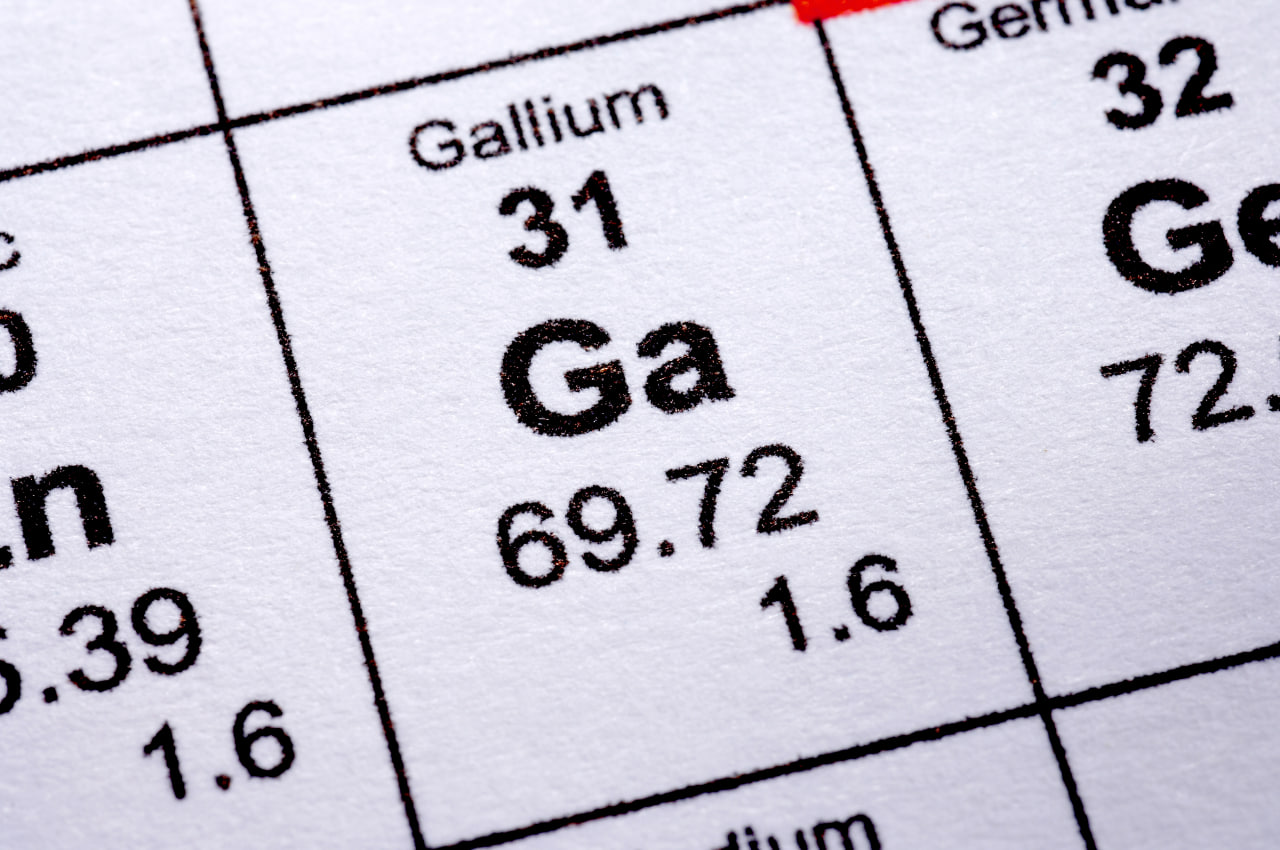
One of gallium’s characteristic properties is a long period in the liquid state: the metal melts at t = 29.76°C and boils at t = 2,203.85°C. Thus it retains liquid form over a very wide temperature interval — 2,174.09°C. At room temperature the metal is resistant to oxidation, but when heated it actively reacts with oxygen, as well as with iodine and sulfur. It slowly reacts with nitric and perchloric acid and quickly dissolves in sulfuric and hydrochloric acid.
On contact with aluminum and its alloys, gallium penetrates the intercrystalline lattice of the metal, leading to destruction of the latter. For example, if an aluminum can is partially coated with Ga, it will not only begin to oxidize instantly but after a short reaction will easily crumble in one’s hands. Moreover, gallium here acts as a classic catalyst — like mercury, it turns aluminum into a liquid amalgam, but itself is not consumed in the reaction.
Gallium’s unique characteristics were unused for many years, but after semiconductor properties were discovered in it the situation changed sharply. Back in 1990 world gallium mining was only 6.5 tonnes per year; in 2008 — already 270 t; and in 2022 — more than 430 tonnes. The sharpest growth in demand for Ga occurred in the early 2000s, when mobile phone production and fiber-optic communications began to develop at a rapid pace. Exactly in that period most enterprises for producing gallium were built. Remarkably, despite continuous growth in demand for the metal, world capacities for mining and processing Ga are considered excessive — according to the U.S. Geological Survey, existing enterprises can produce more than 480 tonnes per year (which exceeds consumption by more than 10%).
Without Ga there would be no such technologies as Wi-Fi, Bluetooth, and mobile communications. Gallium arsenide (GaAs) chips are ubiquitously used in wireless networks, and gallium nitride (GaN) — in chargers and electric vehicles. Exactly microprocessor electronics is the main application area of Ga — 96.7% of metal produced in the world is consumed there.
Gallium arsenide is a semiconductor like silicon, but when operating at ultra-high frequencies it provides better communication quality and reduces noise. In addition, gallium electrons move five times faster than silicon’s, which makes it possible to raise signal transmission speed many times. For some time only unique expensive parts were made from GaAs, for example solar cells for space stations. But with the appearance of 3G and 4G communication standards the need for Ga grew more than tenfold (and development of 5G without it would have been impossible altogether, since only gallium can provide the required data exchange speed). Today more than half of mined gallium is spent precisely on producing 3G/4G chips.
Another application area is LED production. Compounds of Ga with other elements make it possible to obtain “luminous” elements with various color spectra. For example, for infrared radiation gallium arsenide or its alloy with aluminum (AlGaAs) is used; for green — gallium phosphide with aluminum and indium (AlGaP and AlGaInP); for violet — indium-gallium nitride (InGaN).
Gallium nitride is widely used in manufacturing liquid-crystal displays, components for electrical distribution devices, industrial control systems, microwave radiation sources, and base stations for wireless networks.
A potentially growing market for gallium is production of thin-film photovoltaic cells, including those used to absorb solar radiation. But besides that there is another industry able to give Ga another sharp jump in demand — so-called wearable electronics — devices able to form a single whole with the human body.
To manufacture such products liquid wires are needed that in that state not only retain their electrical conductivity but also do not impede penetration of light, heat, and moisture. And if to achieve the required water and light permeability it is enough to use a transparent polymer base, only a metal is suitable for the desired heat dissipation. The solution was gallium placed in an elastic polymer shell.
Individual devices with liquid wires are already available to some users. Unfortunately, for now predominantly only to their developers and interested scientists. For example, in prototypes of virtual reality system elements being created, gallium enclosed in a polymer shell is used to transmit information about tactile sensations.