Iron is the fourth most abundant element by mass in the Earth’s crust. The Earth’s core is believed to consist mainly of iron with nickel and sulfur.
The age of the earliest iron objects found in Egypt is dated to about 3500 BCE. They contain about 7.5% nickel, indicating meteoritic origin.
The ancient Hittites of Asia Minor, today’s Turkey, were the first to smelt iron from their ores around 1500 BCE, and this new, stronger metal gave them economic and political power. The Iron Age began.
Some kinds of iron clearly surpassed others depending on carbon content, though this was not appreciated. Some iron ore contained vanadium, from which so-called Damascus steel was produced, ideal for making swords.
The first person to systematize various types of iron was René Antoine Ferchault de Réaumur. In 1722 he published a book explaining how steel, wrought iron, and cast iron differ in charcoal (carbon) content.
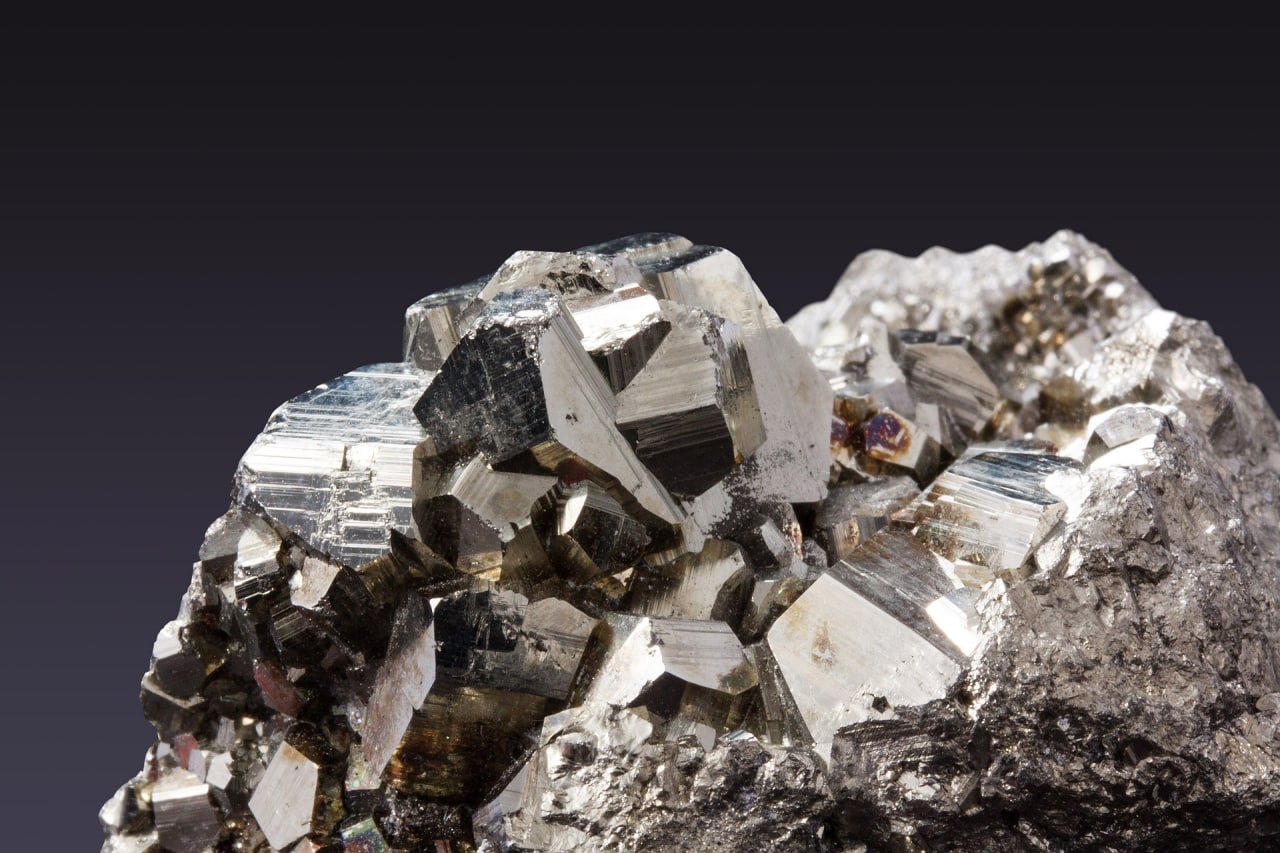
The most common iron-bearing ore is hematite, but iron is also in other minerals such as magnetite and taconite.
On an industrial scale iron is produced in a blast furnace by heating hematite or magnetite with coke (carbon) and limestone (calcium carbonate). This forms pig iron, which contains about 3% carbon and other impurities.

Pure iron is used to make transformer and electric motor cores, electromagnets, and microphone diaphragms. But the main structural materials in virtually all branches of modern production are precisely iron alloys — cast iron (used to produce steel) and steel.
There are many different types of steel with different properties and purposes. Ordinary carbon steel is an alloy of iron with carbon (from 0.1% for low-carbon steel to 2% for high-carbon steel) with small amounts of other elements.
Alloy steels are carbon steels with other additions such as nickel, chromium, vanadium, tungsten, and manganese. They are stronger and stiffer than carbon steels and have a huge variety of applications, including building bridges, electrical towers, making bicycle chains, cutting tools, and rifle barrels.
Stainless steel is highly corrosion-resistant. It contains at least 10.5% chromium. Other metals such as nickel, molybdenum, titanium, and copper are added to raise strength and machinability. Stainless steel is used in architecture, bearings, cutlery, surgical instruments, and jewelry.
Cast iron contains 3–5% carbon. It is used for pipes, valves, and pumps. It is not as strong as steel but is cheaper.
In the free state iron is a silvery-white metal, quite ductile, heavy, refractory (melting temperature — 1539°C). Its characteristic feature is magnetic properties.
Atomic number — 26. Symbol — Fe (Latin “ferrum”). Boiling point — 2862°C, density — 7.874 g/cm³
1. The average amount of iron in the human body is about 4.5 g.
2. When people first learned to extract and process iron, it cost more than gold.
3. The largest piece of pure iron ever discovered weighs 66 tonnes. It is all that remains of a meteorite that once fell on the African country of Namibia.
4. Every 45–47 minutes as much iron is extracted from the Earth’s interior as gold mined throughout history.
5. One of the few places with deposits of pure native iron without impurities is Greenland.