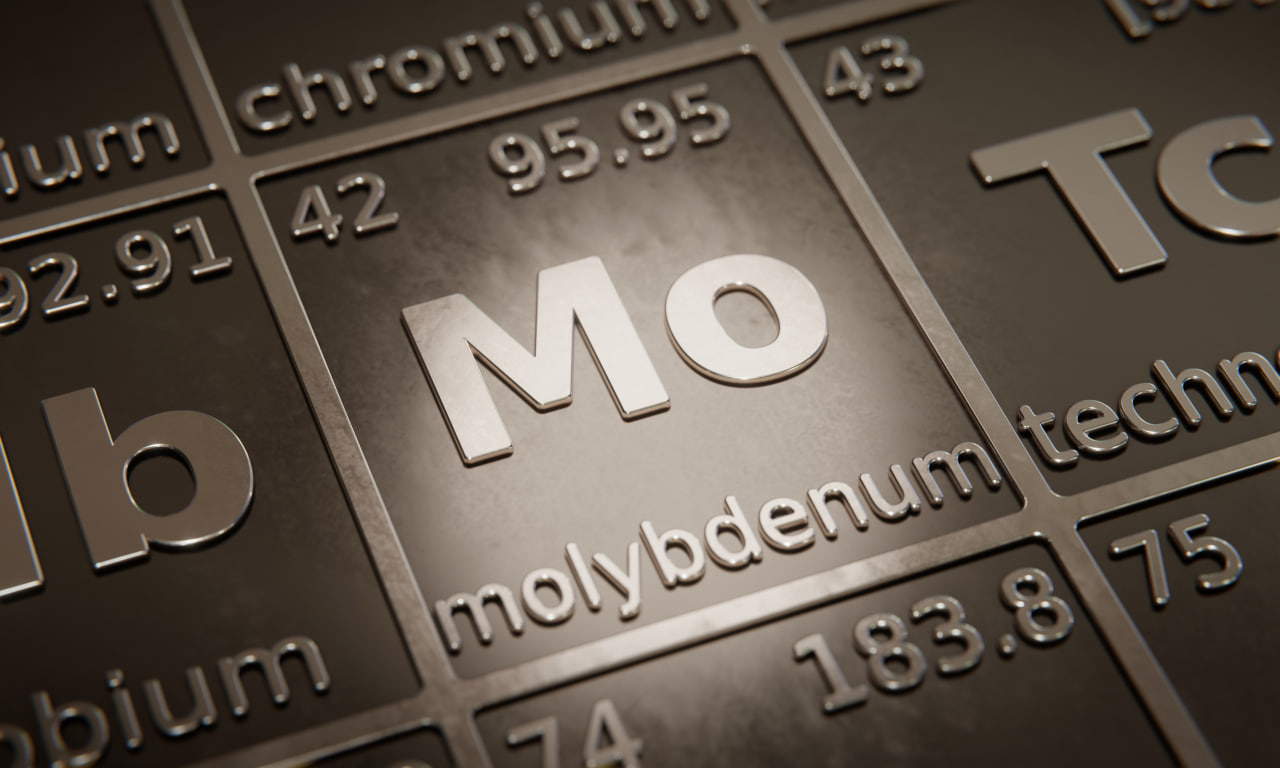
Molybdenum is the 42nd element of D. I. Mendeleev’s periodic system of chemical elements. It has a silvery-white color and resembles lead in appearance. Exactly because of this similarity it received its name: translated from Greek μόλυβδος [mólyvdos] means “lead.”
Molybdenum has high electrical conductivity and low TCLE (temperature coefficient of linear expansion). Mo melts at t = 2,620°C and boils at t = 4,630°C. Under normal conditions it does not react with air, but when heated above 400°C it begins to oxidize rapidly, and at 700°C it loses its strength, which limits use of Mo in pure form under high temperatures.
To raise molybdenum’s strength characteristics, tungsten (W) is added to it. Such alloys usually contain from 49 to 51% Mo and at least 48% W, and may also include some quantity of various impurities. The resulting metal has high mechanical strength and corrosion resistance at elevated temperatures, allowing use in instrument making, including manufacturing heating elements of industrial electric furnaces.
The history of molybdenum’s discovery is linked simultaneously with several Swedish chemists:
In industry molybdenum began to be used only at the beginning of the 20th century, after it was discovered that adding Mo makes gun and armor steels stronger.
In the Earth’s crust molybdenum is present in an amount of 0.003%. Main deposits are in China, Russia, the USA, and Chile. Mo is mined from ores containing up to 50% of the sought metal, 30% sulfur, 10% silicon, and some quantity of other elements.
After mining the ore is roasted in special furnaces at 550…600°C, resulting in molybdenum oxide contaminated with various impurities. It is purified by one of the following methods:
After purification molybdenum oxide is heated in furnaces with working chambers shielded from the surrounding atmosphere. At the first stage furnace temperature is set at 600…700°C, at the second — 900…1,000°C. As a result of such sequential heating a powder is obtained that is then converted into metal by heat treatment. Finished molybdenum products may take the form of sheet, strip, bar, wire, or rod.
In industry molybdenum is predominantly used as an addition when melting steels: the quantity of Mo added to them determines the type of product produced:
In addition, ferromolybdenum is produced from pure Mo — an alloy with molybdenum content from 55 to 75%, which can subsequently be used as an addition when alloying steels.
Only a third of mined molybdenum is used as pure metal or alloys in which Mo is the main component. Such materials are used in producing supersonic aircraft and space rockets to create skin elements, heat shields, and jet engine parts. Molybdenum alloys are also used in creating nuclear reactors, various vacuum devices, electrodes for melting glass, and parts of equipment operating in acid environments, including phosphoric, hydrochloric, and sulfuric.