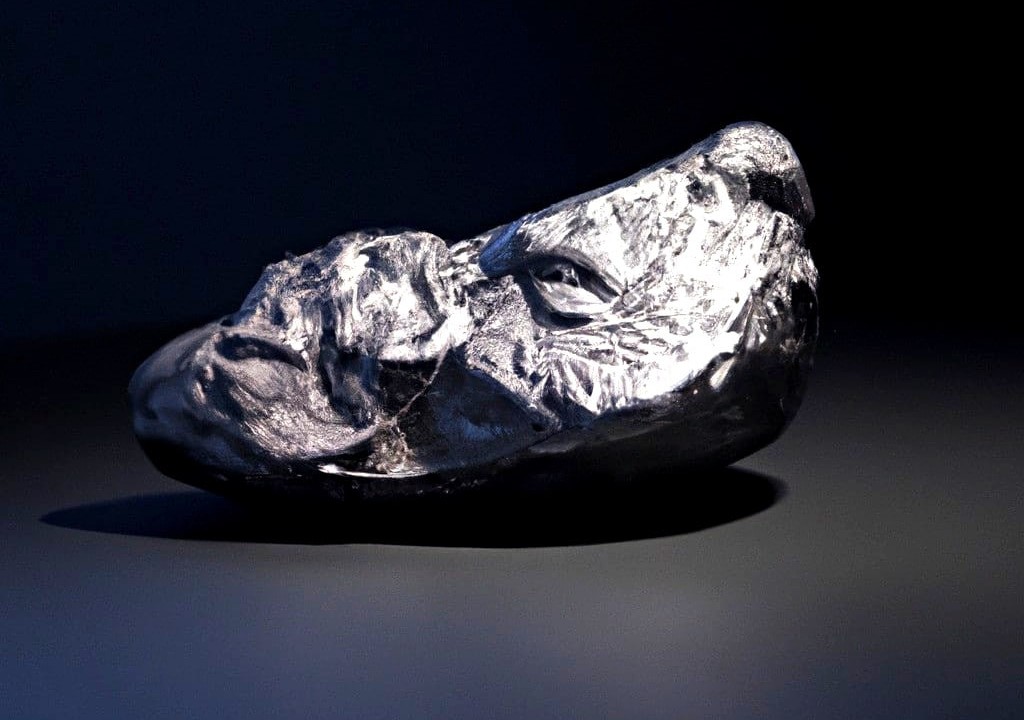
Tin (Sn) is a ductile, light metal of silvery-white color. It is mainly used as a non-toxic coating protecting a product from corrosion. It is used both in pure form and in alloy compositions, including precision ones. In D. I. Mendeleev’s periodic table it is under number 50.
The Latin name of tin is stannum, which translates as “strong, durable.” Initially this was the name of an alloy of lead and silver, later — tin-based alloys, and only by the 4th century CE — the element Sn itself.
Today it is impossible to say exactly when tin was found. The first mentions of it date to the 4th millennium BCE. In those times this metal was little available and very expensive, so products from it were quite rare.
Tin began to become popular only toward the end of the 3rd millennium BCE in the Bronze Age. Being one of the components of tin bronze (along with copper), it became a “strategic metal” and was used in many spheres: from making jewelry and dishes to producing armor and weapons. Among scientists there is an opinion that bronze — an alloy of tin and copper — is the first artificial metal that humanity learned to melt.
Despite the rich history of using tin, scientists were able to obtain the pure metal only in the 12th–13th centuries — until then the metal used always contained some quantity of lead. The first mentions of pure tin appear in the works of Roger Bacon (1214–1292) — an English philosopher and natural scientist.
After people learned to purify tin of impurities, pure metal began to be used to make jewelry and kitchenware. Unfortunately, as soon as a tin product spent a little time in the cold, a strange “disease” struck it: gray spots appeared on the surface that gradually grew, and then the metal in those places seemed to dissolve. Medieval scientists called this phenomenon “tin pest.”
The cause of “tin pest” was found only at the beginning of the 20th century by examining crystal lattices of “infected” and “pure” metal using X-ray radiation. It turned out that at t below 13.2°C stannum transitions from the β-modification (white tin) to the α-modification (gray tin), which leads to crumbling of the solid metal into powder.
It is believed that “tin pest” was one of the causes of the death in March 1912 of polar explorers from the Terra Nova expedition. The British under Robert Scott, advancing toward the South Pole, left “caches” of food and fuel along the way that they planned to use on the return. Upon returning to the camp sites they found empty containers. In those times seam soldering was still done with pure tin, because of which canisters leaked under low temperatures.
Napoleon Bonaparte’s defeat in Russia is also partly linked to “tin pest.” According to legend, belt buckles and buttons on soldiers’ and officers’ uniforms were made of tin, which in Russian frosts crumbled very quickly, making further combat actions difficult.
There is still no “cure” for “tin pest,” and in general there is no need for one — it is significantly simpler to use tin not in pure form but in alloys such as:
In modern microelectronics practical application has also been found for “tin pest.” Etching microcircuits needs deep ultraviolet (UV rays with wavelength 13.5 nm), and obtaining it needs the finest optics, which during service quickly dull due to tin condensation. Cleaning glasses with gray tin makes it possible to remove the finest metal particles from their surface without leaving the slightest scratches on the lenses.