At the beginning of Alexander I’s reign, French master Alexandre Guérin arrived in Saint Petersburg with the dream of founding his own business, and already in 1805 he opened a bronze foundry workshop on Vasilyevsky Island. Over 30 years Guérin achieved great success, and by the early 1840s his workshop was considered one of the largest in Petersburg. In 1838, when Guérin was about 60, he invited the son of his long-time Paris partner — Félix Chopin — to the post of manager.
Although at the time of arriving in Russia Félix Yulianovich (as he came to be called in his new homeland) was only 25, he was already not only an experienced founder but also an experienced businessman. The young man quickly settled into the manager’s role, and literally three years later the entire production together with the shops passed into his ownership.

And already the next year, 1843, Chopin received a gold medal for high quality of interior bronze at the 7th Exhibition of Russian Manufactured Goods in Moscow. Among the workshop’s sample works was a bust demonstrating Russia’s first independent experience of using galvanic gilding. It was most likely still imperfect, so on November 6, 1844 the process was repeated in the presence of the inventor himself, Professor Boris Semyonovich (Moritz Hermann) Jacobi.
On March 7, 1845, at a session of the Academy of Sciences, Duke Maximilian of Leuchtenberg, friend and patron of B. S. Jacobi, announced the founding in Saint Petersburg of the first electroforming establishment. According to some researchers, Chopin’s electroforming factory was founded precisely with the duke’s funds; he wished to improve the method of gilding surfaces “through fire,” since the latter involved mercury and caused severe poisoning among workers who did the gilding.

In the 1840s–1850s Chopin received large orders from the government and court. Among them were a number of works for the interiors of the Winter Palace, monumental doors for St. Isaac’s Cathedral in Saint Petersburg and the Cathedral of Christ the Saviour in Moscow, lighting fixtures and interior bronze for the Grand Kremlin Palace, chandeliers, clocks, and candelabra for the Marble Palace and imperial suburban residences. The plant also made various bronze mounts for products of the Imperial Porcelain and Glass Works and the Peterhof Lapidary Factory.
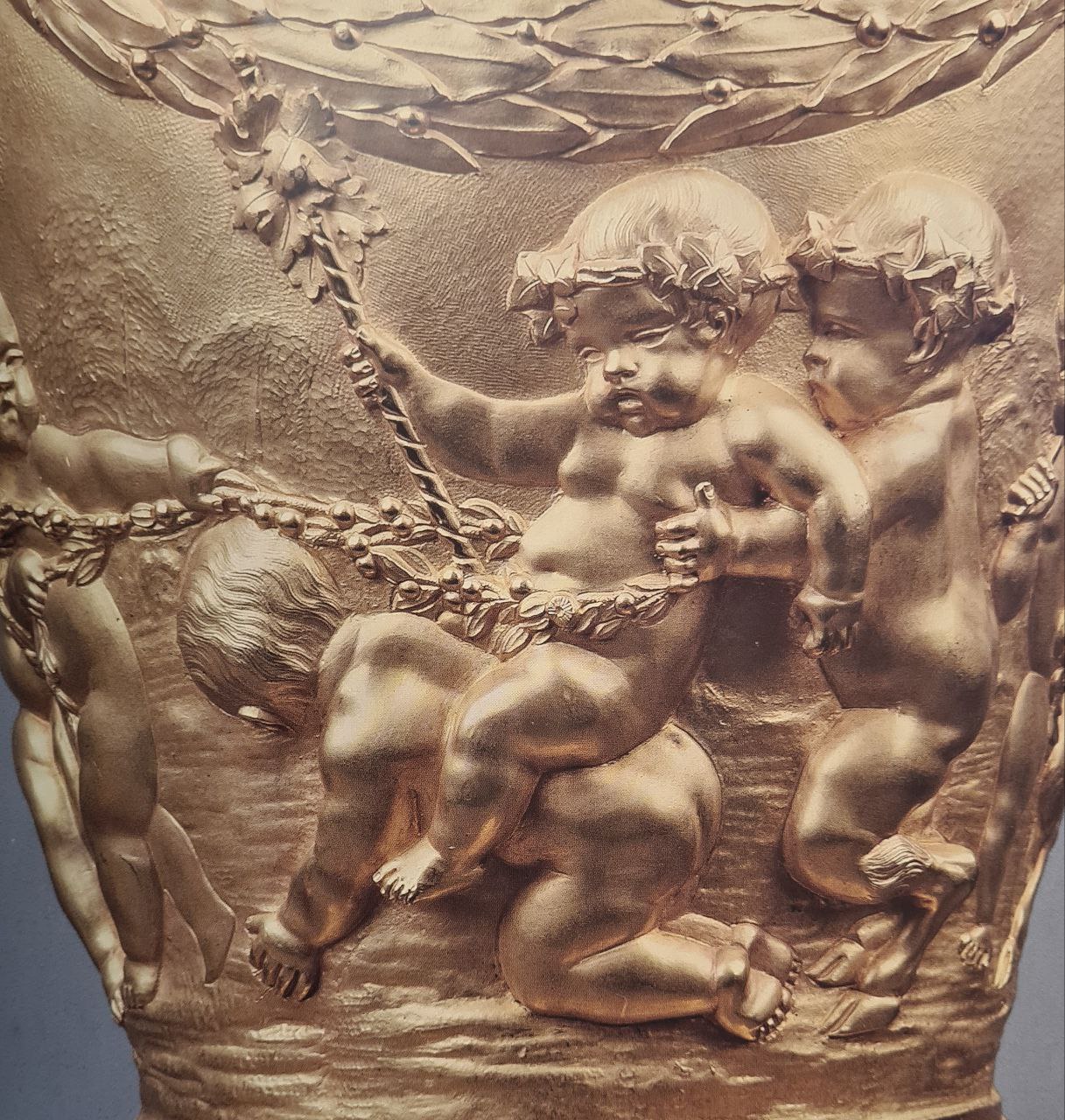
Interior bronze of that time matched fashion and was executed mainly in the neo-rococo style. Such objects were distinguished by complex ornamental-plastic form. Clocks, candelabra, table legs, and floor lamps were adorned with dynamic intricate décor of acanthus and grape leaves; the composition also included frolicking putti, satyrs, and bacchantes.
In 1847 Chopin expanded production, adding to the bronze establishment an iron foundry with locksmith workshops for casting various machines and shells, as well as making cast-iron and iron ornaments for entrances, balconies, grilles, fireplaces, fountains, spiral staircases, benches, tables, and stools. In the 1860s the iron foundry surpassed bronze production in number of workers.

A special place in Chopin’s career was occupied by busts of Russian rulers. In 1840 he discovered marble busts made by Italian sculptor A. Penna. They were distinguished by a certain conventionality of depiction, but despite this Chopin used the idea and nine years later presented 63 busts of Russian rulers made life-size.

Fifteen years later Chopin presented reduced versions of them at an international exhibition in Paris. In that difficult time for the factory and the whole economy, the shift from large busts to reduced copies proved a successful move, because they now belonged to cabinet sculpture and were in high demand. In the reduced version the series consisted of 64 busts. Thanks to a registered patent Chopin retained exclusive rights to produce this product for a stated period. Busts could be purchased by subscription through a newspaper advertisement.
In the 1860s Chopin continued to make products mainly after French models. Following Guérin’s traditions, Chopin cast diverse interior bronze distinguished by high quality of execution. At the 1861 exhibition Chopin was awarded the Order of St. Stanislaus 3rd class. At that time the factory, besides bronze castings, also made monuments and church utensils and produced articles of silver, zinc, and its alloys.
Although the factory was fairly large, well equipped, and produced goods in demand, Chopin periodically experienced financial difficulties, which worsened after the Crimean War. However, a large state order obtained by Chopin in time saved the manufacturer from ruin.
In 1870, to reduce production costs and lower selling prices, the shop and factory were moved to Obukhovsky Prospect and combined in one place. At that time Chopin emphasized making chamber cabinet sculpture after French and domestic models.

In the 1870s–1880s the factory’s success is associated primarily with the name of Yevgeny Lansere. In the then beginning author Félix Chopin managed to discern a bright individuality and broad creative possibilities. Chopin acquired ownership rights to produce 17 of the sculptor’s models.
Besides Lansere’s works, Chopin also cast some sculptures by A. L. Ober, and for the 1882 Moscow art and industry exhibition the enterprise made exhibits after models by leading Russian sculptors, architects, and draftsmen — M. O. Mikeshin, M. M. Antokolsky, N. A. Laveretsky, I. A. Monighetti, G. Bosse, A. A. Gun, A. N. Chichagov, F. F. Kamensky, and others.
The 1882 art industry exhibition summed up Chopin’s entrepreneurial activity, bringing him well-deserved fame and honor. That year, as a member of the Council of Trade and Manufactures, he received the Order of St. Vladimir 3rd class and was “granted the right to depict the coat of arms for introducing into Russia, along with the bronze trade, many new models of high merit, for the firm’s long existence, and for constant striving for improvement.”
In 1886 Chopin’s enterprise again found itself in a difficult position. Having once arrived in Petersburg as manager of Guérin’s factory, Félix Yulianovich in turn invited master Karl Berto from France to breathe new life into the dying production. And in 1888, at the age of 80, Félix Chopin left Russia forever.
Chopin can rightly be called the “Russian Barbedienne.” The virtuoso casting and purely French craftsmanship demonstrated in exhibition pieces clearly explained why contemporaries considered Chopin the best Russian bronze-worker of his time. In the 1870s–1880s “Chopin bronze” served as a kind of standard for all articles of this metal.