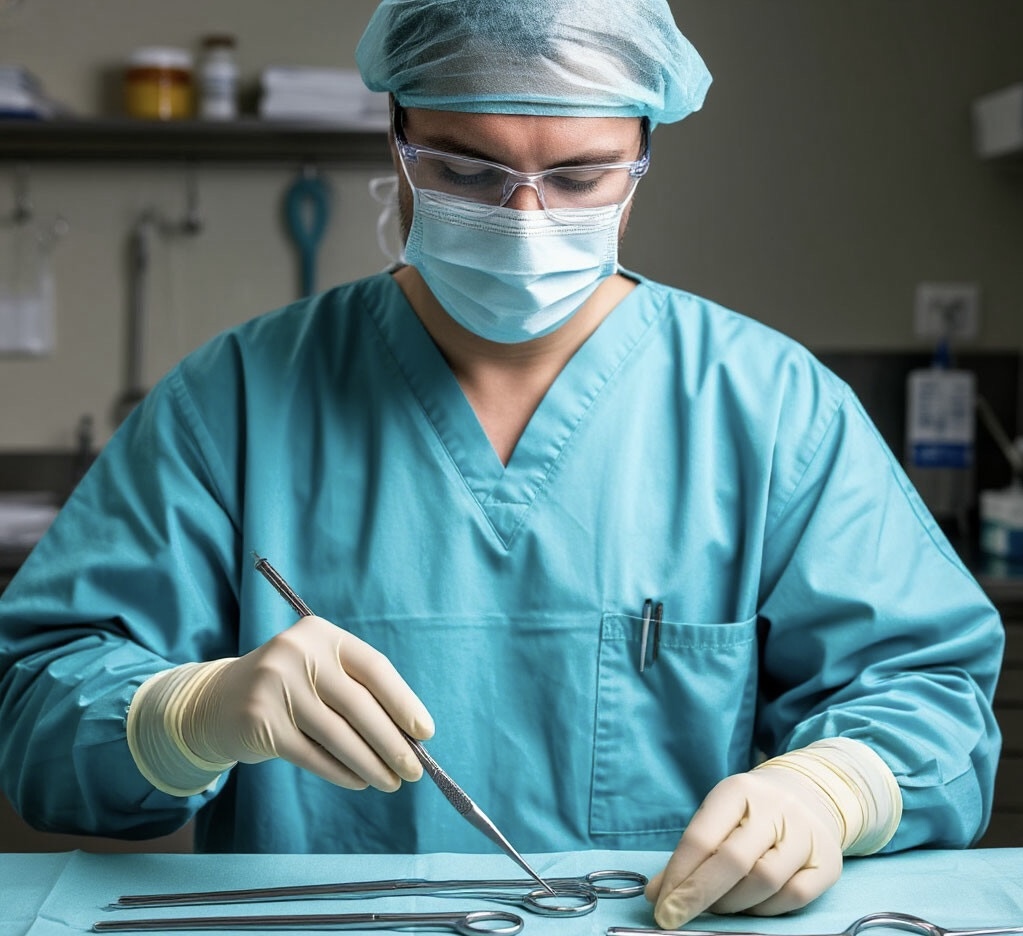
We are used to seeing steel as a symbol of strength, engineering reliability, and industrial power. Yet this material plays no less important a role in medicine. Every third person on the planet encounters surgical-steel products at least once in life — from a simple dental forceps to complex implants, screws, orthopedic plates, or surgical scalpels.
At first glance a paradox appears. The human body is an aggressive electrochemical environment, about 60% water containing salts, chlorides, dissolved oxygen, and enzymes. In such an environment most metals corrode quickly.
Nevertheless medical instruments and implants made of stainless steel can serve for decades without degrading or causing tissue rejection. How is that possible? The answer lies at the junction of metallurgy, electrochemistry, and biomaterials science.
In everyday speech almost any steel without visible rust is called “stainless.” In engineering and medical practice the term has a much stricter meaning.
Ordinary food-grade or construction stainless steels are indeed resistant to moisture and atmospheric corrosion. But conditions inside the human body are far harsher than those of a kitchen or industrial shop.
The internal body environment contains:
Such an environment acts as an electrolyte capable of starting corrosion processes. That is why ordinary stainless steel can begin to degrade after only a few months inside the body.
For a material to be used safely in medicine it must meet strict requirements. The key properties of biomedical steels can be reduced to three fundamental criteria:
It is the combination of these characteristics that distinguishes medical stainless steel from ordinary household alloys.
To understand the nature of corrosion resistance one must turn to basic metal chemistry.
Ordinary carbon steel contains mainly iron. Iron readily reacts with oxygen to form iron oxides — rust. This layer is porous and loose, so it does not protect the metal: oxygen and water keep penetrating and destroying new layers of material.
The situation changes radically when chromium (Cr) is added to the alloy. For steel to be considered stainless, chromium content must be at least 13%. In medical alloys its concentration usually reaches 17–20%.
When chromium interacts with oxygen, an ultra-thin chromium oxide (Cr₂O₃) film only a few nanometers thick forms on the metal surface. Despite its minimal thickness, this film has unique properties:
It is this film that forms so-called passive protection, thanks to which the steel does not corrode.
However, under body conditions chromium protection alone is not enough. Chlorine contained in blood destroys the oxide film and causes local corrosion. That is why medical steels are additionally alloyed with other elements.
Nickel (Ni)
Molybdenum (Mo)
Carbon (C)
The combination of these elements forms an alloy with a unique balance of strength, corrosion resistance, and biocompatibility.
The best-known and most widely used material for medical instruments is AISI 316L. This steel belongs to the austenitic stainless class and consists of:
The letter L (Low Carbon) in the designation means reduced carbon content. This prevents chromium carbide formation and protects the material from intergranular corrosion that can appear during welding or heat treatment. Thanks to these properties, 316L steel is used to make:
In Russia, proprietary corrosion-resistant steel grades developed to similar requirements are widely used. One of the most common is 12X18N10T, which contains:
Medical stainless steel can work for decades in the body’s aggressive environment, keep mechanical strength, and cause neither toxic nor allergic reactions. That is why it remains one of the main structural materials of modern surgery despite the development of titanium, cobalt alloys, and bioceramics.
There is an interesting paradox: the longer high-quality surgical steel stays in the body, the more corrosion-resistant it becomes. This effect is linked to surface passivation.
In air the oxide film forms in fractions of a second. Inside the body that film continues to build. Oxygen ions, hydroxyl groups, and biomolecules interact with chromium and molybdenum, gradually:
As a result a stable nanostructured oxide shell forms that effectively protects the metal from further reactions. This process is one reason medical implants last so long.
Creating medical stainless steel requires far stricter control than producing ordinary structural materials.
At every stage of the metallurgical process, alloy purity and structure parameters are controlled.
Key production aspects include:
At the St. Petersburg Precision Alloys Plant, cold-rolled strip is produced from corrosion-resistant steels of grades 20X13, 12X18N9, 12X18N10T, and 10X17N13M3T. Such materials are used in instrumentation, medicine, the chemical industry, and other high-tech sectors.