However, development of the foundry industry for heavy industry needs did not prevent capital entrepreneurs from using new technical possibilities also in decorative and applied arts. Among the most successful foundrymen of that time who gained international fame stands out a merchant and manufacturer with the musical surname Chopin.
Felix Chopin was born in a small French town in 1813. His father, Julien Chopin, a sculptor and foundryman from Paris, collaborated with Alexandre Guérin’s workshop in St. Petersburg. He not only equipped Guérin’s plant with necessary equipment and invited skilled chasing craftsmen and foundrymen but also supplied the best models for casting. Already in 1840 Guérin’s plant on Vasilyevsky Island was considered one of the largest in the capital.
However, affairs at the enterprise did not always go well, and in 1838 Felix Chopin set out to manage the plant in St. Petersburg, becoming its full owner by 1841. He expands production capacity and carries out a full reorganization, thanks to which the factory begins to prosper. The plant’s heir proved very talented. Not for nothing did they begin to call him the “Russian Barbedienne,” comparing him with one of France’s most famous sculptors.
The first period of production development fell on the 1840s–1860s. This was a favorable time for Russian bronze workers; factories received large government orders. From 1845 Felix Chopin was awarded the status of Supplier to the Court of His Imperial Majesty and in the mid-19th century performed large-scale works for the Winter, Marble, and Grand Kremlin Palaces, St. Isaac’s Cathedral, and the Cathedral of Christ the Saviour.
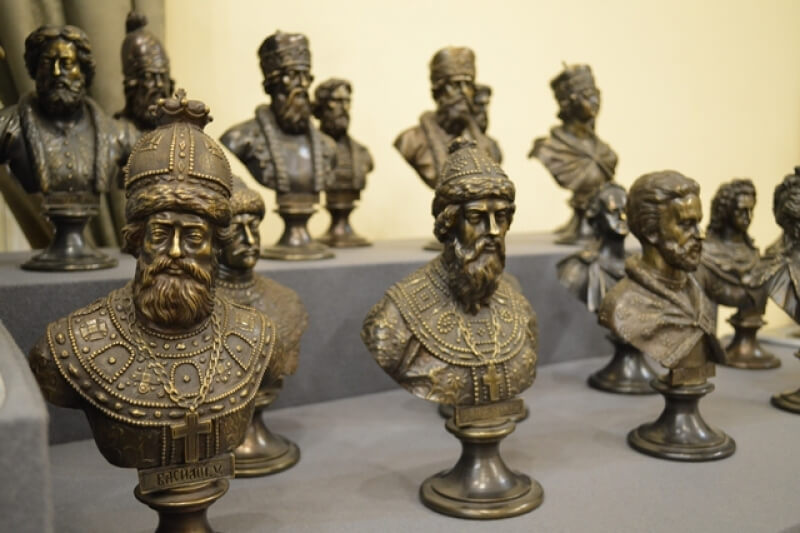
In 1849 at the All-Russian Manufactures Exhibition in St. Petersburg Chopin’s plant presented a collection consisting of sixty-three bronze busts of Russian tsars, princes, and emperors. Subsequently Chopin was one of the first in Russia to formalize patent rights for reproducing his models and began to replicate these busts already as desk cabinet sculpture, which was then gaining popularity. Casting works in a smaller size was allowed by a special device whose use patent Chopin acquired in France.
In 1862 at the World Exhibition in London Chopin’s workshop presented a statue of Catherine II cast from a drawing by sculptor Mikhail Mikeshin. The work received a medal for high technique of execution. An enlarged copy of exactly this sculpture now stands before the Alexandrinsky Theatre in St. Petersburg.
Chopin’s workshop constantly participated in international exhibitions, demonstrating the best results. Thanks to this many masters gained great fame not only in Russia but also abroad. Works cast at Chopin’s plant were in huge demand, and the reason was not so much the factory’s popularity as the highest quality of every product released.

The plant engaged in both bronze casting and zinc as well as silver works. Chopin tried to adapt to the constantly changing tastes of the Russian nobility and merchant class, therefore he decided to introduce patinated bronze into production. It matched new color design solutions. Such metal had many different shades and could imitate other alloys. Chopin and his colleagues managed to achieve great results in this field.
The flowering of bronze casting production coincided with the fashion of that time for the “neo-rococo” style, reflected mainly in design of residential interiors, furniture, household items, and jewelry art. The style implied complex ornaments to execute, an abundance of decorative elements, and an appeal to “historicism.” Chopin’s factory followed fashion trends and decorated its interior bronze with complex figures of cupids, ornamental décor (for example cast grape vines), and animalistic motifs.
The enterprise’s success in the 1870s–1880s was inseparably linked with the name of major animalist sculptor Yevgeny Lanceray. Chopin saw in the beginning author a bright individuality and great creative potential. Lanceray studied with French masters, transferring current trends in European sculpture to plots of Russian reality. Success was stunning. In the late 1870s Chopin even bought from Yevgeny the ownership rights to his sculptures. According to official data he then bought 17 models. Lanceray’s life was short, but his legacy is enormous, and his works are currently kept in the largest museums.
Felix Chopin is the first master who combined casting of high-quality models and French skill in conveying texture. His unsurpassed talent is the main reason why Felix became one of the best and most successful Russian bronze workers of that period. His works were widely known throughout the world and served as a standard even for foreign bronze casting plants.
In the 1880s crisis times came for the bronze casting industry. Trying to prevent the factory’s closure, Chopin took on a representative of the new generation of foundrymen — a master named Karl Berto, who had already collaborated for more than ten years with the legendary sculptor F. Barbedienne. In the late 1880s Chopin decided to step back from affairs, transferred plant management to Berto, and returned to his native France, where he ended his days in 1892 in Paris.