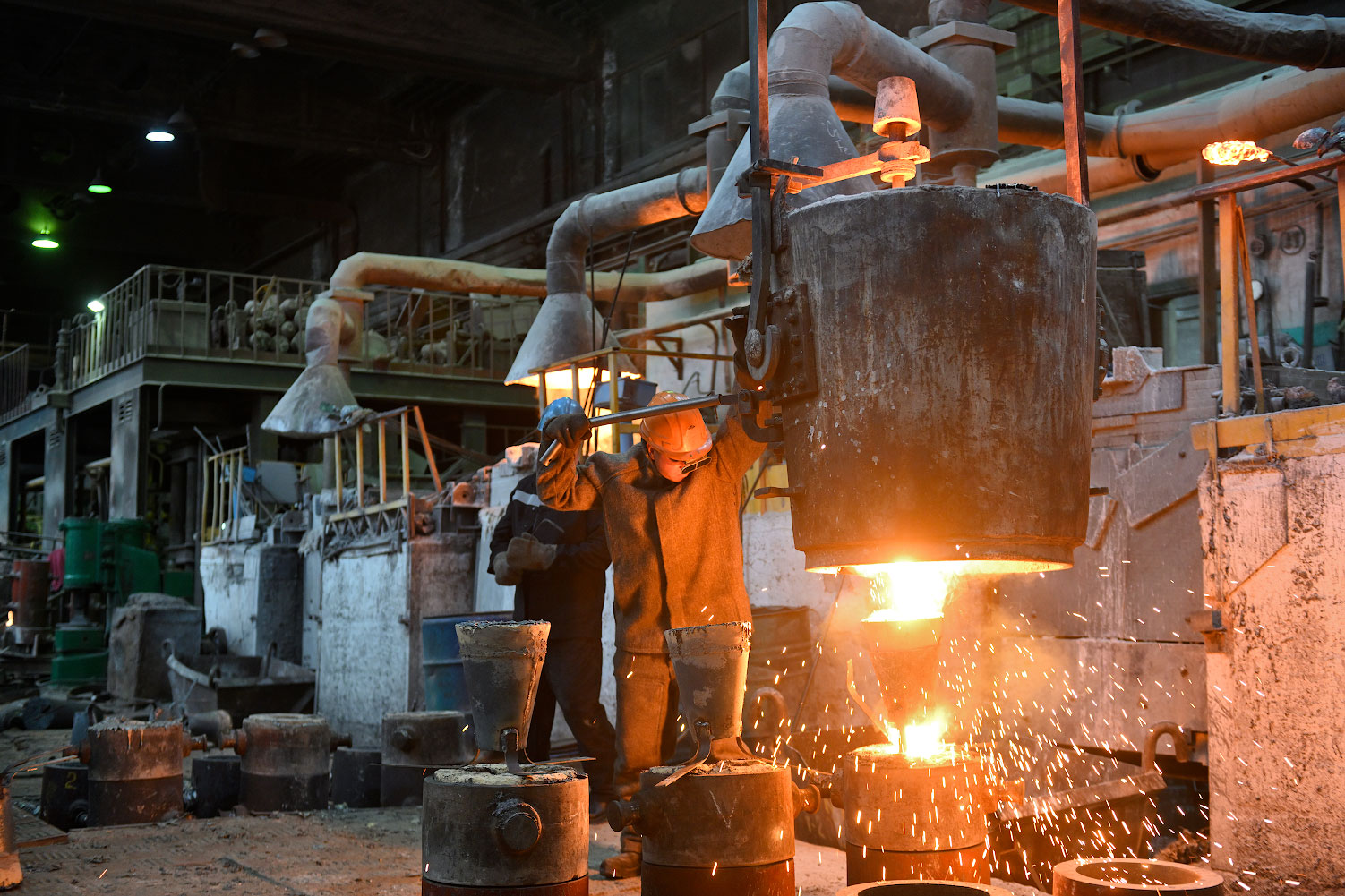
Metallurgy has defects you can see at once: cavities, pores, surface cracks. But there are also ones hidden deep inside the metal, like delayed-action mines. Flakes (hairline cracks) belong to them — one of the most dangerous internal defects in the structure of alloy steels and precision alloys.
Flakes are internal fracture ruptures (cracks) with a characteristic crystallographic pattern — star-shaped or “snowflake-like.” Their nature is linked to supersaturation of the solid solution with hydrogen. At the St. Petersburg Precision Alloys Plant a full set of process measures is strictly observed to exclude flake formation in the product.
To understand the danger of flakes, picture what happens to metal during cooling. While steel is liquid it can dissolve large amounts of gases, including hydrogen. On transition to the solid state the situation changes.
A sharp drop in solubility during cooling supersaturates the metal with gas. Subsequent processes resemble a chain reaction.
As hydrogen diffuses into crystal-lattice defects, dissolved atomic hydrogen converts to molecular form. Hydrogen molecules cannot diffuse further through the lattice, which causes an avalanche-like pressure rise.
When the pressure exceeds the metal’s strength in a zone of structural inhomogeneity, an internal crack — a flake — nucleates.
In industrial metallurgy flakes never appear by chance. There is always a set of conditions that raise the probability of the defect.
In practice those conditions include the following process risks that must be considered at every production stage:
Each of these factors increases the chance of hydrogen saturation of the metal — and therefore the risk of hidden cracks.
Certain alloyed materials are especially sensitive to flakes — alloys based on nickel, chromium, molybdenum, and vanadium. These elements lower the hydrogen diffusion coefficient and block its escape from the structure. As a result the gas is retained inside the metal and creates conditions for the defect.
Hydrogen control is especially important in the production of aircraft parts, turbines, medical equipment, and high-precision electronics. Even a minimal defect in such products can cause system failure.
At PZPS the flake defect is classified as unacceptable. Prevention is achieved not by inspection after production, but by forming a structure with an extremely low hydrogen concentration.
This is a fundamentally important approach: eliminate the cause rather than fight the consequences.
The plant’s main unit is a vacuum induction furnace — a high-tech installation that controls metal composition down to micro-impurities. Melting is carried out at low residual pressure. Vacuum ensures hydrogen removal from the liquid bath.
Hydrogen is removed at key stages of the metallurgical cycle:
Modern vacuum furnaces can maintain pressure tens of times below atmospheric. Under those conditions hydrogen actively leaves the melt, making the technology one of the most effective in high-quality alloy metallurgy.
Even a small amount of moisture or contamination in the starting materials can saturate the finished alloy with hydrogen. That is why raw-material preparation at PZPS is performed with special care.
Large scrap and alloying additions are dried. Materials showing traces of the following are excluded:
This policy minimizes the risk of hydrogen entering the melt even before melting starts.
After all cleaning stages the metal undergoes additional protective treatment — a kind of insurance against residual hydrogen.
The final melting stage in open induction furnaces includes introducing calcium-bearing modifiers that perform several functions at once:
Thus an extra barrier is created that not only binds hydrogen and prevents flakes, but also improves the structure and raises the reliability of the alloy or steel.
Flakes are a critical structural defect that rules out using the metal in critical industries such as:
Even a single defect can cause a part to fail in service. The only method that guarantees the absence of flakes is strict control of hydrogen concentration at the metallurgical stage. PZPS confirms that, under the current technical regulations, formation of this defect in the plant’s product is fully excluded.
The enterprise produces a wide range of materials used in precise and critical designs. These alloys are applied in electronics, instrumentation, energy, mechanical engineering, and other industrial sectors.
At PZPS you can purchase:
If you need high-quality alloys and steels for critical tasks, PZPS specialists are ready to select an optimal solution for your requirements. You can get technical advice, clarify material characteristics, choose an alloy for specific service conditions, place an order, or request a commercial proposal.
Contact PZPS specialists today — and obtain materials that meet the highest standards of modern industry.