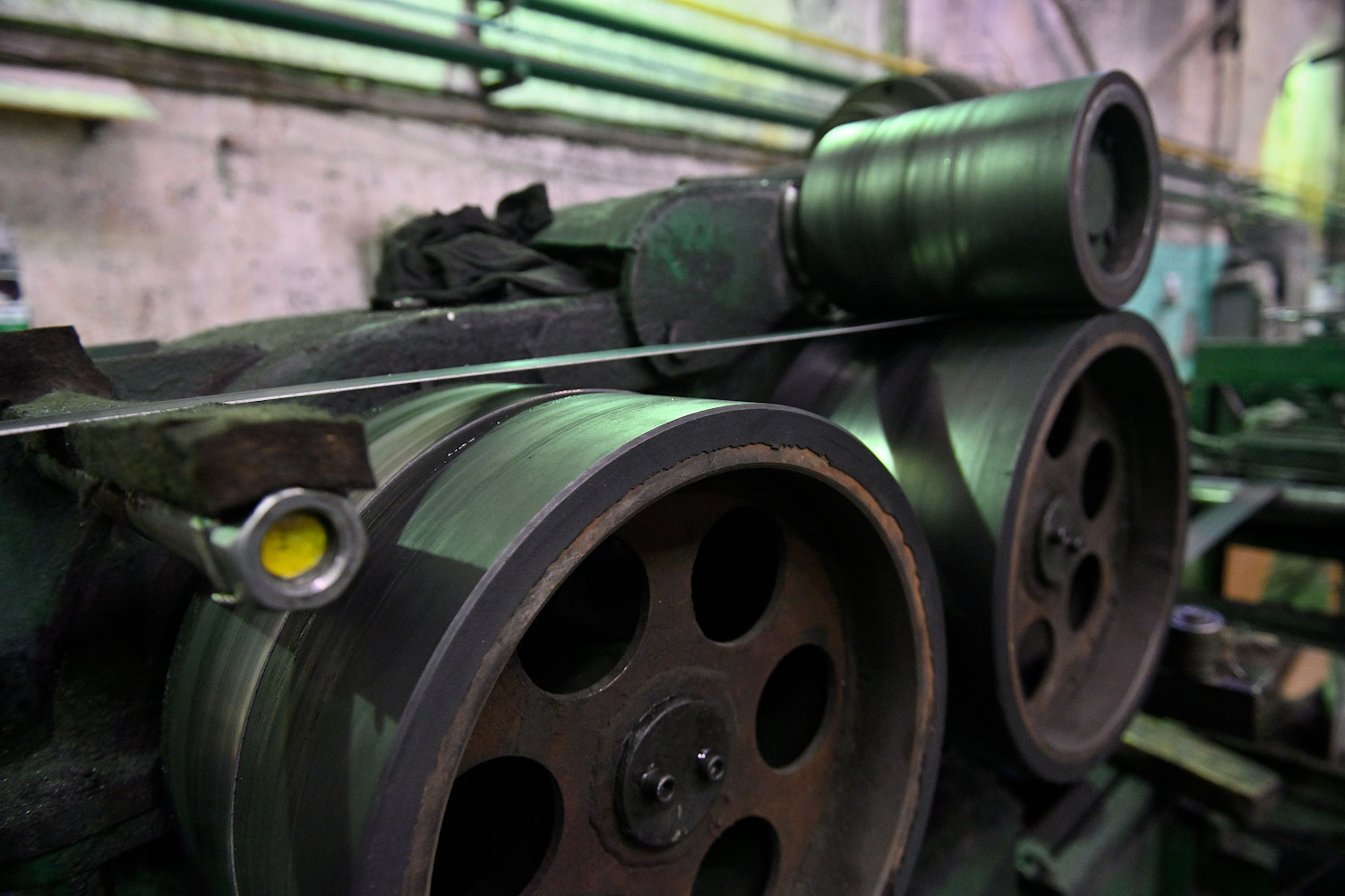
Cambers (edge wave) in metal strip is a deviation from a straight line in which the strip bends in an arc or sickle shape. This defect significantly affects the performance characteristics of the final product, creating problems during use and reducing product quality. Camber can occur at all stages of working with strip — from production to transport and storage. Understanding the nature of this phenomenon helps minimize risks and improve the quality of finished metal products.
Impact of camber on product quality
Camber deformation negatively affects product performance in various industries:
- Packaging industry. Camber leads to packaging geometry violations, reducing dimensional accuracy, strength, and reliability of finished products. Deformed strip can cause errors in packaging machines, worsening package sealing and increasing the risk of product damage.
- Construction. Curved strip makes installation difficult and reduces the strength and reliability of load-bearing elements, leading to weakening of structures and their failure or deformation under load. Where high dimensional accuracy is required — for example, in bridge and high-rise construction — camber poses a particular hazard.
- Mechanical engineering. Cambered strip causes mechanism malfunctions, increasing downtime risk and financial losses due to repair needs. For example, in automotive parts production, incorrect strip geometry can disrupt cutting or stamping processes, leading to scrap.
- Fabricated metal structures production. Sickle-shaped bending can cause poor-quality welds, which in turn reduces the strength and reliability of the entire metal structure.
Causes of camber
To better understand the problem, let us consider the main factors causing camber.
Technological factors
- Equipment setup errors:
- misalignment of rolling mill rolls leads to uneven force distribution on the strip, causing it to lose shape;
- incorrect selection of rolling parameters (for example, excessive speed or pressure) creates internal stresses.
- Uneven cooling:
- metal cooling at different rates in different areas undergoes structural changes that can cause bending.
Logistics factors
- Improper transport:
- mechanical damage, impacts, or pressure during transport deforms the strip.
For example, stacking strip coils on top of each other without protective spacers can cause lower layers to bend.
- Storage errors:
- failure to comply with storage conditions, excessive humidity, or improper coil placement can lead to deformation.
For example, excessive pressure from improper coil stacking causes gradual metal bending.
Equipment wear
- Worn or outdated production line elements, such as rolling mill rolls, create uneven loads on the metal, provoking deformation.
Human factor
- Insufficient staff qualification, violation or absence of process regulations aggravate the problem.
For example, errors when installing and adjusting rolling equipment or improper strip handling during transport can lead to camber formation.
During production, internal stresses can arise in cold-rolled strip, leading to camber deformation. This is often caused by uneven cooling after rolling or welding, or structural changes due to plastic deformation and recrystallization. To effectively eliminate the problem, attention must be paid to every stage — from production to transport and storage.
Camber control methods
Various control methods are used to prevent and minimize camber deformation:
- Visual inspection. The method is used for preliminary defect assessment. For example, an operator can roll the strip on a flat surface and visually determine the presence of bending. However, visual inspection does not always accurately determine the degree of camber, especially with minor deviations.
- Use of special tools. For more accurate camber control, micrometers, calipers, and other measuring instruments can be used. These tools measure the distance between two points on the strip and determine the presence and degree of camber.
- Machine vision technologies. Modern automated monitoring systems automatically detect defects in real time, improving control accuracy. For example, high-resolution cameras and specialized software detect even minimal deviations from the norm.
Camber is a serious problem that can lead to significant losses. Therefore, it is important to control the strip production and storage process to prevent camber deformation.
Methods for eliminating and preventing camber
St. Petersburg Precision Alloys Plant uses a comprehensive approach to eliminating camber. Key measures include:
- Production process optimization:
- rolling equipment setup adjustment: regular maintenance and precise machine adjustment, including timely roll alignment and rolling speed correction, eliminate causes of bending;
- temperature regime control: modern cooling systems ensure uniform temperature distribution across the entire strip surface.
- Strip straightening and leveling:
- specialized equipment such as rolling and bending machines, presses, and other tools are used to correct existing defects.
- Logistics improvement:
- use of specialized packaging: for example, metal strip coils are packed in sturdy frames protecting them from external effects;
- proper storage conditions: coils are stored on flat surfaces, with protective spacers used when stacking.
- Staff qualification improvement:
The camber problem has been known since the first rolling mills appeared in the 19th century. At that time, camber correction was done manually. Today, machine vision systems can detect defects with accuracy to fractions of a millimeter, significantly improving product quality. Eliminating bends at early production stages reduces scrap and improves finished product quality.
Cold-rolled strip from PZPS
Camber in metal strip is a serious production defect that can negatively affect product quality, reliability, and performance characteristics. To eliminate it, we use a comprehensive approach including production process improvement, analysis of transport and storage conditions, and implementation of modern control and straightening technologies.
At PZPS you can buy cold-rolled strip per GOST 21996-76 in grades 60С2А, 65G, 70С2ХA, as well as precision alloys meeting the highest quality standards. Thanks to modern equipment and technologies, we guarantee minimal camber values and flawless performance characteristics of our products. Contact us, to learn more about our products!