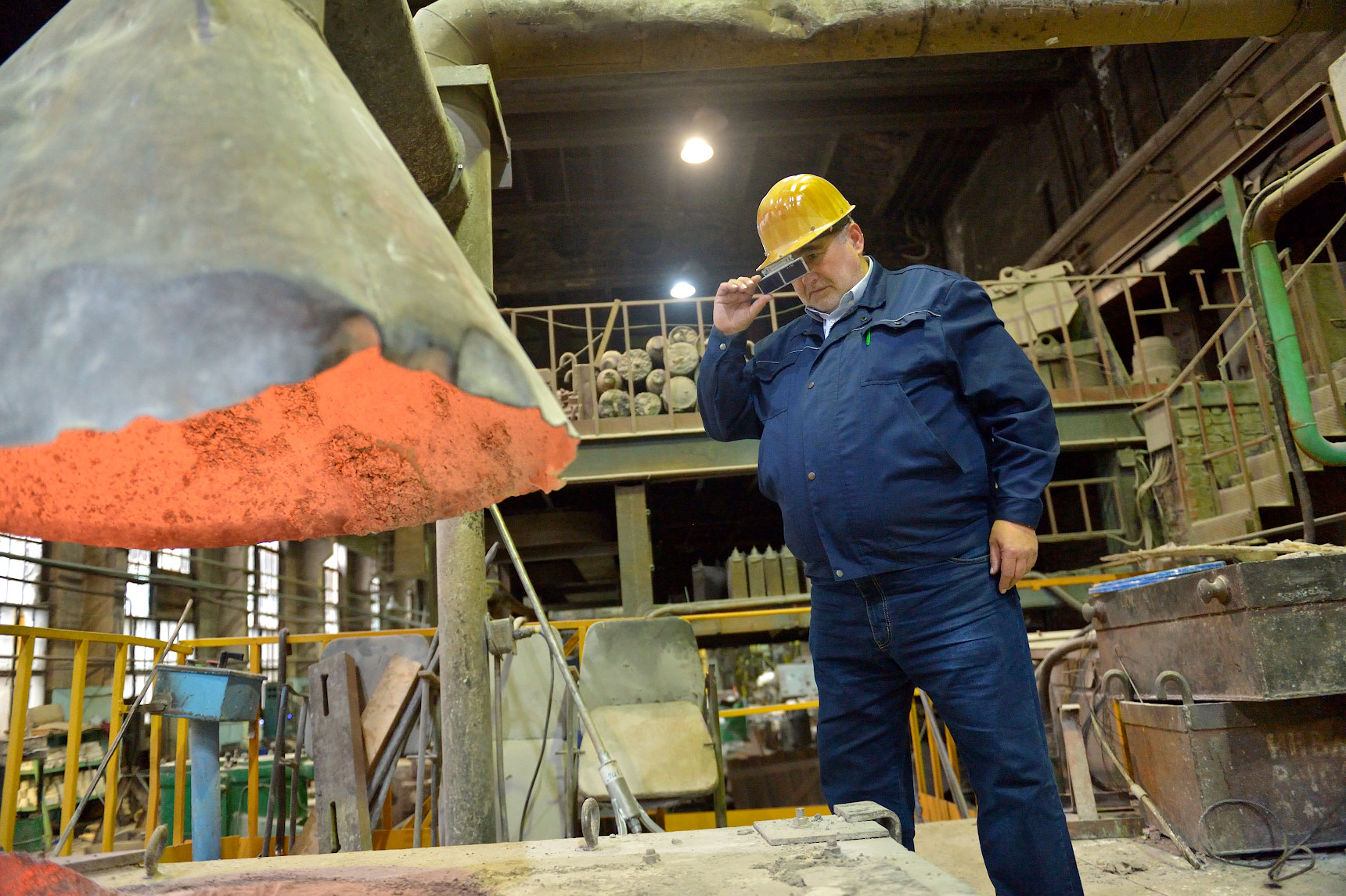
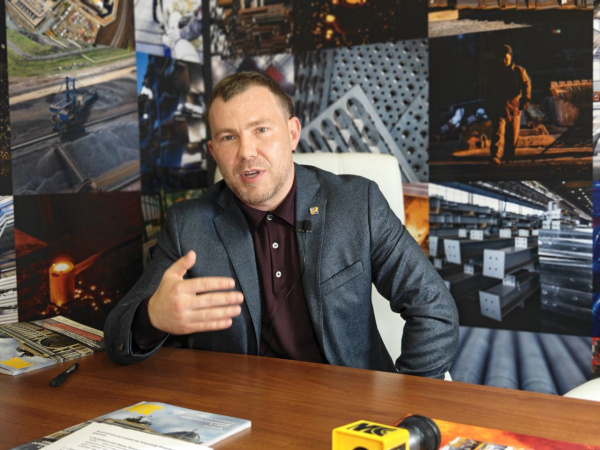
Aleksandr Nikolayevich - Production Director of PZPS LLC, is a true veteran of Leningrad’s metallurgical industry. He has been working at the St. Petersburg Precision Alloys Plant for 40 years and remembers how the declining Steel Rolling Plant in the 1990s was given a new lease on life and transformed into a modern, successful enterprise:
“Due to the sharp decline in production in the 1990s and early 2000s, the former Steel Rolling Plant had large unused or inefficiently utilized production areas. To reduce maintenance costs for these large spaces, it was decided to consolidate all existing production facilities, relocating equipment to the areas the plant occupies today. This significantly reduced electricity and heating expenses, allowing those funds to be redirected toward production development and workers' wages.”
Aleksandr Nikolayevich notes that the plant did not have to start from scratch. During the Soviet era, the Steel Rolling Plant was also a leader in precision alloy production and had an extensive research center. Its technologies were used to develop and refine various materials, and the plant traditionally had highly skilled specialists.
During modernization, the plant primarily used existing equipment and did not reduce production volumes:
“We did not halt operations; the entire optimization process continued without reducing production volumes. Equipment was dismantled in parts, while other machinery remained operational to avoid disrupting the technological cycle. Overall, the optimization process took about three years.”
New equipment was also purchased, mainly to automate production and reduce the costs of maintaining a large standby staff, freeing up employees for other tasks.

The plant had to relearn the production technologies for some alloys. Aleksandr Nikolayevich explains that during Soviet times, many products were manufactured through cooperation between industry enterprises: one plant produced part of the materials, and another completed the process. In modern times, these technological chains were disrupted:
“If in Soviet times many enterprises were allies, in the new era they became competitors. From then on, we had to rely solely on our own strengths. Some alloys our plant had to master from scratch, even under existing production conditions. For example, we worked on mastering almost the entire production cycle for resistance alloys such as Kh15Yu5. We also fully mastered the technological cycle for producing 40KhNM from the group of elastic alloys, which are now entirely manufactured at our plant.”
The uniqueness of PZPS LLC is not only in the grades of materials produced: “There is also a dimensional group of alloy production,” explains Aleksandr Nikolayevich. “The uniqueness of our enterprise lies in the fact that there are practically no manufacturers in our dimensional group. Today, we produce any type of product—both alloys and structural materials—with thicknesses ranging from 7 microns to 3 millimeters and tape widths from 4 to 300 millimeters. Few operate in this niche.”

According to Aleksandr Nikolayevich, large metallurgical giants produce millions of tons of products in large sheets. However, the St. Petersburg Precision Alloys Plant can fulfill orders ranging from several tons and kilograms to just a few grams:
“In the technological production chain, we are the last in metallurgy—after us come mechanical engineers, instrument makers, and electronics. Essentially, we create a kind of semi-finished product for other industries. While large metallurgical plants produce for the next metallurgical cycle, we are followed by technologies and high technologies. Our products are used in devices and various mechanisms.”
In addition to geometry and dimensions, the plant’s products are divided into several types based on alloy groups. Each material must have specific physical, chemical, or, for example, magnetic properties.
“We have a technical department that directly develops documentation, process charts, and diagrams, monitors technological parameters for each unit, and assists with calculations. The X-ray spectral laboratory determines the required content of each element in the alloy. The physical laboratory defines and studies the physical properties of the material obtained in the final product. The mechanical laboratory determines how malleable the metal is, how it responds to bending and torsional moments. In the linear-angular measurement laboratory, we measure geometry and surface roughness to ensure the tape is flat, not wavy or curved. Based on the protocols and conclusions of the testing laboratories, we certify the products—without this, we cannot release even a single kilogram.”
Precision alloys are mainly used in industrial devices. However, we often encounter them in everyday life.
“If you fly on airplanes,” Aleksandr Nikolayevich gives an example, “many elements in those planes are produced at our plant. Many materials are used in the automotive industry. Heating elements in the form of coils (made from resistance alloys) are found in old household ovens. Even a simple clothing button or paperclip is made of metal and may be made from our material. Clothespins—inside there is a tape spring—that is also our production.”
One might want to hear about “secret materials,” but according to Aleksandr Nikolayevich, almost all alloys are known today. Of course, developments are ongoing because life demands new types of materials, but there hasn’t been a significant breakthrough in this area yet. Metallurgical technologies are conservative, and the main methods have been known for centuries. The advent of electricity has only increased productivity. Automation is another matter:
“Computer technologies are entering our lives and replacing people,” says the production director. “Control and regulatory functions are performed by entire processors, which do it more accurately and faster than humans. So, our plant also widely uses automatic control systems. We continuously train our staff—both with our own resources and by bringing in outside specialists. We maintain contacts and exchange experiences with leading research institutes in metallurgy, including determining directions for further work on mastering new types of products.”
Aleksandr Nikolayevich assures that production expansion is inevitable. Modern conditions bring new requirements related to import substitution, and the St. Petersburg Precision Alloys Plant is already involved in these processes. In the near future, the enterprise plans to produce the thinnest tapes with a thickness of 3-5 microns.

For the Production Director of the St. Petersburg Precision Alloys Plant, metal is a separate kind of music:
“I know the properties of materials, and of course, I evaluate metal objects not only by their physical parameters but also by their internal state. I can imagine the components of the material and what is inside. Therefore, I understand how much labor, resources, creativity, and energy are invested in each product. I see how it carries the energy of all the people who contributed to its creation.”