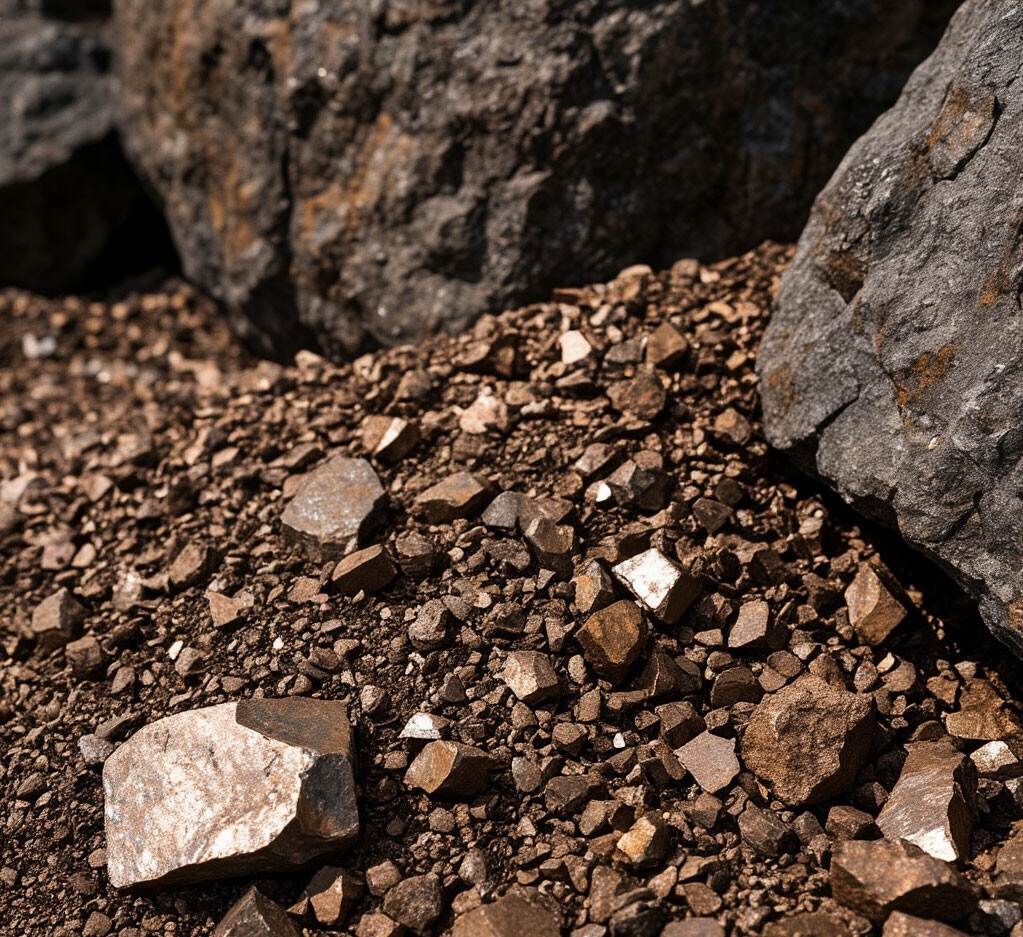
Metals play a fundamental role in the development of human civilization. From the first copper ornaments to complex precision alloys — their history reflects humanity’s path from the Stone Age to the world of high technology. The PZPS plant works with metals whose discovery became a milestone in science and technology: iron, nickel, and cobalt. We recount how they were discovered, what they enabled humanity to achieve — and how they are used today.
The use of metals in different historical eras contributed to technological progress, the growth of industry, and the expansion of human capabilities. The history of mastering metals can be conditionally divided into the following key periods:
Metals became the basis of the transition from manual labor to modern technologies and had an enormous influence on the development of human civilization, promoting progress in science, the economy, and culture.
The use of iron began even before the Iron Age. The earliest artifacts, dated to the 4th millennium BCE, were made from meteoritic iron, noted for high strength and purity. However, the metal became widespread only with the start of the Iron Age (about 1200 BCE), when it began to be actively used for tools, weapons, and housewares.
Ancient Egypt
In Ancient Egypt iron was used from early times, but mainly as meteoritic iron. Egyptians called it “white copper” and made valuable objects and ornaments from it. As ironworking technologies developed, it began to be used for weapons and tools.
Mesopotamia
In Mesopotamia iron was also known in an early period. Assyrians and Babylonians used it for weapons and armor, which gave them an advantage in military conflicts.
China
In China iron became known at roughly the same time as in other regions. Chinese craftsmen developed their own ironworking methods, including the use of cast iron. From iron they made agricultural tools, weapons, and various household items.
Iron (Fe) became a key element of technological progress. Iron tools raised labor productivity and fostered growth in agriculture and urbanization. Iron weapons and armor gave an advantage in military conflicts, leading to territorial expansion and the formation of new states. And the use of iron in construction contributed to infrastructure development.
Nickel is a chemical element denoted Ni in the periodic table. The history of its discovery and use goes back to deep antiquity. The first mentions of nickel can be found in ancient texts describing ores containing this metal. However, nickel in pure form was isolated much later.
Until the 18th century, minerals containing nickel were confused with copper ores. Miners called nickel “kupfernickel” — “copper deceiver” or “devil” — because its ores, outwardly similar to copper ores, did not yield copper when smelted. This led to disappointment among miners and metallurgists.
Only in 1751 did the Swedish chemist Axel Cronstedt isolate a new element from nickel ore and name it after the mythical mountain spirit Nickel, who, according to legend, confused miners, making them find barren rock instead of valuable metals.
Nickel is a strong, silver-white metal resistant to corrosion thanks to an oxide film that forms on its surface and protects the metal from the environment. It forms alloys with iron, chromium, copper, and other metals. These alloys have improved mechanical and chemical properties, making them indispensable in:
In addition, nickel plays an important role in jewelry. Thanks to its ductility and ability to take various shapes, it is used to create ornaments and decorative articles.
Producing nickel is a complex process that includes several stages. The main methods of obtaining nickel are:
Modern technologies make it possible to obtain nickel with a high degree of purification and various physicochemical properties, making it an indispensable material for a wide range of needs — from electronics to the defense industry.
Cobalt (Co) is one of the most sought-after and promising metals of the 21st century. The name “cobalt” comes from the German word “kobold” — “goblin” or “mine spirit.” In the Middle Ages miners believed that ore containing cobalt brought only trouble: valuable metals could not be smelted from it, and fumes on heating poisoned the air. Only in 1735 did the Swedish chemist Georg Brandt first isolate pure cobalt from Saxon ore and prove that it was an independent chemical element.
Long before its chemical discovery, cobalt was used to color glass a deep blue. Archaeological finds confirm that ancient Egyptians and Venetians knew of this property of cobalt-bearing minerals. However, the exact composition of the “secret” paint was not revealed until the 18th century. It is cobalt oxide — the active substance that gives the deep blue color — that underlies the famous “zaffer.”
Today cobalt is an indispensable component in a number of industries. Its unique physicochemical properties have made it sought after in many high-tech directions.
Metallurgy and alloying alloys
Cobalt is widely used in the production of:
Using cobalt in metallurgy makes it possible to produce materials that combine hardness, resistance to thermal loads, and corrosion resistance. These qualities are especially important for the aviation and defense industries.
Energy and batteries
The industrial boom of the 21st century is impossible without cobalt. It has become a central element in the production of lithium-ion batteries — a key technology for:
The reason is the ability of lithium–cobalt oxide (LiCoO₂) not only to provide high energy density but also to prevent battery overheating. Thanks to the discoveries of Japanese chemist Koichi Mizushima, the industry developed rapidly. Demand for cobalt has increased nearly tenfold since the early 2000s.
Cobalt makes batteries not only efficient but also safe. This is especially important for transport and next-generation energy storage systems.
Medicine and biotechnology
In medicine cobalt is used in the production of:
Although magnetic attachments have not yet become widespread due to incompatibility with MRI, their convenience has already been confirmed in clinical trials.
Today cobalt is actively used in the development of:
In solar cells, cobalt compounds are used as electron carriers. Experiments have shown that such systems are stable, efficient, and cheaper than analogues based on platinum or ruthenium. In addition, cobalt compounds have shown high activity as catalysts for producing hydrogen — an alternative fuel of the future.
Cobalt has already proved indispensable in various industries. But the future holds even larger tasks for it:
Cobalt’s potential is a bridge between our technological capabilities today and an energy-clean, mobile, and intelligent tomorrow.
Based on iron, nickel, and cobalt, PZPS creates alloys with unique properties. These materials are used in the most demanding fields: aviation, instrument making, medicine, and defense.
Precision soft magnetic alloys
They have low coercivity and high magnetic permeability and are used in transformers, sensors, and magnetic shields.
Alloys with specified elastic properties
Used in precision mechanisms, gyroscopes, watches, and sensors.
Alloys with high electrical resistivity
Suitable for resistors, heating elements, and current stabilizers.
Alloys with a specified coefficient of linear thermal expansion (CTE)
Used in electronics, micromechanics, and systems with high positioning accuracy.
Heat-resistant alloys
Retain mechanical properties at high temperatures.
The history of iron, nickel, and cobalt is the history of technical progress. Today they form the basis of precision materials without which modern production is unimaginable. The PZPS plant continues this tradition, turning millennia of knowledge into high-precision solutions for the future: more than 50 grades of precision alloys and special steels, innovative compositions and technologies, property research under various operating conditions — all of this shapes the face of modern metallurgy.