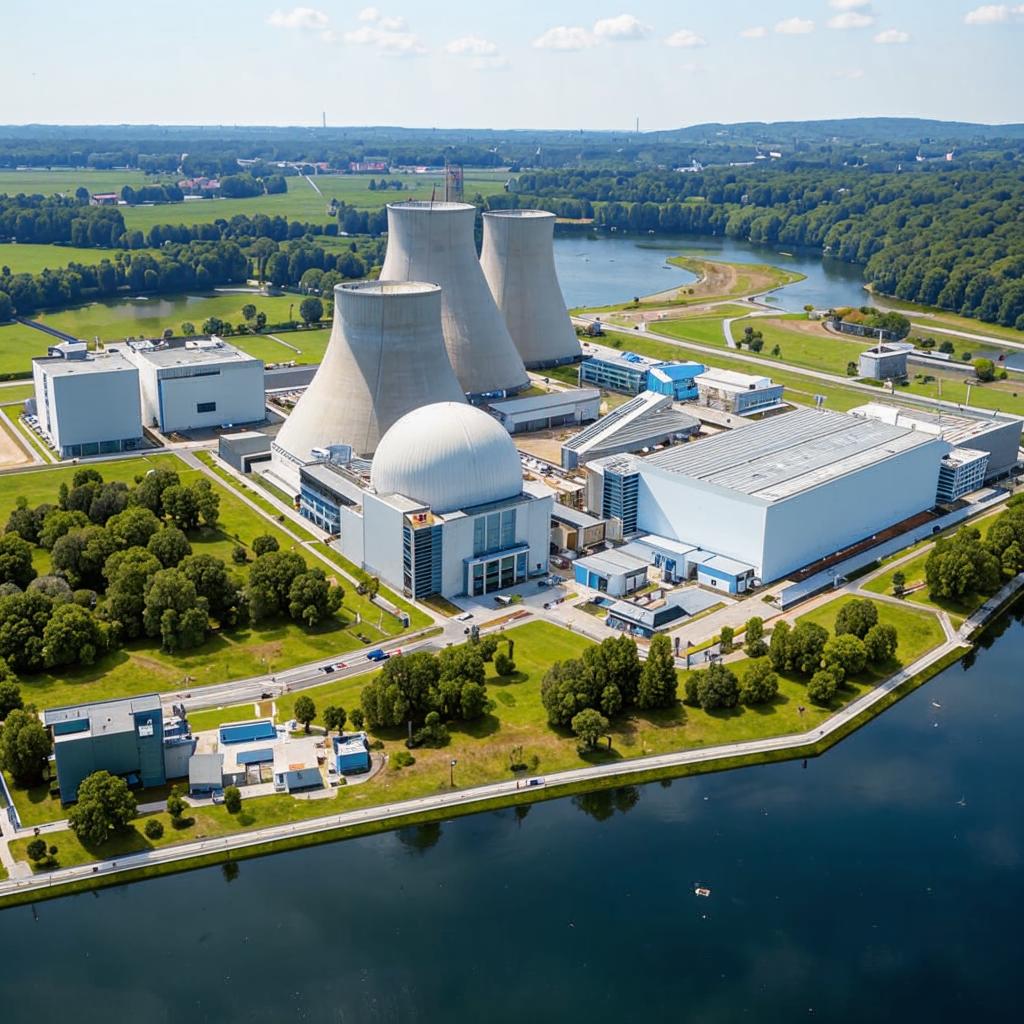
Energy progress is inseparably linked to growing demand for electricity, which in turn requires seeking new, more efficient and economically sound energy sources. Limited resources of traditional organic fuel and the desire to overcome the energy crisis have made nuclear power one of the priority directions of energy industry development worldwide. Today NPPs (nuclear power plants) have become an important element of energy systems in developed countries.
Nuclear power plants have much in common with thermal power plants (TPPs). Both NPPs and TPPs use the principle of converting thermal energy into electrical energy. The main stages of this process are as follows:
Despite a similar operating principle, the main difference between nuclear and thermal power plants lies in the method of obtaining heat to heat water. Traditional TPPs use heat obtained by burning coal or gas fuel for this purpose. At nuclear power plants heat is generated as a result of a controlled uranium fission chain reaction, making this method more efficient and environmentally clean.
Modern NPPs are built using advanced technologies that ensure high reliability and safety of operation. The basis of such plants is a light-water nuclear reactor used for efficient and safe electricity production.
Operating principle of a light-water reactor
In light-water reactors installed at NPPs, water plays a key role in energy generation. The reactor vessel contains the core and the primary circuit. Water in the primary circuit performs two important functions:
When water circulates through the primary circuit, it absorbs heat released in the reactor core. Then this heat is transferred to the secondary circuit through a heat exchanger, also known as a steam generator. In this circuit steam is formed that is then used to rotate a turbogenerator, where mechanical energy is converted into electrical energy.
Containment: protecting the environment
Another key NPP element is containment (protective shell) — a specially designed structure surrounding the primary circuit and all its components, including pipelines. Containment plays a critically important role in ensuring safety: it isolates any radioactive products that may enter primary-circuit water, preventing their release into the environment.
Economic aspects of nuclear reactors
Financial costs of equipment needed for NPP operation make up a significant part of the overall plant construction budget. About 90% of a nuclear power plant’s cost falls on the reactor vessel, heat exchangers, pumps, vessels, and pipelines. These assemblies must be designed and manufactured to ensure maximum economic efficiency without sacrificing reliability and durability.
Radiation has a multifaceted effect on steels and alloys, changing their mechanical properties and corrosion resistance. Increased strength is accompanied by loss of plasticity and toughness, making materials more brittle. At the same time, water radiolysis intensifies corrosion processes, destroying protective oxide films on metal surfaces. These factors must be considered when choosing materials for structures operating under high radiation loads to ensure durability and safety.
Mechanical properties under radiation
Interaction of high-energy neutrons with atoms making up the crystal lattice of metals leads to radiation defects. Neutrons striking atoms transfer their energy to them, leading to displacements in the lattice. The process resembles a billiard game: one atom, receiving a blow, displaces others, creating a chain reaction of displacements.
In this process, regions with high vacancy (void) concentration form in the material structure, surrounded by zones with elevated atom density in interstitial spaces. These changes increase metal strength but at the same time reduce toughness and plasticity. As a result the metal becomes more brittle, which can substantially limit its use where high resistance to mechanical loads is required.
Effect of radiation on corrosion resistance
Corrosion resistance of steels and alloys decreases significantly under radiation. This is especially relevant for materials working in contact with water and steam used in NPP heat-exchange systems. Irradiation causes water radiolysis, leading to breakdown of water molecules into ions, oxygen and hydrogen atoms, and hydroxide ions OH–.
The oxygen formed oxidizes the metal, and hydrogen causes hydrogenation, which later promotes embrittlement. Under normal conditions oxide films forming on the metal surface protect it from corrosion. However, water radiolysis and increased hydroxide-ion concentration promote destruction of these films, accelerating corrosion processes.
For aluminum alloys, for example, corrosion rate in an aqueous environment under radiation may increase 2–3 times. Austenitic chromium–nickel steels used under wet steam are subject to intergranular corrosion and stress corrosion cracking, which substantially reduces their service characteristics.
Modern materials play a key role in ensuring radiation and corrosion resistance, making them indispensable in nuclear power. One of the main materials for NPPs is corrosion-resistant chromium–nickel steels such as 12Kh18N9, 12Kh18N10T, 12Kh18N9SMR, and 10Kh17N13M3T. They resist radiation and aggressive environments, which extends equipment service life.
For welding housings of NPP working elements, high-alloy steels 08Kh19N10G2B, 10Kh18N25AM6, 04Kh19N11M3, and 07Kh25N13 are used. Their application makes it possible to reduce equipment repair and maintenance costs.
The Saint Petersburg Precision Alloys Plant offers proven, reliable solutions matching the strictest safety and efficiency requirements. We are proud of our contribution to nuclear power development and continue working to improve our products and technologies. For cooperation call or leave a request on the website. Our specialists will contact you and answer your questions in detail.