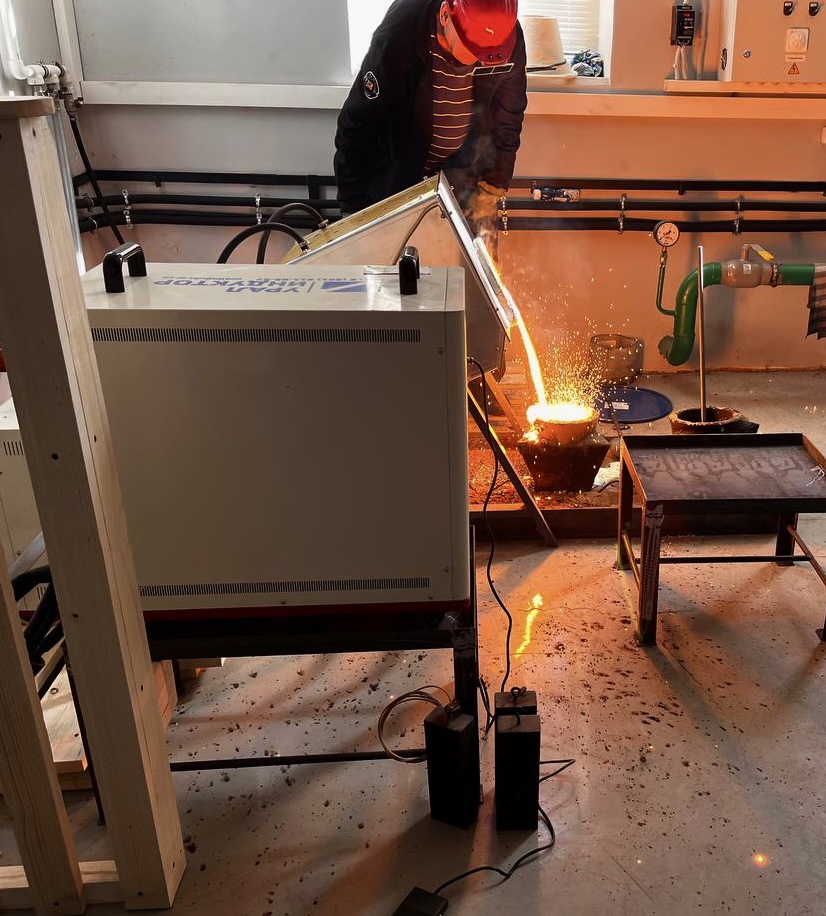
A new laboratory melting furnace — specialized equipment intended for scientific research and experiments in metallurgy — has been commissioned at Petersburg Plant of Precision Alloys. The furnace’s main function is melting metals and alloys, which opens new opportunities for research and production processes at the enterprise.
Research and development
Using a laboratory melting furnace in research work has many advantages:
- Temperature accuracy and control. Modern laboratory furnaces make it possible to precisely control heating temperature, which is important for many scientific and industrial processes. This yields more accurate experiment and analysis results, in particular when developing new steel and alloy grades.
- Safety. Laboratory melting furnaces are equipped with modern safety systems such as overheat protection and automatic shutdown when the door is opened. This significantly reduces the risk of fires and other emergencies, ensuring safety of research processes.
- Efficiency. Laboratory furnaces ensure fast, uniform heating of materials, which speeds up research and saves time. This makes it possible to conduct tests and analyses faster, raising overall research productivity.
- Wide temperature range. The ability to heat to high temperatures makes it possible to work with a wide variety of materials for a broad spectrum of experiments. This opens new horizons for research and development of innovative steels and alloys.
- Economy. Laboratory furnaces help save funds thanks to accuracy and reproducibility of results. This reduces the need for repeated experiments and cuts material costs, making research processes more economical.
Thus the laboratory melting furnace becomes an important tool not only for scientific research but also for improving production processes that require precise temperature control and a minimal amount of starting materials.
Melting enterprise standard samples (ESS)
An important stage in mastering production of new steel and alloy grades is melting control samples for X-ray spectral analysis. This process includes several key stages:
- Material preparation. Before melting the material from which control samples will be made must be carefully prepared: be homogeneous and contain no impurities that could distort analysis results.
- Melting the material. The prepared material is placed in the crucible of the laboratory melting furnace and heated to a temperature sufficient for melting.
- Cooling and solidification. After melting the material must cool and solidify. The cooling process may occur naturally or using specialized methods.
- Sample analysis. The control sample undergoes chemical analysis to determine its precise chemical composition.
- Interpreting results and further use. Analysis results are interpreted with account of accuracy and precision requirements. Based on the data obtained a decision is made on further use of the control sample in production processes.
Melting its own control samples at PZPS makes mastering production of new steel and alloy grades faster and more efficient, which is a significant advantage for the company.
New steels and alloys already mastered at PZPS
Launching the laboratory melting furnace will allow PZPS to accelerate mastering production technologies for new materials. Recently the following steel and alloy grades have been mastered:
- soft magnetic alloys 80NM, 81NMA;
- corrosion-resistant steel 10Kh17N13M3T;
- alloys with a specified temperature coefficient of linear expansion 29NK, 36N, 42N;
- heat-resistant and heat-resistant alloys KhN78T, 20Kh13, as well as analogues of foreign alloys Inconel 718, Inconel 625, Inconel C-276.
Launching the laboratory melting furnace at PZPS not only expands opportunities for scientific research but also strengthens the enterprise’s position in producing high-quality steels and alloys that meet modern requirements and standards. For cooperation, call the listed phones or leave a request on the website. Our specialists will contact you promptly and answer your questions in detail.