The «Metall-Expo» exhibition is valuable because it allows journalists to meet representatives of a wide variety of manufacturers in person, including the most modern ones. In particular, one of the stands belonged to the Petersburg Plant of Precision Alloys. This enterprise has seen many turns in its history, some of them quite dramatic. A «Pro Metall» correspondent spoke with Head of Production at PZPS LLC Alexander Vlasenko about the plant’s fate and prospects.
— A precision alloy (from French precision — ‘accuracy’) is a metallic alloy with special physical properties (electrical, magnetic, thermal, elastic) or a rare combination of properties determined by precise chemical composition and special manufacturing technologies. Unlike ordinary alloys, where a certain spread of parameters is allowed, it has strictly defined characteristics that ensure stable properties across a wide temperature range and under external influences... But the plant’s history did not begin with this at all?
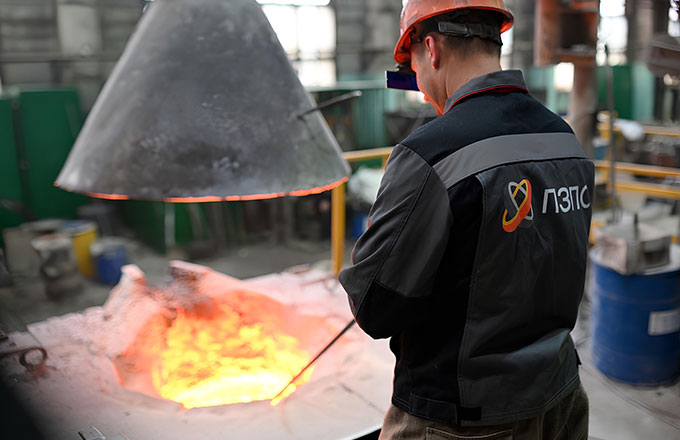
— The enterprise traces its history to the nineteenth century. The plant began operating on 21 June 1857; it was organized by the famous caster of cast iron and bronze products Felix Schopen, a supplier to the imperial court. At that time the enterprise was called an iron-working and cast iron foundry. It also worked with bronze.
But in the end Schopen sold the plant in his old age and moved to France, where he died... At the turn of the nineteenth and twentieth centuries the enterprise became part of the «Society of the Iron-Rolling and Wire Plant.» After the revolution it was renamed «Red Nail Maker.»
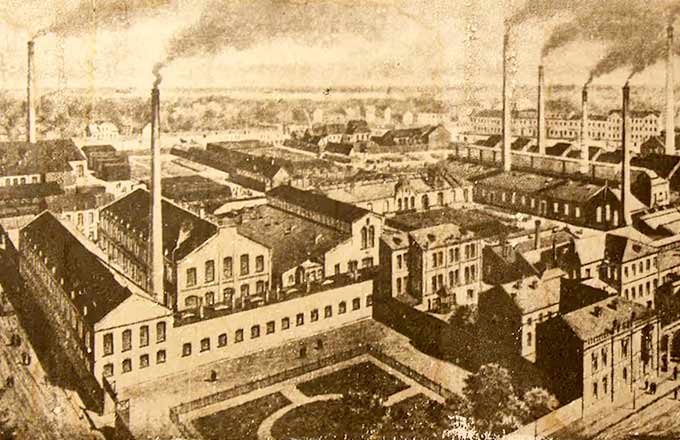
The plant began operation in the mid-19th century.
Incidentally, on Vasilyevsky Island individual elements of «Red Nail Maker» structures still remain. There is a water tower included in the UNESCO heritage register. There were two such towers in the former Soviet Union — one in Ukraine, one here in Leningrad, and it still stands. A residential complex was built there, but the tower was preserved.
After the revolution the plant organized production capacity for hot rolling to produce wire. Around the period of the first five-year plans, closer to the 1930s, a cold-rolling shop was organized. This was production of cold-rolled strip from various carbon materials.
Before the war the plant was named after a Stalin associate — «V. M. Molotov Steel-Rolling and Wire and Rope Plant.» After the war, in the 1950s, when Molotov was expelled from party leadership, from 18 November 1957 the enterprise became the «Leningrad State Steel-Rolling Plant.»
— When did you start working with precision steels?
— That is when it began. The economy was developing rapidly and demand appeared. Aviation, the nuclear industry, shipbuilding, electronics, space... Production was mastered at the plant with the help of specialists from the Bardin Central Research Institute of Ferrous Metallurgy; they had experience. Young graduates entirely from our Leningrad Polytechnic were brought in, and these people began mastering precision alloys. Besides the traditionally produced fasteners and cold-rolled strip. And around the early 1960s precision alloy production was already operating and worked actively through the 1990s, until perestroika.
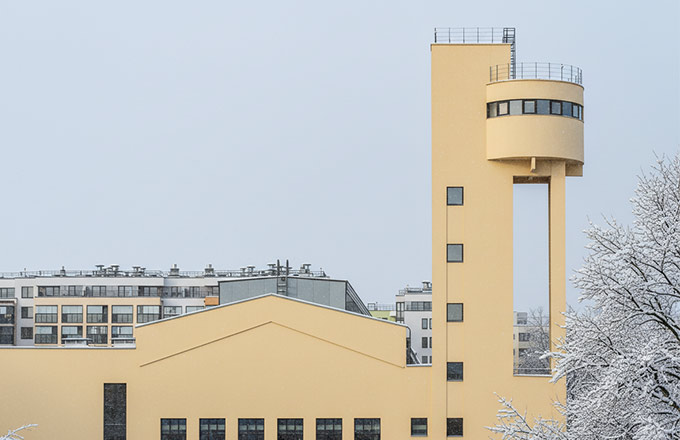
That famous plant tower.
— Then a collapse?
— Of course. There was a theme then — conversion. To close production facilities capable of working, including for the defense industry, and reorient them to making pots and frying pans. Budget money was allocated for this, by the way. Innovative alloys were no longer needed.
In the 2000s understanding began to arrive that the country could not do without high tech and the defense industry. But that wave reached us slowly. The fact is that in the USSR there was such a phenomenon as a mobilization reserve in case of war. A large amount of our products remained in mobilization reserve warehouses. And when it ran out after several years, they remembered us. A new era of our plant began here. Moreover, by that time China had essentially flooded the entire Russian market for fasteners, so there was no point in doing that anymore.
— And where are you based — still on Vasilyevsky Island?
— Yes, exactly. You know how developers today fight for central city territories to build residential complexes on them. We had to move a little. Our historical address from the nineteenth century is 25th Line, building 8. Now we are on 27th Line, the next one over. Into two buildings adjoining the Baltic Shipyard, we moved equipment and preserved a continuous technological cycle for producing precision alloys and carbon strip. Since 2007 we have borne our current name: Petersburg Plant of Precision Alloys.
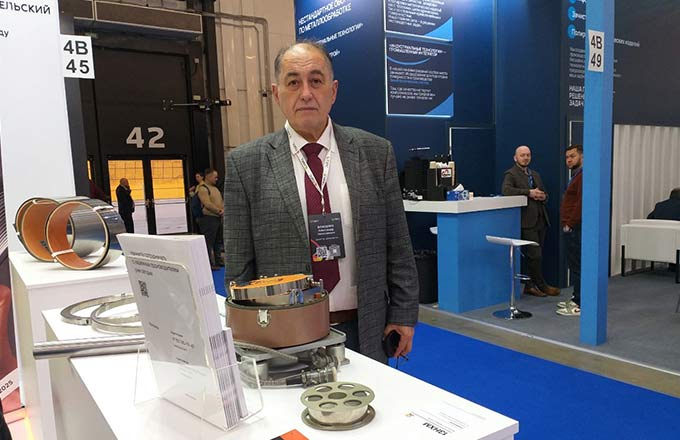
Head of Production at PZPS LLC Alexander Vlasenko at the Metall-Expo exhibition.
— There are different groups of precision alloys. What do you specifically produce now?
— We have a broad product range, more than 100 types. For example, soft-magnetic alloys needed for manufacturing various generators, motors, and aircraft among other things. Elastic alloys operating across a wide temperature range from −70 to +400 degrees while retaining their spring properties.
Here we have samples of 29НК (called «Kovar» in the West), 42Н. These are alloys for microelectronics, where bonding with glass or ceramic occurs during manufacture. When heated or cooled, the linear expansion of this alloy matches that ceramic. Remember the old television tubes? They heated up, expanding according to the laws of physics. And they had metal contacts that had to expand synchronously because they were made from precision steel.
If the contacts had their own linear expansion and the glass vacuum bulb had its own, it would simply crack. Such televisions no longer exist; the tube era is long gone. But various resistors — resistors, thyristors, and so on — have taken their place. Ceramic heats up too!
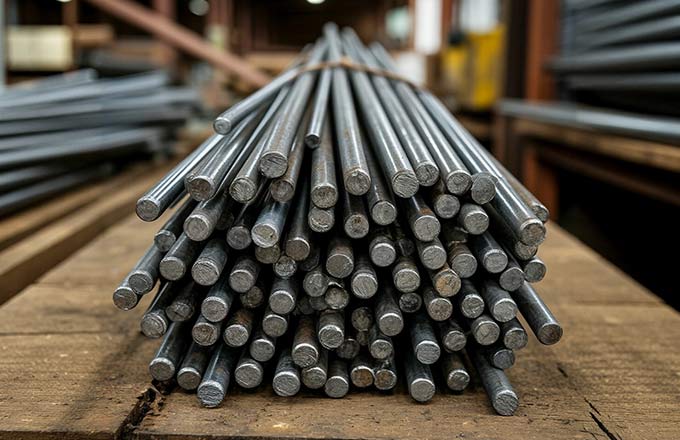
Rods from soft-magnetic alloys.
Another direction is high electrical resistance alloys. They are mainly used for ordinary heating spirals, including industrial equipment heating. Furnaces, thermal equipment...
They are also used in rheostats through which large currents pass — for example, when braking electric locomotives. They heat up quite slowly... We should note that we produce analogues of many foreign alloys and participate in import substitution.
— Is there any widely known equipment where your alloys are used?
— Over there on the stand is an emergency flight recorder, better known as a «black box.» People remember them when aircraft disasters occur. Information is recorded on our strip, which can withstand extreme temperatures without losing its properties. In a disaster, even if this strip breaks into pieces, they can be collected, glued together, and the information read.
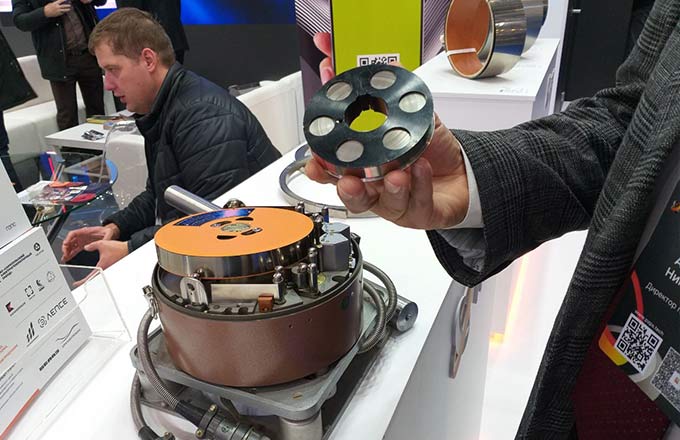
"Black box" on the company stand.
— Do you conduct scientific research?
— We are proud that we recreated a research center here. That is exactly what it does, attracting young specialists. We are mastering new types of products. For example, manufacturing substrates for superconductors is very topical now.
Incidentally, five accredited laboratories operate within the Central Plant Laboratory!
Plans include developing our own Training and Methodology Center, which will help us train personnel. We have a broad investment program and are purchasing equipment. From 2022 to 2029, 4.6 billion rubles will be invested in the development of PZPS LLC.
— We wish you success in your important work for the country.