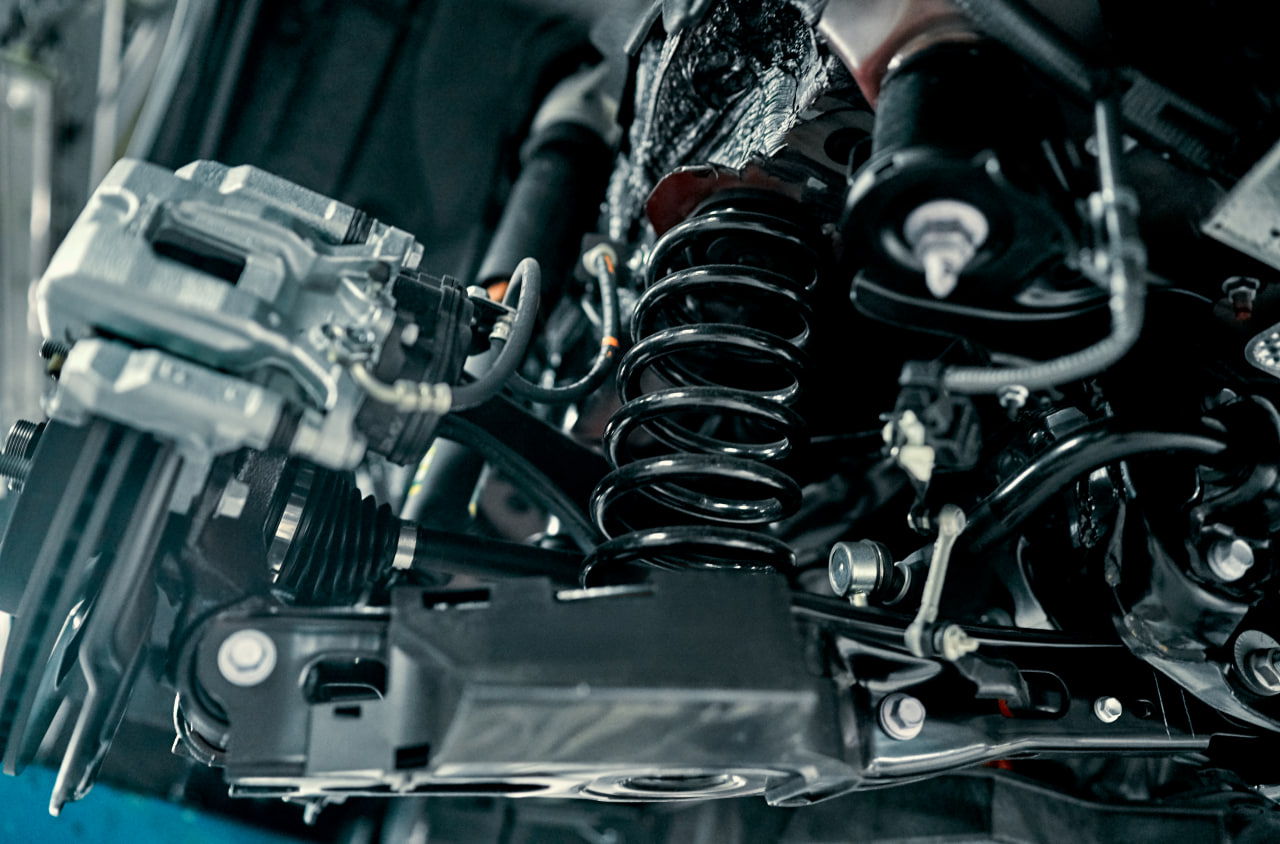
To achieve the required mechanical and chemical characteristics, spring steels are alloyed with silicon, manganese, nitrogen, chromium, and other components. Each of them has a certain effect on metal properties and also makes it possible to raise their strength and elasticity, which in turn increases alloy reliability in service under extreme conditions. For example:
If various additions in steel total less than 2.5%, the alloy is classified as low-alloyed; from 2.5% to 10% — medium-alloyed; more than 10% — high-alloyed.
But even when adding all available alloying elements it is impossible to obtain a super-strong metal that can work for many decades in aggressive conditions without undergoing destruction. This is because in different proportions combinations of chemical elements behave differently. Therefore, before obtaining a new steel grade, specialists conduct hundreds of experiments that make it possible to understand how the new metal will behave under various conditions.
Let us consider examples of how the same alloying additions make it possible to obtain alloys with different properties — not only due to different additions but also production features.
For example, steel grade 65S2VA contains at least 1.5% and not more than 2% silicon and 0.8–1.2% tungsten and is suitable for manufacturing critical and highly loaded springs. Whereas steel 60S2A contains only from 1.5% to 2% silicon and is more suitable for manufacturing collets, spring washers, and torsion shafts.
The main difference lies in material hardness, yield strength, and short-term strength. Moreover, the short-term strength limit for both metals will differ only after quenching, cooling in oil, and subsequent tempering. In that case it will be 1,570 MPa for steel 60S2A and 1,860 MPa for 65S2VA. Whereas for cold-rolled strip from both metals it will be from 780 to 1,180 MPa. At the same time Brinell hardness will differ regardless of production technology: for 60S2A — 269 MPa after annealing and 302 MPa without it; for 65S2VA — 285 MPa and 321 MPa respectively.
Another example of how the same chemical element in combination with other additions can change alloy properties. Steels 50KhFA and 70S2KhA contain chromium, only in the first its amount is 0.8–1.1%, and in the second — 0.2–0.4%. Also in the composition of 50KhFA there is vanadium in an amount from 0.1 to 0.2%, and in 70S2KhA — silicon — from 1.4 to 1.7%. They also differ in carbon and manganese amounts: in 50KhFA C=0.46–0.54%, Mn=0.5–0.8%; in 70S2KhA C=0.65–0.75%, Mn=0.4–0.6%.
All this gives them different physical-chemical properties and, consequently, application areas. 70S2KhA is considered an alloy not prone to temper brittleness and ideally suitable for manufacturing clock-mechanism springs. Whereas 50KhFA already has slight susceptibility to temper brittleness, which leads to reduced impact toughness. It is considered more suitable for producing heavily loaded elements that will be operated at temperatures up to 300°C.
Each spring steel grade has its features and most suitable application areas. Within one article it is difficult to cover all characteristics, advantages, and disadvantages of different metals. If you need an alloy for specific production tasks, contact us — we will help select a suitable material and tell in detail about its properties and application areas. We manufacture steels of various grades as cold-rolled strip in full accordance with set goals and current regulatory requirements.