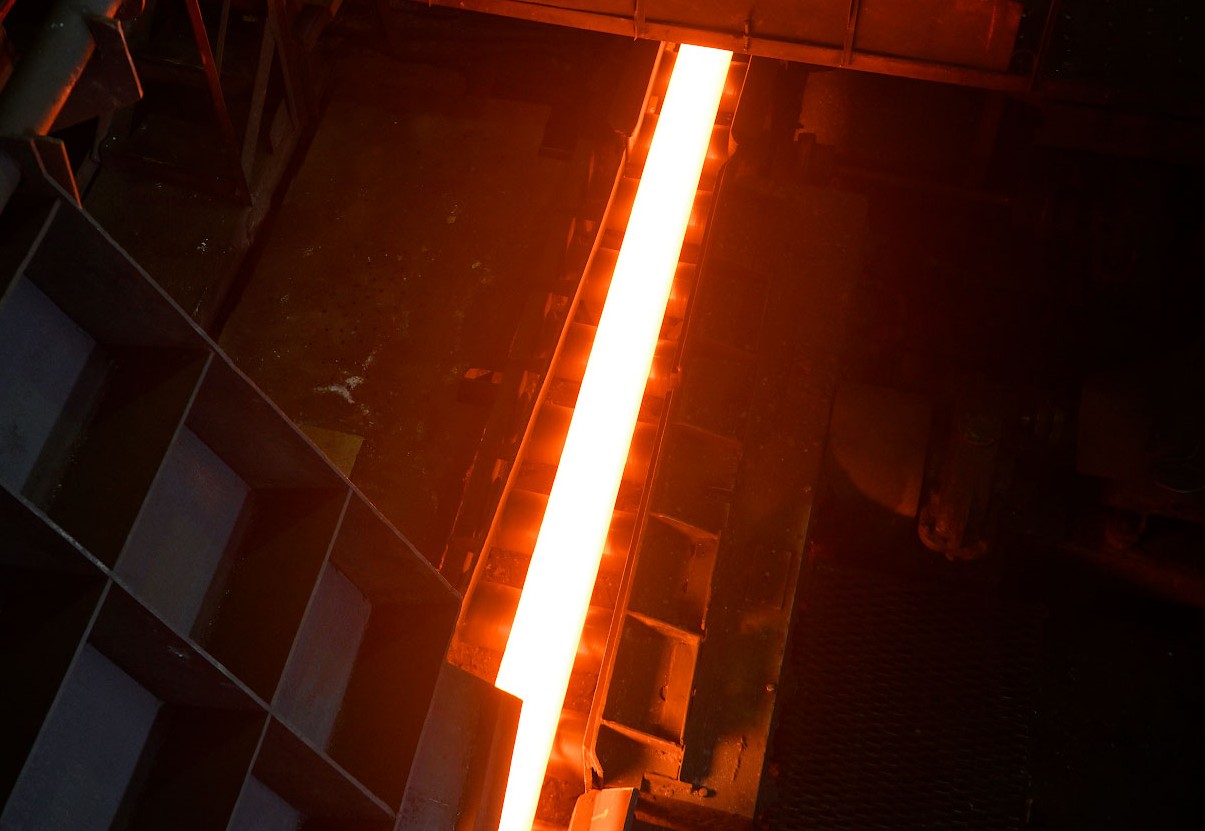
Incandescent colors of metals are the change in surface color of a material on heating depending on temperature. This effect is used for visual control of temperature regimes in metallurgy and heat treatment. Knowledge of annealing colors makes it possible to avoid overheating, preserve material structure, and ensure stable service properties.
Significance of annealing colors for metallurgy and materials science
Studying annealing colors matters for metallurgy and materials science for several reasons:
- Temperature control: allows metallurgists to visually assess the temperature of heated metal without special instruments.
- Development of new materials: helps obtain valuable data on material behavior at high temperatures, which matters when developing new alloys and composites with improved properties.
- Ensuring safety: in some industrial processes serves as an additional control means, helping prevent overheating and possible emergencies.
Radiation intensity and spectrum depend on body temperature, its physical properties, and surface condition. The higher the temperature, the more energy is radiated and the shorter the wavelength of maximum radiation. This explains why bodies heated to high temperatures emit light in the visible spectrum.
Physical basis of annealing colors
Light emission by heated bodies (thermal radiation or black-body radiation) is a phenomenon based on the fact that as temperature rises atoms and molecules of a substance begin to move faster and interact more often, which increases internal energy that is then released as electromagnetic radiation, including visible light.
When a body is heated, its atoms and molecules begin to emit electromagnetic waves of various lengths. At sufficiently high temperatures this radiation enters the spectrum visible to the human eye. Emission color depends on body temperature:
- at low temperatures radiation is mainly in the infrared region, and the body appears dark or red;
- as temperature rises the emission spectrum shifts toward shorter waves, and color changes from red through yellow and white to blue.
As temperature rises metal atoms and molecules begin to vibrate more intensely, which increases the frequency and energy of emitted electromagnetic waves. The emission spectrum shifts from the infrared region toward visible light, appearing as color shades.
Annealing colors of steels
As metal heats up, certain oxide shades present in the thin surface layer (oxide film) disappear. First violet shades diminish, then yellow, green, and red. At maximum heating the metal begins to glow pure white.
Annealing colors are an important parameter in heat treatment of steels and alloys, because heating temperature directly affects the mechanical and physical properties of the material.
- Dark red (about 550–600°C) — start of tempering and relief of internal stresses.
- Cherry red (about 600–700°C) — full tempering, softening of the structure.
- Bright red (700–800°C) — start of relaxation and improvement of ductility.
- Yellow-red (about 800–900°C) — normalizing and quenching of alloy steels.
- Light yellow (about 900–1000°C) — austenitization before quenching.
- White heat (above 1000°C) — start of melting and risk of overheating.
As temperature increases the color becomes lighter and shifts from red to yellow. On further heating steel may reach white heat, indicating a very high temperature close to the melting point. Exact determination of annealing colors, however, depends on alloy composition and other factors.
Effect of material composition on annealing colors
Annealing colors can differ substantially depending on the physicochemical properties of the alloy. Main factors affecting surface coloration:
- Thermal conductivity and heat capacity. Different materials have different thermal conductivity and heat capacity, which affects heating and cooling rates and temperature distribution within the alloy. Materials with high thermal conductivity, for example copper or aluminum, heat faster and distribute heat more evenly, making the color less pronounced.
- Emission spectrum. Material composition determines its emission spectrum on heating. Each chemical element and their compounds have an individual spectrum, leading to differences in annealing colors. For example, an alloy with high carbon content will have richer red and yellow shades than low-carbon steel.
- Oxide films. On heating, oxide films form on metal surfaces and also affect annealing colors. These films can absorb or reflect light waves of certain lengths, changing the observed color. For example, the annealing color of aluminum may differ because of oxide film formation on its surface.
- Material structure. Crystal structure and microstructure of the material also play a role in its annealing colors. Grain size, differences in crystal forms, defects, and impurity elements can affect the emission spectrum on heating, especially in precision alloys.
Thus material composition is a key factor determining its annealing colors. Understanding these effects makes it possible to control heat-treatment processes more precisely.
Methods of determining temperature from annealing colors
Visual method
Visual assessment of temperature by annealing color is the most accessible method and requires no special equipment. However this approach has a number of limitations:
- High requirements for material surface cleanliness. To ensure good surface visibility, oxide films and other contamination that can distort color perception must be removed.
- Need to compare the observed color with a known color scale or table that links annealing colors to specific temperature ranges. Such scales may differ depending on metal or alloy type.
- Possibility of error. Visual temperature assessment is subjective and depends on lighting, viewing angle, and individual color-perception features of the observer. Therefore this method is often used together with other temperature-measurement methods.
The visual method is useful when using measuring instruments is difficult or impossible. To raise accuracy it is recommended to use reference scales that account for the specific material and viewing conditions.
Pyrometers
For precise temperature measurement pyrometers are used — instruments that measure temperature without contact. They are widely used in metallurgy and other industries for precise temperature control of metals and alloys.
Types of pyrometers:
- Optical — work by comparing the brightness of radiation from a heated body with the brightness of a reference light source at a given wavelength. They can measure very high temperatures but require setup and calibration.
- Infrared — register thermal radiation in the infrared range and convert it into temperature values. They are convenient to use, provide fast measurement, and can be set for various temperature ranges.
- Ratio (two-color) — assess temperature based on brightness ratios in several spectral ranges. Suitable for measuring temperature under strong radiation or light reflection.
Advantages of using pyrometers:
- Contactless measurement avoids damage to the measured object and ensures operator safety.
- High accuracy and measurement speed make it possible to obtain reliable temperature data promptly.
- Ability to measure high temperatures that cannot be measured by contact methods.
Use of pyrometers is especially relevant in producing precision alloys where high accuracy of temperature control is required.
Importance of temperature control in producing precision alloys
Precise temperature control in producing precision alloys matters for several reasons:
- Material structure and properties. Temperature affects crystal structure and phase transformations in alloys. An incorrect temperature regime can lead to unwanted phases, grain-size changes, and other structural defects, which will negatively affect mechanical and physical properties of the end product.
- Material uniformity. Precision alloys require high property uniformity throughout the volume. Exact observance of the temperature regime helps ensure even distribution of components and avoid local inhomogeneities that can reduce strength, ductility, and some magnetic characteristics.
- Compliance with standards. Precision alloys are often used in critically important equipment where strict compliance with established standards and technical requirements is needed. Strict temperature control is an integral part of quality assurance and reliability of such materials.
PZPS produces a wide range of special steels and precision alloys, including various billets and hot- and cold-rolled strip:
- of soft magnetic alloys 27KKh, 49K2FA-VI, 50N, 79NM, 80NM;
- of precision alloys for spring elements 17KhNGT, 36NKhTYu, 40KKhNM;
- of alloys with high electrical resistivity Kh15Yu5, Kh23Yu5, Kh20N80N, Kh15N60N;
- of alloys with a specified temperature coefficient of linear expansion 29NK, 36N, 42N;
- of corrosion-resistant steels 10Kh17N13M3T, 12Kh18N9, 12Kh18N10T;
- of heat-resistant steel 20Kh13 and alloy KhN78T.
At PZPS we apply modern temperature-control methods to ensure high quality of products. For advice or to order precision alloys and special steels contact us via the website or by phone +7 812 740-76-57.