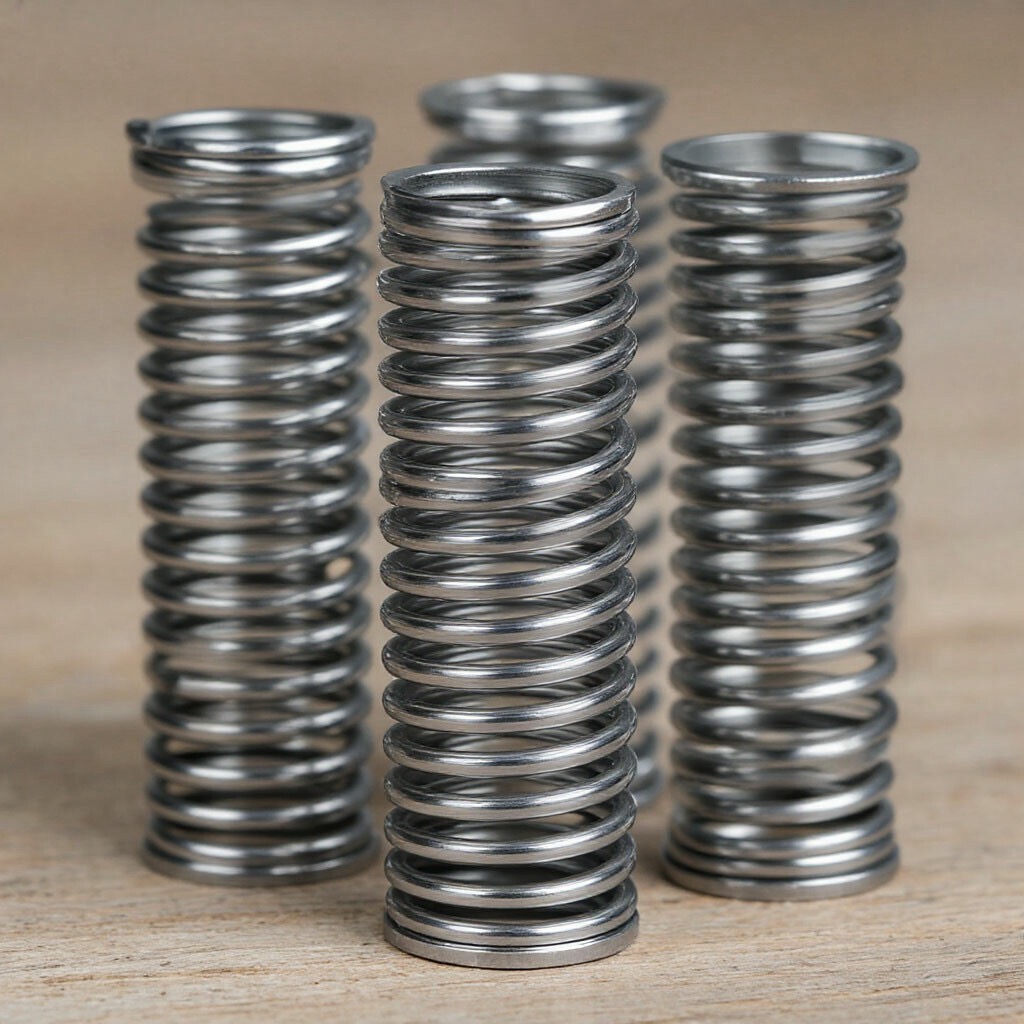
In modern technology there is a special group of structural materials that require not merely strength, but the ability to perform elastic work — to deform repeatedly and return to the original state without loss of properties. Exactly this task is solved by spring steels and alloys.
From railway carriage leaf springs of the nineteenth century to ultra-miniature drives of medical robots of the twenty-first century — the evolution of spring materials reflects the development of all mechanical engineering. Today an elastic element has ceased to be a passive part: it has become an intelligent component able to adapt to load, temperature, and even “remember” shape.
The first spring materials became a technological symbol of the industrial revolution. Their key characteristic is a high elastic limit achieved by a combination of chemical composition and heat treatment. Metallurgists’ main task was creating a structure resistant to cyclic loads and fatigue failure.
The classic scheme for obtaining elastic properties included quenching and tempering, forming a troostite structure that provides a balance of strength and plasticity.
Development of spring materials went from simple carbon steels to complex alloys. Each group solved its own engineering tasks.
Carbon steels (65, 70, 75)
These are basic materials for general-purpose springs. Their advantages are production simplicity, high elasticity after heat treatment, and availability. However, such steels have limited hardenability, low resistance to stress relaxation, and a limited working temperature range.
Alloy spring steels (65G, 65S2VA, 70S2KhA)
Adding silicon, manganese, chromium, vanadium, and other elements made it possible to substantially improve characteristics. As a result the following increased:
Isothermal quenching to lower bainite
Introduction of isothermal quenching became an important technological stage. Forming a lower bainite structure made it possible to:
This is especially critical for transport mechanical engineering, aviation, and power generation, where failure of an elastic element is unacceptable.
The next evolutionary step was creating precision alloys with predetermined elastic characteristics. Precision alloys are supplied already with guaranteed, stable parameters. This is critically important for instrumentation, micro- and nanomechanics, sensors, and medical devices.
Modern domestic precision alloys cover a wide application spectrum.
40KKhNM
Composition: cobalt (Co) — 39–41%, chromium (Cr) — 19–21%, nickel (Ni) — 15–17%, molybdenum (Mo) — 6.4–7.4%.
Application:
36NKhTYu
Composition: iron (Fe) — base, nickel (Ni) — 35–37%, chromium (Cr) — 11.5–13%, titanium (Ti) — 2.7–3.2%, aluminum (Al) — 0.9–1.2%.
Application:
17KhNGT
Composition: iron (Fe) — base, chromium (Cr) — 16.5–17.5%, nickel (Ni) — 6.5–7.5%, manganese (Mn) — 0.8–1.2%, titanium (Ti) — 0.8–1.2%.
Application:
Using such materials ensures:
The peak of elastic materials evolution became shape memory alloys (SMAs). Their uniqueness lies in the ability to:
The effect is based on thermoelastic martensitic transformation — a reversible transition between austenitic and martensitic phases. As a result the material can “work” as a thermomechanical actuator.
Development of these materials led to formation of two technological families.
Titanium nickelide (TiNi, nitinol)
The best known and most processable material. Distinguished by:
Copper systems (Cu–Al–Ni, Cu–Zn–Al)
More affordable in cost, but inferior to nitinol in cyclic stability and life.
SMAs have already become an integral part of advanced technologies:
Thus an elastic element turns into an intelligent actuator.
Modern research is aimed at creating next-generation materials where structure is designed at micro- and nanoscale. Among promising directions:
Such solutions make it possible to create “smart” structures that adapt to load.
3D printing of spring elements from metal powders makes it possible to create designs impossible in traditional production:
The path from simple spring steel to an alloy able to remember shape took more than a hundred years. Over that time spring materials evolved from passive elements to active components of engineering systems. Today an elastic alloy is not merely a metal. It is a carrier of a predetermined mechanical function.
The Saint Petersburg Precision Alloys Plant continues to develop this direction, creating materials with specified elastic characteristics for instrumentation, medicine, power generation, and aerospace technology.