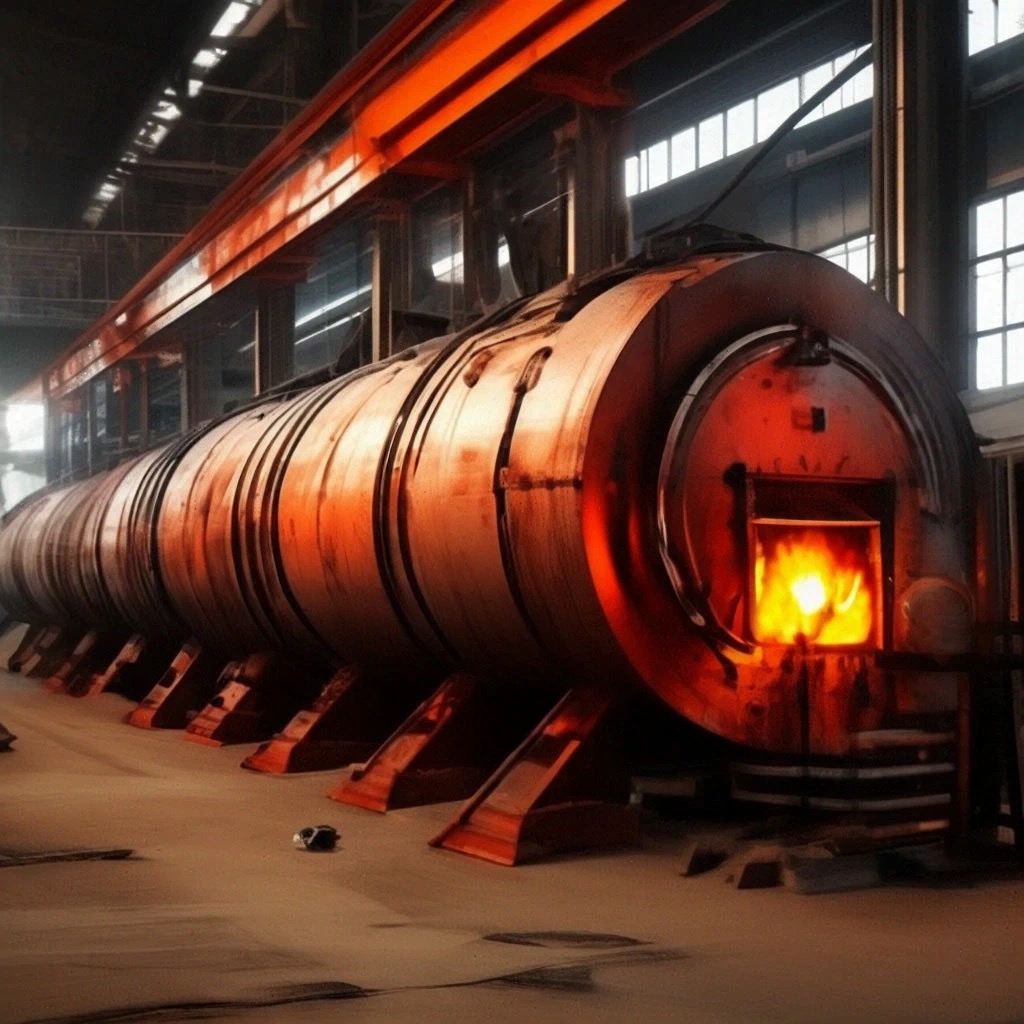
Annealing plays a key role in producing high-quality steels and precision alloys and is one of the important stages of heat treatment of metal blanks. This process includes heating parts to a specified temperature, holding under such temperature conditions, and subsequent slow cooling. The purpose of annealing is to eliminate residual stresses, ensure a uniform and stable structure of precision alloys and high-quality steels, and give them the necessary ductility.
There are several types of annealing that differ in their effect on the internal structure of the material.
Full annealing
Used for hypoeutectoid steels such as 08KP, 08PS, 20, 70 containing less than 0.8% carbon. It is aimed at forming fine austenite grains that on cooling form a uniform ferrite-pearlite structure, which significantly improves steel characteristics. Heating temperature and holding time depend directly on blank sizes, their placement in the furnace, chemical composition, and other production factors. To protect semi-finished and finished products from oxidation and decarburization, heat treatment is conducted in protective atmospheres.
Isothermal annealing
Aimed at improving machinability of alloys such as 12Kh18N9 and 12Kh18N10T and obtaining a more homogeneous ferrite-pearlite structure. It makes it possible to shorten recrystallization time, which is especially important for alloy steels, since after full annealing they require quite a long time for cooling to reduce hardness.
Incomplete (spheroidizing) annealing
Recommended for carbon and alloy steels such as 60S2A, 65G, 70S2KhA, U8A, U10A. Widely applied for hypereutectoid materials (containing from 0.8% to 2.14% carbon) and limitedly for hypoeutectoid ones. This type of annealing leads to formation and growth of new crystalline grains (practically complete recrystallization) and formation of spheroidal pearlite instead of the usual lamellar form. As a result of heat treatment, alloys and steels are better cut and also acquire improved properties for cold rolling, stamping, and drawing.
Homogenizing annealing
Used to eliminate chemical inhomogeneity in alloy steels and alloys that arises during metal crystallization. It includes heating the blank to high temperatures followed by long holding and slow cooling. As a result a material with coarse grain is obtained, which if necessary can be reduced by pressure or additional heat treatment. Applied for alloys 50N, 50NP, 79NM, 49K2FA, 27KKh to ensure high magnetic property indicators.
Annealing for relieving internal stresses
Aimed at reducing residual stresses that arise in metal during various technological operations such as forging, welding, and cold rolling. The purpose of such heat treatment is to reduce or fully relieve stress that arose as a result of external mechanical action.
Recrystallization annealing
Involves heating cold-deformed steel to a temperature exceeding the start of recrystallization, holding in the specified temperature regime, and further slow cooling. Conducted to increase metal ductility before cold pressure working, relieve work hardening between technological operations, and impart the necessary physical-mechanical properties.
Normalization
Often applied as an intermediate operation to soften steel or alloy before pressure working or cutting, as well as to eliminate defects and improve material structure. In the normalization process steel is heated to a high temperature and then left to cool slowly in air. Compared with annealing it makes it possible to obtain a stronger material.
In some cases normalization is preferable to annealing if both processing methods give comparable results. This is explained by the fact that normalization is more economical in cost and time.
Annealing of steels and precision alloys is an important process aimed at improving mechanical and physical properties as well as material structure. This type of heat treatment can significantly raise the processability of an alloy or steel, improve their structure, eliminate defects, and reduce internal stresses.
In addition, annealing improves machinability, which facilitates operations such as milling and drilling. This process also raises material weldability, which is critically important for reliability and durability of welded structures in the oil-and-gas and energy industries.