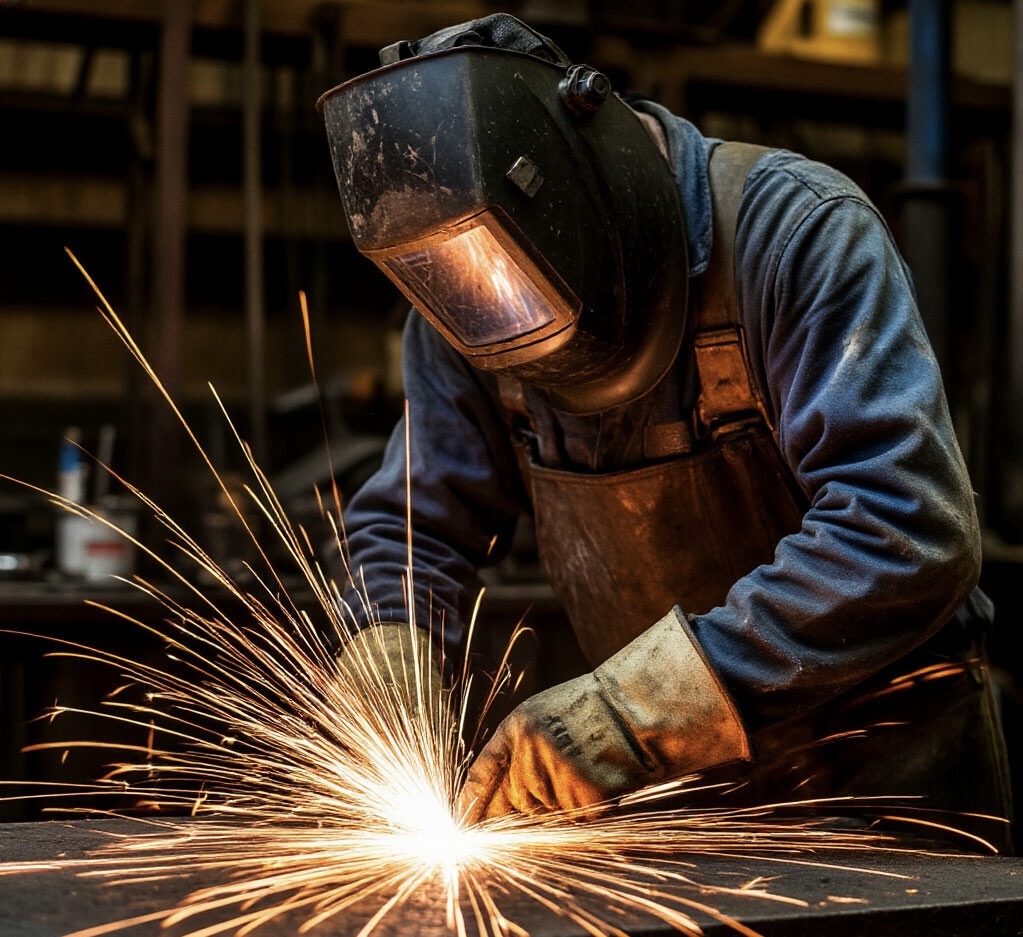
Cold-rolled metal strip is one of the key materials in modern industry. Thanks to elevated strength, dimensional accuracy, surface smoothness, and a wide range of steel grades, it is widely used in many industries, from automotive manufacturing to microchip production. An important technological operation in its manufacture is welding, which provides an economically efficient and flexible rolling process.
In this article we will discuss in detail the role of welding in cold-rolled strip production, types of welding, and the characteristics of steels produced at PZPS.
What cold-rolled strip is and where it is used
Cold-rolled strip is thin metal bands obtained by cold rolling, in which stock is passed through rolls at a temperature below the recrystallization temperature. This process achieves the following results:
- minimal thickness tolerances (down to hundredths of a millimeter);
- high surface finish (suitable even for mirror polishing);
- excellent mechanical properties: strength, hardness, and ductility.
Main application areas:
- Automotive and aviation equipment: used to produce body elements, shock absorbers, and fasteners.
- Construction: used as reinforcing material, as well as for fencing, architectural profiles, and exterior and interior elements.
- Electronics and power engineering: used to manufacture transformers, windings, contact groups, and other current-carrying parts.
- Household appliances: needed for appliance housings, fasteners, heating elements, and other internal components of various devices.
- Instrument making and mechanical engineering: thanks to high ductility and the ability to retain shape after forming, strip is well suited for producing stamped parts.
Overview of steel and alloy grades produced by PZPS
PZPS offers a wide range of cold-rolled product grades, each with its own applications in modern industry.
Electrical steels:
- 20895, 20880, 20860, 20832 — silicon-alloyed materials with high magnetic saturation and low hysteresis losses, used in transformers and generators.
- 21895, 21880, 21860, 21832 — varieties of the above grades with improved characteristics for high-frequency equipment.
Precision soft magnetic alloys:
- 50N, 50NP — nickel-based materials with high magnetic permeability, used in various sensors and relays.
- 79NM, 80NM, 81NMA — iron–nickel alloys with a narrow hysteresis loop and low coercive field, ideal for operation in alternating magnetic fields.
- 49K2FA-VI, 27KKh — for rotor and stator parts.
Precision alloys with high electrical resistivity:
- Kh15Yu5, Kh23Yu5, Kh23Yu5T — used to manufacture heating elements; resistant to overheating and oxidation.
- Kh20N80N, Kh15N60N — used in instrument making, electric heaters, and industrial automation for devices operating above 1000°C.
Alloys with a specified CTE:
- 29NK, 33NK, 36N, 42N — used in electronic equipment where dimensional stability with temperature change is important. Applied in joints with ceramics and glass (for example, in radio tubes, electronic boards, and thermal blocks).
Corrosion-resistant steels:
- 12Kh18N9 — a classic austenitic stainless steel resistant to corrosion in atmospheric and weakly acidic environments. Used in the chemical, food industries and in medicine.
- 12Kh18N10T — a modification with titanium addition, resistant to intergranular corrosion. Ideally suited for welded structures.
- 10Kh17N13M3T — elevated resistance to aggressive environments, including saline and acidic ones.
Corrosion-resistant steels are also widely used in modern construction for manufacturing various decorative elements.
Why welding is indispensable in cold-rolled strip production
Rolling production lines work with metal coils, but each coil has a limited length. To ensure process continuity and reduce costs, welding is used — a way to join two coils into one without sacrificing quality.
Key benefits of using welding:
- Increased rolling process efficiency — long coils reduce the time needed to change over equipment between batches, speeding up production and raising efficiency.
- Production flexibility — joining several metal coils into one long coil makes it possible to obtain strips of the required length without needing longer starting coils.
- Material savings — joining coils makes efficient use of raw material, minimizing scrap and reducing the amount of metal needed to produce a given volume of product.
- Production optimization — lengthening metal coils optimizes raw-material use and increases rolling productivity.
With welding, manufacturers can optimize their processes, reduce costs, and offer customers a higher-quality product.
Fact: welding a single thin strip 0.3 mm thick requires accuracy to fractions of a millimeter, and the weld zone itself must be strong but no thicker than the base material — otherwise it will cause defects in subsequent rolling.
Types of welding used in cold-rolled strip production
In modern production three main types of welding are used: resistance, arc, and laser. Each has its own features.
Resistance welding
A method of joining metal in which heat generated by an electric current passing through the contact area of the parts is used. The process is accompanied by application of mechanical pressure, which ensures a strong joint. Resistance welding is used for thin steels, in mass production, and on automatic lines.
Process stages:
- Surface preparation. To ensure good contact, the sheets to be welded are cleaned of rust, dirt, and oxide films.
- Heating of the metal in the contact zone. A high-intensity electric current is passed through the parts being welded, heating the steel to melting temperature.
- Application of pressure. The heated surfaces are pressed together with a given force, forming a strong welded joint.
- Cooling and solidification of the metal. After current is switched off, the metal cools and solidifies, and a strong welded joint forms in the weld zone.
Advantages:
- Productivity. The high speed of the welding process significantly reduces joining time.
- Joint strength. To obtain a reliable weld, it is enough to set the parameters of the welding equipment accurately.
- Economy. Resistance welding does not require electrodes or filler materials, which simplifies the process and reduces costs.
Disadvantages:
- Not suitable for materials of large thickness. Resistance welding is most effective for joining materials of small thickness.
- Precise equipment setup and surface preparation. To obtain a quality weld, welding parameters (current, time, clamping force) must be strictly observed. This requires a highly qualified operator and precise equipment.
- Difficulty of welding some materials. For example, alloys with high thermal conductivity or corrosion-resistant steels may be difficult to weld by the resistance method because of their specific properties.
In resistance welding the current can reach several thousand amperes, but it acts for no more than a few seconds. At the same time the temperature in the contact zone can exceed 1300°C — above the melting point of most steels.
Arc welding
Metal parts are joined by heat released by an electric arc formed between the electrode and the metal being welded. The resulting arc melts the metal and makes it possible to join materials. This method is widely used for joining various types of steel.
The process includes the following stages:
- Preparation. The surfaces to be welded are cleaned of dirt, rust, and oxide films to ensure good contact between the surface and the electrode.
- Creation of an electric arc. Using a welding machine, an electric arc is created between the electrode and the metal. The high temperature of the arc melts the metal in the weld zone.
- Formation of the weld. The molten metal joins, forming a weld. After power is cut off, the metal solidifies, forming a strong joint.
Advantages:
- Suitable for various alloys and metals, including steel, aluminum, copper, and others.
- Equipment simplicity and availability. Arc welding machines are relatively inexpensive and simple to use, which makes this method popular.
Disadvantages:
- Requires protection from radiation. Welding produces ultraviolet radiation that is harmful to the retina and skin, so personal protective equipment must be used.
- Dependence on welder experience. Weld quality strongly depends on the welder’s skill and correct equipment setup. Incorrect choice of welding parameters leads to defects in the weld.
The average temperature of the weld pool in arc welding is about 1700°C, and the maximum temperature of the welding arc is 8000°C.
Laser welding
The most high-tech method. It is used on automated lines, especially when working with expensive materials sensitive to deformation. It is based on using laser energy for local melting and fusion of materials.
The process consists of the following stages:
- Preparation. To ensure good contact and a quality weld, the surfaces to be welded are cleaned of dirt, rust, and oxide films.
- Focusing of the laser beam. The laser beam is focused on the contact point and melts the metal with minimal heat input. This makes it possible to melt the metal accurately and quickly in the required area.
- Welding. Under laser radiation the metal in the weld zone melts and joins.
- Formation of the weld. After the laser beam is switched off, the molten metal cools and solidifies, forming a strong joint.
Advantages:
- High precision and quality. Laser welding makes it possible to control metal melting accurately, ensuring high weld quality and minimizing the risk of damage to surrounding materials.
- Minimal heat-affected zone. The laser beam is concentrated on a small area, which reduces thermal impact on surrounding material and minimizes distortion.
- Suitable for automation. Laser welding is easily automated, which makes it possible to integrate it into production lines and raise process efficiency.
- Ability to weld difficult-to-weld alloys. This method is suitable for welding various metals and alloys, including those that are difficult to weld by other methods.
Disadvantages:
- Expensive equipment. Laser welding systems are costly, which limits their use in some areas.
- Requires highly qualified personnel. Effective work with laser equipment requires highly qualified operators familiar with the features of the laser welding process.
The focal spot diameter in laser welding can be less than 0.1 mm, which ensures jewelry-like precision even at high working speeds.
Modern welding technologies: a look into the future
Modern welding is developing rapidly. Among advanced solutions that are used or being tested in strip production, the following can be named:
- Hybrid laser–arc welding. Combines the advantages of the laser (precision) and the arc (penetration depth). Provides high strength and speed.
- Ultrasonic welding. Ideal for thin strips and foil. Used when materials must be joined without melting them, for example for sensitive electronic components.
- Welding in an inert atmosphere. Provides an ideal level of joint cleanliness, especially when working with precision alloys and steels sensitive to oxidation.
- Induction welding. Used for long longitudinal joints. The method is effective for rapid heating and joining of strip on continuous production lines.
Why choose PZPS
The Saint Petersburg Precision Alloys Plant is one of the leading suppliers of cold-rolled strip in Russia and the CIS. Our range includes more than 50 types of steels and alloys, from standard to unique precision materials. Thanks to modern equipment — automatic lines and high-precision rolling and welding machines — we can manufacture strip of the length, width, and thickness you need. Our quality control process guarantees that all our products meet high industry standards.
Order cold-rolled strip with ideal welds today. Contact us to get a product that meets the requirements of your industry.