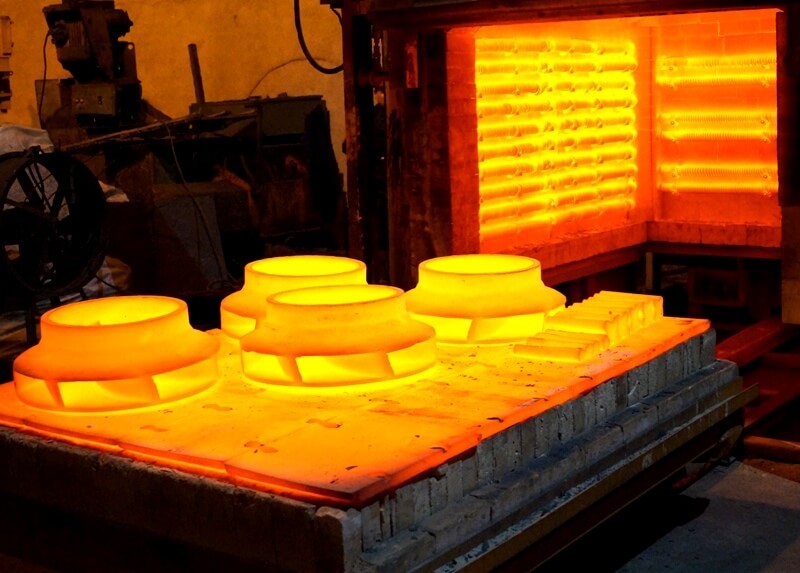
Heat treatment is a set of measures including heating, holding, and subsequent cooling of solid metal alloys. During heat treatment the internal structure and crystal lattice of metals change, which makes it possible to achieve the required physical-mechanical characteristics.
Heat treatment of precision alloys, as of other steels, is an integral stage in producing metal parts and tools, in particular hand tools, knives, springs, and more. It makes it possible to significantly improve strength of finished products, as well as reduce their brittleness, raise wear resistance, and restore other key characteristics.
The process of heat treatment of tool, stainless, and other steels includes heating the blank to the temperature recommended by GOST, holding for the time established by regulatory documents, and subsequent cooling in a certain medium (in oil, water, or air) at a regulated or unregulated rate.
Advantages of heat treatment of metal blanks
Heat treatment of metal is a key stage in producing durable and reliable structures. This process makes it possible to improve physical and mechanical qualities of alloys, including:
- raising metal wear resistance and increasing its resistance to mechanical action;
- increasing service life of finished parts and structures, as well as minimizing the number of rejected blanks;
- improving corrosion resistance by creating a protective layer on the metal surface, which is especially important if structures will be operated in aggressive environments or outdoors;
- restoring original physical-mechanical characteristics; for example, for precision alloy 79NM after forming the needed part heat treatment is mandatory to impart the required magnetic qualities;
- raising load-bearing capacity and making the finished structure stronger;
- making metal softer and more malleable to facilitate its subsequent deformation, cutting, or drilling.
Heat treatment of steels is an integral part of producing various tools and metal structures, ensuring high reliability and durability of finished products.
Main types of heat treatment of precision and other alloys
Each type of heat treatment is intended to impart certain characteristics to the finished structure.
- Normalization — makes it possible to relieve stress caused by casting, quenching, or welding of metal. Conducted at a temperature about 40°C above the maximum service temperature. Due to normalization steel becomes stronger and harder and also acquires compositional uniformity. Recommended for products requiring high impact toughness and low susceptibility to deformations under maximum loads.
- Annealing — usually conducted at the maximum critical temperature. Raises toughness, eliminates plastic deformations during recrystallization, relieves internal stress, makes the alloy more malleable for subsequent forming. Can be of the first and second kind — makes it possible either to slightly change the crystal lattice or to achieve noticeable phase changes.
- Quenching — the most widespread type of heat treatment. During it metal is heated to a specified temperature and then cooled in water, oil, or another liquid medium. This makes it possible to harden the outer layer of the finished product while leaving its inner part soft. Most often this type of heat treatment is applied in manufacturing shafts. Errors in quenching may lead to crack formation, reduction of steel hardness, oxidation of the metal surface or its overheating and, consequently, increase of grain size and rise of brittleness.
- Tempering — reduces brittleness and restores alloy hardness. Usually conducted immediately after the quenching process. With rising temperature during tempering toughness and softness of the metal blank increase. Temperature is determined visually by temper colors: dark red corresponds to about 630–730°C, light red — 800–900°C, dark yellow — 1050–1150°C, dazzling white — 1200–1300°C. Cooling of parts from high-carbon steel such as 65G is done in water or oil; from stainless — in oil. One of the most important factors in tempering is the trajectory of immersing the blank in the cooling medium: if technology is violated, part warping may occur.
Heat treatment is not always needed and not for all precision alloys and steels. For example, for steel 50N to possess the required magnetic properties it must mandatorily undergo annealing at a temperature from 1100°C to 1150°C and subsequent cooling to 200°C. Whereas for alloy 08KP heat treatment is not mandatory, although it may be recommended to improve mechanical qualities of the finished product or structure.
Petersburg Plant of Precision Alloys PZPS offers a number of cooperation formats in researching and conducting heat treatment of precision steels and alloys for engineers, technologists, designers, and other specialists. For cooperation, call the listed phones or leave a request on the website. Our specialists will contact you and answer all questions of interest in detail.