Every engineer working with metal structures has at least once faced failure caused by corrosion. It is a quiet but relentless enemy of industry: tanks, pipelines, reactors, welds — all are subject to its effects. Corrosion not only spoils appearance but also greatly reduces structural reliability, causing accidents, downtime, and billion-scale losses.
In the chemical, oil and gas, and power industries, fighting corrosion is not only an economic issue but also one of industrial safety. This is where weldable corrosion-resistant steels come to the fore — special alloys that retain their properties even after thermal effects during welding and operate in the most aggressive environments.
Metal corrosion is one of the most expensive and insidious problems of modern industry. Annual corrosion losses reach 3–4% of GDP in developed countries. Corrosion of welded joints is especially dangerous, where local thermal effects can change the crystal structure of the metal and lead to failure even under minor external loads.
To solve this problem, weldable corrosion-resistant steels were developed. They are not a separate class, but rather unite a number of grades within the main groups of stainless steels that, thanks to special chemical composition, show exceptional resistance to intergranular corrosion. Their use makes it possible to create reliable and durable welded structures without the need for complex subsequent processing.
Chemical composition determines not only corrosion resistance but also weldability, structure, and mechanical properties of steel. Each element contributes to forming a set of service characteristics.
Carbon (C) — a key but dangerous component. Its excess (more than 0.03%) when heated in the range 450–850°C promotes formation of chromium carbides (Cr₂₃C₆) at grain boundaries. This causes chromium depletion of adjacent zones and leads to sensitization — loss of corrosion resistance. Therefore weldable corrosion-resistant steels always have ultra-low carbon content (<0.03%).
Chromium (Cr, 16–25%) — the main element forming the Cr₂O₃ oxide film. It is this film that ensures metal passivity and resistance to oxidation in aggressive environments.
Nickel (Ni, 8–25%) — stabilizes the austenitic structure. Increases ductility and impact toughness, improves weldability and resistance to cracking and brittle fracture.
Molybdenum (Mo, 2–4%) — increases resistance to pitting and crevice corrosion, especially in environments containing chlorine ions.
Titanium (Ti) and niobium (Nb) — stabilizing elements that bind carbon into stable carbides (TiC, NbC) and prevent chromium carbide formation. This is especially important for steels intended for elevated-temperature service, where sensitization is most likely.
An optimal balance of alloying elements ensures not only strength and ductility but also resistance to the most dangerous types of corrosion — especially in welded joints.
After welding, the structure of stainless steel becomes inhomogeneous and includes several characteristic zones:
weld metal;
fusion zone;
heat-affected zone (HAZ);
base metal.
The HAZ is the most vulnerable region because it is heated in the critical temperature range (450–850°C), where chromium carbide precipitation is possible. This leads to local loss of the passivating film and development of intergranular corrosion.
The main danger during welding is sensitization. During heating and slow cooling in the HAZ, chromium carbides form along grain boundaries. These chromium-depleted zones become anodic relative to the rest of the matrix and dissolve quickly in an aggressive environment, forming a network of intergranular cracks.
To prevent loss of corrosion resistance, a set of metallurgical and process measures is used.
Use of low-carbon grades. Reducing carbon content to <0.03% makes chromium carbide formation thermodynamically impossible.
Stabilization with titanium and niobium additions. Ti and Nb have a higher affinity for carbon than chromium, forming stable TiC and NbC carbides. This prevents chromium carbide precipitation and keeps chromium in solid solution, increasing resistance to intergranular corrosion.
Control of the welding thermal cycle. The less time the metal spends in the 450–850°C range, the lower the sensitization risk. Therefore it is recommended to limit current, speed, and welding time.
Creating a structure with δ-ferrite. When welding austenitic steels, a small amount of ferrite (5–10%) in the weld metal structure is desirable because it dissolves harmful impurities and prevents hot crack formation.
Subsequent heat treatment. In some cases a stabilizing anneal at 850–900°C with subsequent rapid cooling is carried out, which makes it possible to eliminate sensitized sections.
Together these measures ensure microstructural stability and durability of welded joints even under long-term service in aggressive environments.
Weldable corrosion-resistant steels have:
high resistance to uniform corrosion in oxidizing and mildly reducing environments (nitric and acetic acids, water vapor, seawater);
increased resistance to intergranular corrosion even after multiple welding cycles;
resistance to localized corrosion types — pitting, crevice, and stress corrosion cracking (especially with Mo and N content);
durability in environments containing Cl⁻, SO₄²⁻, CO₂, H₂S ions.
The main advantage of such steels is the ability to retain passivity and structural stability even in the most aggressive environments where ordinary stainless steels lose protective properties.
Austenitic weldable corrosion-resistant steels are characterized by:
increased resistance to mechanical effects;
good ductility and formability;
high impact toughness (especially for austenitic steels at low temperatures).
Ferritic and duplex alloys have greater strength and resistance to stress corrosion, but are somewhat inferior to austenitic ones in toughness.
In production and welding it is important to account for process features:
excellent weldability by all types of arc and laser welding without tendency to cold cracking;
high manufacturability in forming, stamping, and bending;
increased tendency to work hardening — requires optimization of machining regimes;
low thermal conductivity and high linear expansion coefficient — important factors when designing welded structures.
During machining it is recommended to use special carbide cutting tools and reduced cutting speeds.
Thanks to their combination of properties, weldable corrosion-resistant steels are used in the most critical assemblies and apparatus:
In oil and gas — for equipment for production, transport, and storage of oil and gas operating in environments containing carbon dioxide (CO₂), hydrogen sulfide (H₂S), and chlorides.
In power and nuclear industries — in thermal power plants, steam generators, NPP elements, and turbine assemblies.
In petrochemical and chemical industries — for welded reactors, columns, heat exchangers, tanks, and pipelines contacting acids, alkalis, and salt solutions.
In the food industry — in apparatus for beverages, dairy products, and pharmaceutical solutions, where full inertness to the medium is required.
In construction and mechanical engineering — for architectural elements, vessels, pressure vessels, and welded pipes.
In shipbuilding — for hull structures, pipelines, and marine vessel assemblies.
In all these fields, weldable corrosion-resistant steels provide durability, tightness, and operational reliability of equipment.
Thanks to optimal chemical composition, controlled structure, and correctly selected welding technology, weldable corrosion-resistant steels ensure durability, reliability, and safety of equipment operating in aggressive environments.
Main recommendations:
During surface preparation, thorough mechanical cleaning and degreasing of abutted edges are needed to prevent weld carburization and porosity.
When welding the first root passes, inert gas (argon) backing from the reverse side of the weld is necessary to protect molten metal from oxidation.
Heat input should be controlled and excessively high heat inputs avoided to minimize HAZ time in the dangerous temperature interval.
Filler metal of similar or more highly alloyed composition than the base metal must be selected.
After welding it is recommended to control δ-ferrite content (5–10%) to prevent hot cracks.
Main welding methods:
Argon arc welding — used for critical root welds and thin-sheet products, provides minimal heat input.
Consumable-electrode arc welding — optimal for large thicknesses and high productivity conditions.
Manual covered-electrode arc welding — used for on-site assembly and repair work.
Laser and plasma welding — make it possible to obtain narrow welds with a minimal heat-affected zone.
Weld joint quality largely determines product service life. Therefore preparation, filler metal selection, and heat input control are of the utmost importance.
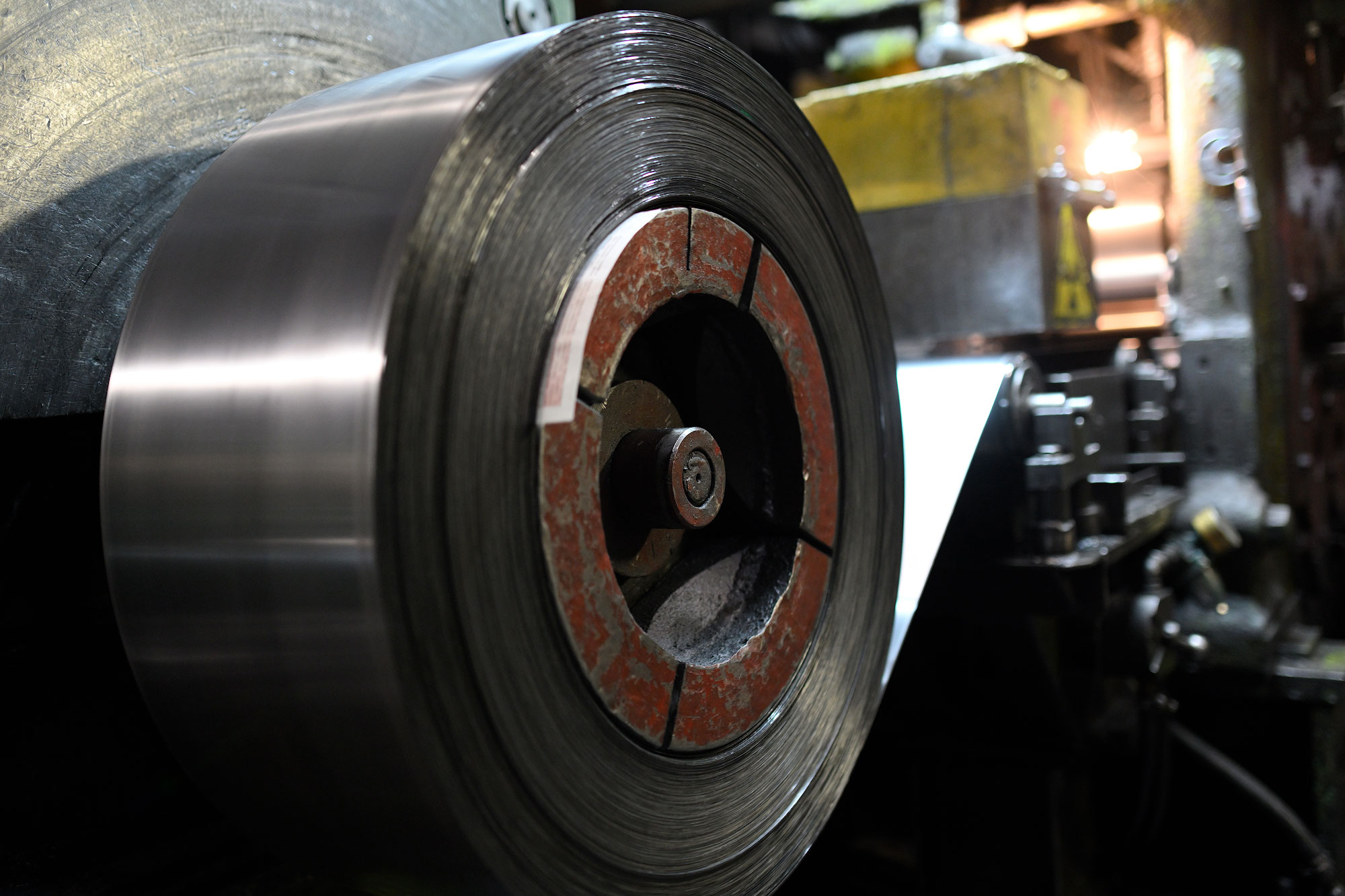
PZPS offers high-quality cold-rolled strip of weldable corrosion-resistant steel. Products meet GOST and technical specification requirements and are characterized by precise geometry, stable chemical composition, and excellent weldability.
The following grades can be ordered:
SV-08Kh19N10G2B
SV-10Kh16N25AM6
SV-04Kh19N11M3
SV-07Kh25N13
SV-04Kh20N10G2B
SV-02Kh21N11G2B
SV-02Kh24N13G2B
SV-03Kh22N11G2B
SV-03Kh24N13G2B
SV-07Kh25N13A
SV-04Kh20N10G2BA
SV-08Kh19N10G2BA
SV-02Kh23N15
SV-02Kh18N10B.
For delivery inquiries, contact the sales department by phone at +7 (812) 740-76-55 or leave a request on the website.