Titanium oxide was first discovered in 1791 by English scientist William Gregor. When studying iron-bearing sand sampled on a Cornwall beach, the mineralogist isolated a previously unknown compound to which he gave the name “menachanite earth.” Several years later German chemist Martin Heinrich Klaproth, during experiments, discovered the oxide of a new metal and named it “titanium.” The pure metal was discovered only in 1825 by Swedish scientist Jöns Jacob Berzelius.
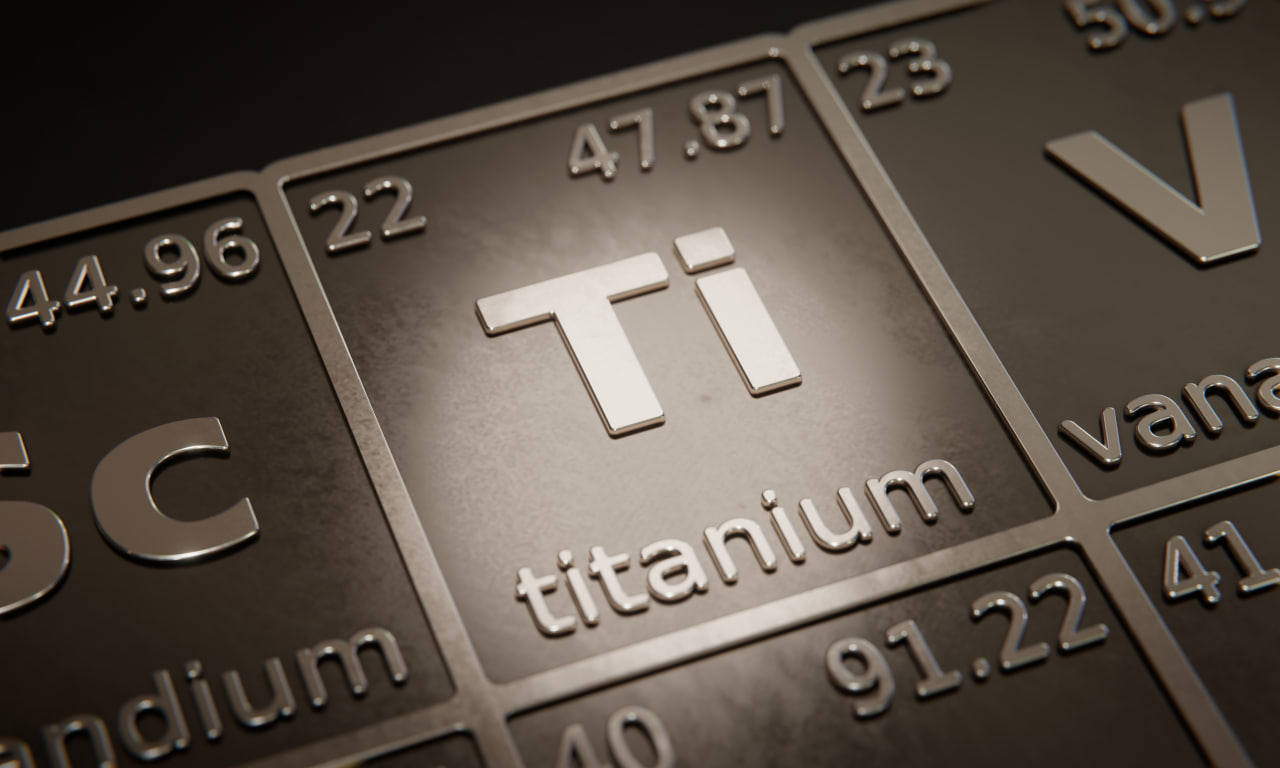
Titanium is the 22nd element of D. I. Mendeleev’s table of chemical elements. In appearance it resembles steel and aluminum. It has a melting temperature of 1,664…1,672°C and boiling temperature of 3,330°C. It is distinguished by elevated resistance to aggressive environments and high-temperature effects, as well as good strength and ductility.
Ti is a paramagnet: it has the ability to magnetize in the presence of an external magnetic field while retaining magnetic permeability below one. But unlike similar materials, as temperature increases titanium’s magnetic susceptibility does not decrease but increases.
Titanium is considered the fourth metal by abundance in the Earth’s crust, after iron, aluminum, and magnesium. But despite its abundance it has high cost. This is due to large costs of obtaining pure metal from ore, because in nature Ti occurs only as oxides and dioxides.
Pure metal welds and cuts very poorly, and chips and dust remaining after processing billets easily ignite at temperatures above 390…400°C. But despite this, the material is widely used in various industries.
The mass fraction of titanium in the Earth’s interior according to geologists’ estimates is about 0.57–0.58%, most of which is in the basalt shell and granite rocks. Main metal deposits are located in Japan, the USA, Canada, the United Kingdom, France, Belgium, Italy, and Spain. But at all deposits Ti is mined exclusively as titanium ores from which pure metal is then obtained by one of the following methods:
To obtain titanium of the highest quality the iodine method of metal reduction is used. Other methods of processing titanium ore make it possible to manufacture only technical Ti.
Applications of titanium in industry
Thanks to high service properties and low mass, titanium (both pure and as alloys) has found wide use in many industrial areas, including:
In non-ferrous metallurgy titanium is used both as pure metal and as part of many precision alloys. It is produced as cold-rolled strip, sheets and bars, rounds, tubes, wire, or thread.