Turbine blades are high-tech elements that determine the efficiency and reliability of modern turbine systems. They are used to convert the energy of high-temperature, high-pressure gases or steam into mechanical work. Let’s look at design features, materials used, modern production technologies, and operational nuances of turbine blades.
Design and purpose of turbine blades
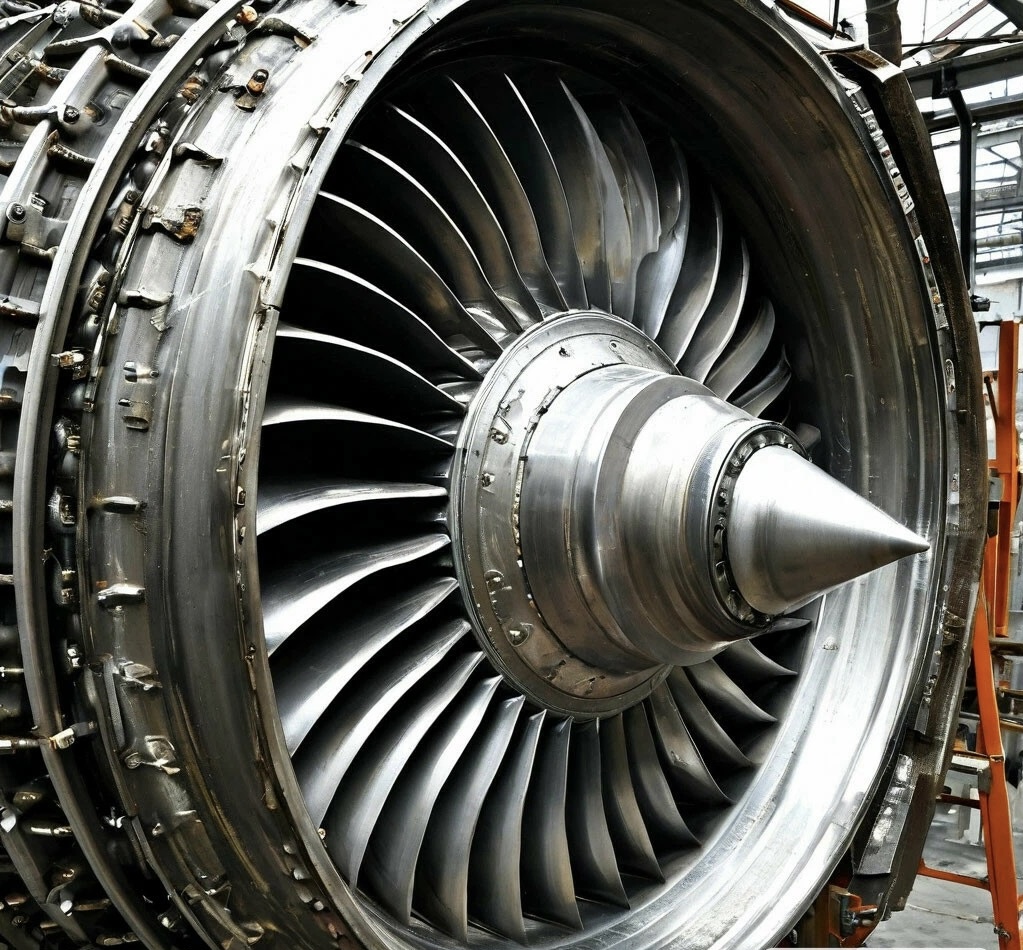
A turbine blade is a radial aerodynamic airfoil fixed on the rim of a turbine disk. Its function is to convert kinetic and thermal energy of the working medium into tangential force that drives the turbine rotor.
Main application areas
- Gas turbine units (GTUs) — in aviation, industry, and power generation.
- Steam turbines — in thermal and nuclear electricity generation systems.
- Hydro turbines and wind turbines — for converting renewable energy of water and wind.
Turbine blades are classified by location:
- Nozzle blades — direct the flow of the working fluid.
- Working blades — convert flow energy into mechanical work.
Operating features and main problems
Operating conditions
Turbine blades, especially in GTUs and steam turbines, operate under very difficult conditions:
- Temperatures — in gas turbine units temperature reaches 1,600°C, which requires heat-strength materials.
- Mechanical loads — high rotation speeds (up to 3,000 rpm and higher) create strong centrifugal forces.
- Chemical aggressiveness — combustion products cause oxidation and corrosion.
Blades of hydro and wind turbines operate under milder conditions (moderate temperatures and rotation speeds), but are subject to abrasive wear, erosion, and moisture corrosion.
Reliability problems
- Fatigue damage. Material fatigue is caused by vibration and resonance phenomena.
- Wear and corrosion. Blades are subject to erosion, oxidation, and thermochemical corrosion.
- Creep. Under prolonged high temperatures the material may deform, reducing part service life.
To improve reliability the following are used:
- Friction dampers that damp vibration and reduce dynamic loads.
- Advanced production technologies such as single-crystal casting (SC).
An important breakthrough was the development of directional solidification (DS) and single-crystal (SC) production methods. These methods significantly increase fatigue and creep strength by aligning grain boundaries in one direction (DS) or completely eliminating grain boundaries (SC).
Materials for turbine blades
Materials from which turbine blades are made must combine heat strength, corrosion resistance, and the ability to retain mechanical properties at high temperatures.
Modern materials
- Nickel superalloys. They are used in hot zones of GTUs and contain alloying elements (cobalt, molybdenum, chromium, tantalum, aluminum).
- Ceramic matrix composites (CMC), in which fibers are embedded in a polymer-ceramic matrix. These materials have low mass, high heat resistance, and specific strength, making them promising for the aviation industry.
- Heat-strength steels. Used for less loaded assemblies in turbines or for hydro and wind generators.
At the PZPS plant the following materials are produced:
- Corrosion-resistant steels: 12Kh18N9 and 12Kh18N10T — for wind and hydro turbine blades.
- Heat-strength alloys: 20Kh13, KhN78T, as well as analogues of Inconel 718, Inconel 625, and Inconel C-276 — for gas turbine units.
History of materials development
- In the 1940s, development of nickel superalloys made it possible to raise turbine operating temperatures.
- In the 1950s, vacuum induction melting was introduced, which helped further increase materials’ thermal resistance.
- In the 1970s, thermal barrier coatings (TBC) were developed that protect against high-temperature oxidation.
- In the 1980s, improved ceramic coatings appeared that increased blade heat resistance by about 90°C.
In some cases thermal barrier and ceramic coatings made it possible to almost double blade service life.
Technological features of turbine blade production
Turbine blade production includes several complex stages requiring high accuracy.
Production stages
- Blank forming. Investment casting makes it possible to give products complex aerodynamic profiles.
- Stamping and high-precision machining (milling) are used for more accurate processing of key surfaces.
- Heat treatment. Thermal treatment of blanks increases their strength, heat resistance, and wear resistance.
- Surface treatment. Grinding and polishing reduce roughness, which lowers aerodynamic losses.
- Coatings (ceramic TBC or aluminide) protect against corrosion and high-temperature oxidation.
- Geometry control. Blade manufacturing accuracy is checked with high-precision measuring instruments and equipment. Geometry control is especially important for large blades prone to warping after heat treatment.
Modern innovations in production
Innovations in turbine blade production are aimed at increasing equipment efficiency and reliability.
- Directional solidification (DS) and single-crystal casting (SC). These technologies eliminate or align grain boundaries, increasing blade life.
- Ceramic matrix composites have the potential to replace nickel alloys in hot engine sections.
- Applying modern coatings almost doubles part service life.
Conclusion
Turbine blades are complex engineered products requiring modern materials and advanced technologies. PZPS offers a wide choice of precision steels and alloys for manufacturing reliable gas turbine, steam, wind, and hydro units, guaranteeing:
- Use of advanced materials and technologies adapted for various turbine types.
- High-precision equipment for quality control at every production stage.
- Experience producing steels and alloys for work under difficult service conditions.
- An individual approach to each project and reliability guarantees at every stage of the production process.
Correct material selection, quality production, and control are the key to reliable, durable operation of various turbine units. PZPS is ready to offer solutions that meet modern high standards and market requirements, ensuring reliability and durability of your equipment.