In modern metallurgy there is a field where standard steel characteristics are not enough. It concerns precision alloys — materials with precisely specified physical properties and chemical composition.
In this sphere the cost of error is extremely high: even a slight parameter deviation can cause equipment failure. That is why vacuum induction melting (VIM) has become the key tool for obtaining such materials — a process that ensures high metal purity and structural stability.
Precision alloys are used where material properties directly determine product reliability and service life — electronics, instrumentation, energy, aviation, space technology, and medical equipment.
The main feature of these materials is high sensitivity to chemistry and microstructure. Even minimal deviations can change magnetic permeability, electrical resistivity, corrosion resistance, and other properties.
Gases dissolved in the metal melt are especially dangerous. Oxygen, hydrogen, and nitrogen promote:
All of this lowers product reliability and raises the risk of equipment failure in service.
Therefore precision-alloy production needs technologies that exclude melt–atmosphere contact, provide deep metal cleaning, and allow precise chemistry control. Vacuum induction melting became such a technology.
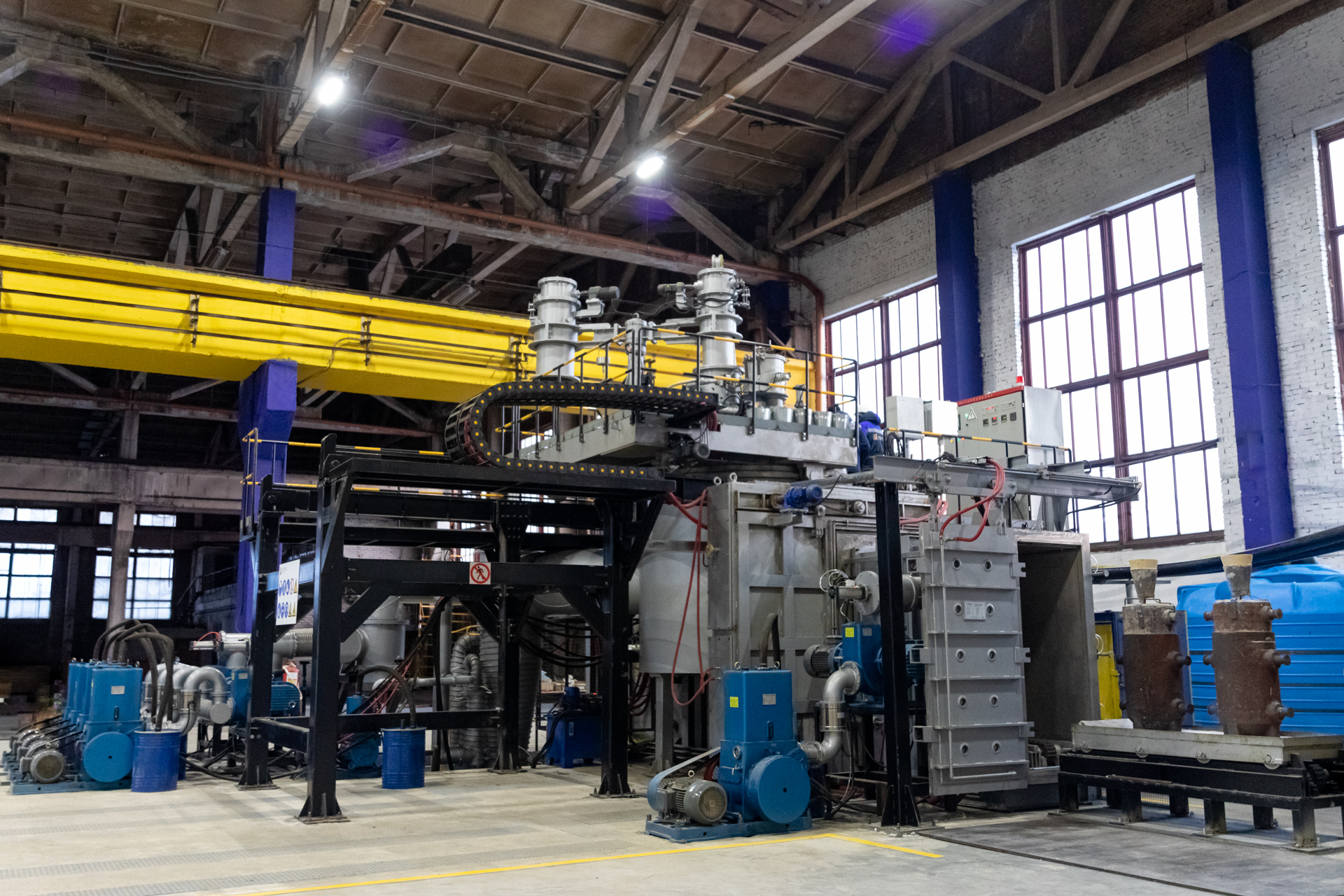
The melting facilities of the St. Petersburg Precision Alloys Plant are equipped with modern vacuum induction furnaces designed to obtain high-purity materials with a controlled structure.
Melting takes place in a sealed vacuum chamber where strictly specified pressure and temperature conditions are created.
Main process stages:
Air is pumped from the chamber to a deep-vacuum state.
Such conditions ensure:
Heating is produced by electromagnetic induction. An alternating magnetic field induces Foucault eddy currents in the metal charge, which leads to:
As a result, metal with a high degree of purity and stable physicochemical characteristics is formed.
Under vacuum, gases dissolved in the metal become thermodynamically unstable and leave the liquid phase. Under reduced pressure, hydrogen, nitrogen, and oxygen are removed from the melt. Metal deoxidation proceeds mainly through the reaction of carbon with residual oxygen in the vacuum environment, without intensive use of slag additions.
As a result, the content of non-metallic inclusions and the porosity level in the metal decrease.
A vacuum environment makes it possible to control melt chemistry precisely and reduces losses of alloying elements through oxidation or evaporation. This is especially important for functional alloys whose properties depend directly on composition.
For example, Invar 36N. This material is characterized by:
Alloying accuracy in vacuum induction melting ensures:
Thus the reliability of products used in high-precision mechanisms and measuring systems is achieved.
During melting the melt is continuously stirred by electromagnetic forces.
This prevents:
As a result an ingot with the same characteristics throughout its volume is formed.
Every kilogram of precision alloy melted at PZPS has:
Vacuum induction melting is not merely a stage of the metallurgical process. It is a technological foundation that determines product reliability throughout the service life.
Parts made of Kovar (29NK) obtained by vacuum induction melting have a thermal expansion coefficient close to that of glass.
This makes it possible to create:
Such joints withstand long-term service.
Elastic elements from alloy 40KXNM retain a stable elastic modulus under repeated loading cycles.
This ensures:
Such materials are used in springs, diaphragms, measuring systems, and pressure regulators.
Rotary transformers and magnetic circuits made of soft-magnetic alloy 79NM are characterized by low remagnetization losses.
This is achieved thanks to:
As a result equipment runs more stably, heats less, consumes less energy, and has a longer service life.
The St. Petersburg Precision Alloys Plant produces a wide range of materials intended for service under demanding technical conditions.
The St. Petersburg Precision Alloys Plant uses vacuum induction melting as the foundation of its production process, creating materials that meet modern science and industry requirements. VIM ensures product reliability in critical industries: from electronics to energy and space technology. For supply of high-precision alloys for critical engineering solutions, call +7 (812) 740-76-87 or submit a request on the website.