Historically, Felix Chopin’s iron foundry and bronze plant stood on this site; at the turn of the nineteenth and twentieth centuries it became part of the Iron-Rolling and Wire Plant Society, and after the revolution it took a name better suited to the new realities — Krasny Gvozdilshchik (matching one of the products manufactured). The name change was followed by modernization and construction of new buildings: steel-wire, rolling, and rope shops, as well as a power station and water tower.
The author of the rope shop project and the adjoining water tower was a graduate of the Petersburg Academy of Arts (by then already VKHUTEIN), head of the Research Experimental Laboratory of Architectural Forms and Graphing Methods, Yakov Chernikhov.

The future inspirer of all modern megacity architecture, forgotten at home and rediscovered abroad in the 1960s, was born in a small town of Yekaterinoslav Governorate in a large Jewish family. From childhood he devoted much time to drawing. At 15 he moved to Odessa and entered the local art school. After graduating he moved to the capital and enrolled in the painting faculty of the Academy of Arts. In parallel he studied at the Higher Pedagogical Courses, which gave the right to teach in various educational institutions. In 1925 Yakov Chernikhov completed studies at the architecture faculty of the Higher Art and Technical Institute.
In the 1920s–30s Chernikhov, in his laboratory with students and colleagues, actively engaged in design and experimental work, wrote scholarly works, and created numerous series of architectural fantasies. His books Fundamentals of Modern Architecture (1929–1930), Construction of Architectural and Machine Forms (1931), Architectural Fantasies. 101 Compositions (1933), and others were published.
As fully as Chernikhov’s theoretical legacy has moved into the twenty-first century, so scantily do his practical works open to us: to this day almost nothing is reliably known about his realized projects. There is an opinion that at the turn of the 1920s–30s several dozen industrial enterprises across the country were built to his designs. These were chemical plants where technology ordinarily prevailed over architecture. But those buildings are lost, their authorship is considered disputed, although some sources say that under Chernikhov’s patronage were almost all chemical plant projects of the Soviet Union.
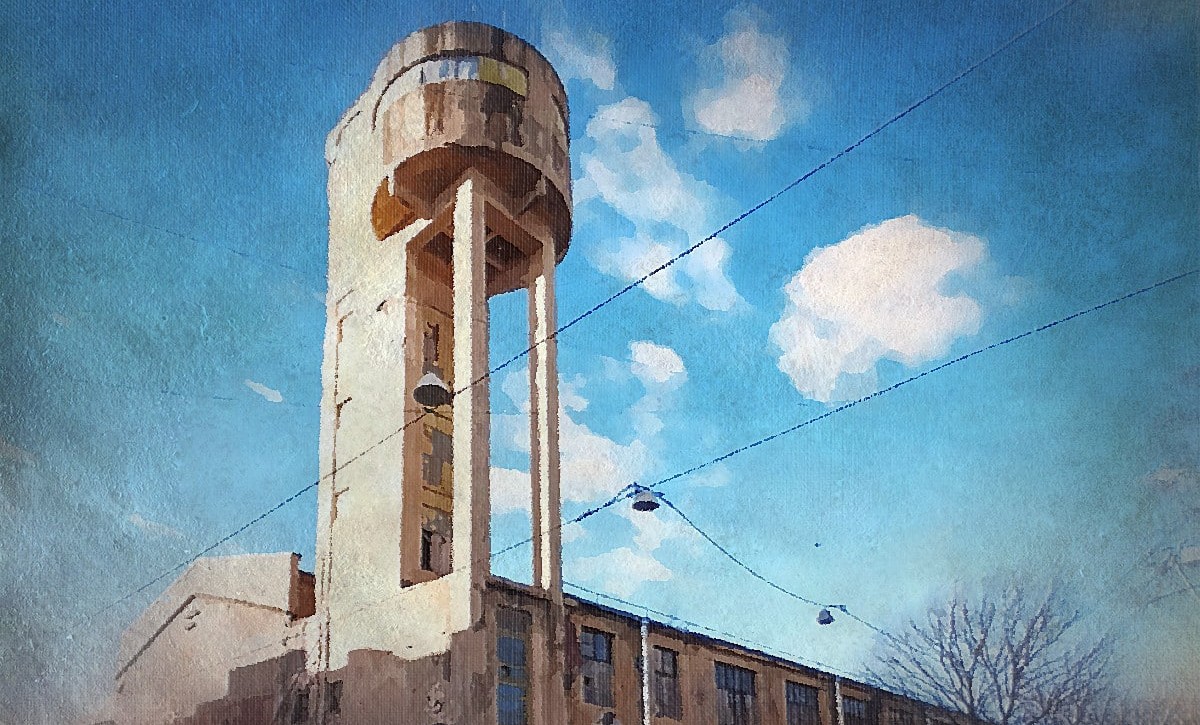
In this sense the tower of the Krasny Gvozdilshchik plant is unique. It is the only surviving building by the outstanding educator, methodologist, designer, and one of the most enigmatic architects that has come down to our day almost in its original appearance.
Let us approach the object of our admiration more closely: the dynamic composition of the ensemble is built on a sharp contrast between the light vertical of the tower and the rope shop building stretched along the 25th Line. For the longitudinal façade of the shop the theme of pylons with wide openings was chosen. Its final design was refined by architect M. D. Felger and engineer K. V. Sakhnovsky. They preserved the previous structural basis, but the realized building turned out simplified and utilitarian, and was later distorted by later alterations.

Unlike its neighbor, the water tower looks more authentic. Except for small changes (ribbon glazing of the upper lantern), it fully matches the architect’s original idea, embodying his Constructivist fantasies and avant-garde thinking. Here the form-making capabilities of the most progressive material of those years — reinforced concrete — are realized at their best. The narrow tall shaft of the tower, containing a metal staircase, lifts the water tank volume skyward; its rounded projection rests on two thin columns. The contrast of rigid rectilinear and smooth curvilinear forms enhances the plastic expression of the tower’s laconic composition. The architect uses two simplest geometric forms here — a parallelepiped (stairwell) and a cylinder (water tank). They are joined abruptly, without softening or transitions. The axes of the bodies are offset so that the cylinder volume projects sideways, resting on two thin support columns. The tower barely resembles prerevolutionary centric structures of this kind, which were distinguished by brick heaviness, solid forms, and ornate façade relief. The expression of the building is complemented by figurative characterization. The architect appeals to a graphic image of the enterprise reflecting its production profile: the water reservoir denotes the nail head, and the upward-stretched base — the body of the nail — the foundation of any construction undertaking.
The tower must have looked especially colorful right after its construction in the early 1930s, reflected in the waters of the Maslyany Canal that had existed here since the mid-eighteenth century. It circled the eponymous buyan in a U-shape and presumably lasted until the 1960s.
Incidentally, a similar architectural form can be seen in other water towers: in the once Finnish city of Sortavala near the railway station of the same name (1942, architect Jarl Unger), and also in Yekaterinburg (the so-called White Tower by architect Moisei Reisher, 1929–1931).
However, it was Yakov Chernikhov’s tower that received a visit from the famous British architect of Iraqi origin, a classic of modern High-Tech architecture, Zaha Hadid, in 2004. It is known that Yakov Georgievich’s books on architectural theory were always a required item on her desk.
It took another ten years for regional authorities to properly appreciate the futuristic reinforced-concrete nail firmly driven into the historic industrial quarter of Petersburg. In 2014 the building was entered in the list of cultural heritage sites of regional significance. The tower was also included by KGIOP in the “List of newly identified objects of historical, scientific, artistic, or other cultural value.” In 2021 plans were announced to restore this Constructivist monument and adapt it as a business center.
We invite you too to trust the impeccable taste of the creators of the future and go to Vasilyevsky Island to see with your own eyes the symbol of avant-garde industry now experiencing a second birth.