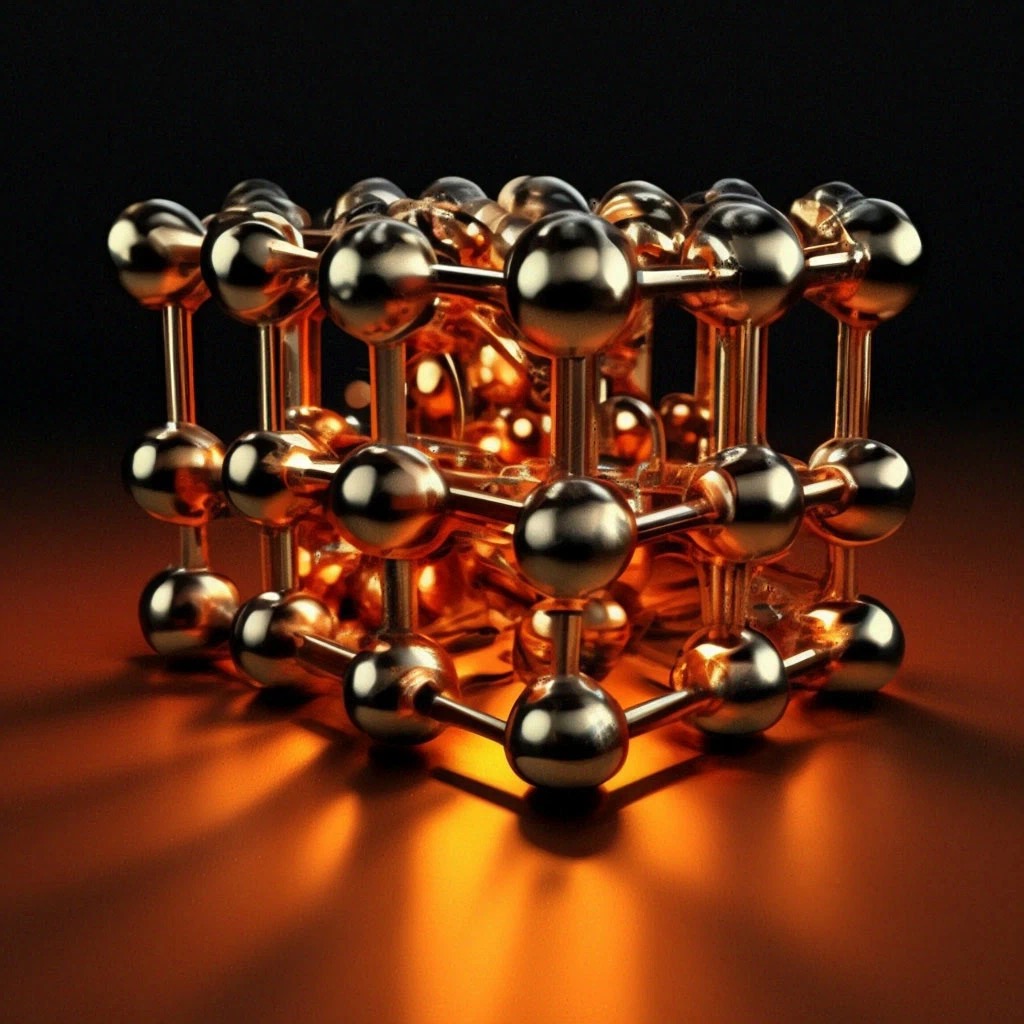
Metals and alloys, despite all their diversity, have one common trait — a crystal structure. This means that material atoms are located at certain points in space and at a fixed distance from each other. Within one crystal the atom arrangement scheme repeats.
To describe atomic structure the concept of crystal lattice (CL) is used — a spatial grid in whose nodes metal ions (atoms) are located, and between them electrons move freely. The smallest unit of CL is the unit cell. With its help one can build the entire spatial structure of the material by parallel transfers.
Below we will consider main types of metal crystal lattices and tell about their significance in creating new steels and precision alloys.
Main types of metal CL include hexagonal close-packed (HCP) lattice and cubic face-centered (FCC) and body-centered (BCC). Each of them is characterized by coordination number (number of nearest atoms), distance between them, and packing density, and also reflects properties manifested by metals.
It is a cube consisting of nine atoms: eight of them are located in nodes of the unit cell, and the ninth — at the intersection of diagonals. The BCC lattice is characteristic of such metals as vanadium, tungsten, molybdenum, chromium, and alpha-iron (Feα). In the latter (Feα) this structure exists at temperatures up to 911℃.
Iron-based alloys in which alloying elements are introduced directly into the Fe lattice have exactly such a crystal structure at room temperature. This is characteristic of carbon and low-alloy steels (65G, 65S2A, 70S2KhA, U8A), as well as iron-based alloys with a fairly large addition of another chemical element, for example cobalt, as in precision soft magnetic alloy 27KKh.
Like BCC, the FCC lattice is a cube but with additional atoms. Element particles are located not only in CL nodes and inside the cube (9 in total) but also in the middle of each face at the intersection of diagonals (6 in total, 14 altogether). The face-centered cubic structure is characteristic of such metals as aluminum, silver, gold, nickel, copper, as well as gamma-iron (Fe𝛾) at temperatures from 911℃ to 1,392℃. In addition, most nickel-based alloys possess an FCC lattice, for example precision soft magnetic alloy with high magnetic permeability 79NM.
The HCP lattice has a complex structure that is a hexagonal (six-sided) prism. The unit cell consists of 17 atoms. They are located in nodes of each base as well as in their centers (14 atoms in total). In the middle of the prism there are three more atoms forming an equilateral triangle. The hexagonal close-packed structure is characteristic of such materials as manganese, zinc, titanium, cobalt, and cadmium.
The crystal lattice is the main building block of materials determining their structure and properties. Understanding types of crystal lattices is important for developing new steels and precision alloys for several reasons described below.
Knowledge of crystal lattice type makes it possible to determine the precise material structure including arrangement of atoms or ions inside it. This is extremely important for understanding special material properties such as strength, elasticity, and electrical conductivity. For example, precision soft magnetic alloy 49K2FA demonstrates ordering processes that require a special technological approach in production. Understanding crystal structure of such materials makes it possible to precisely control their properties.
Crystal lattices may undergo various deformations when environmental conditions change or under mechanical action. Knowledge of lattice type helps understand how the material will react to deformations and which properties will be modified as a result of these changes. Research of crystal lattice deformations opens a path to developing materials with improved mechanical properties and elevated resistance to various effects.
Knowledge of material crystal lattice type allows engineers and scientists to design new materials with desired properties. Relying on knowledge and understanding of structure and properties of existing materials, they can create innovative alloys with unique characteristics. An example may be the new material KhN53MTYUB (NN 178) developed by the PZPS R&D Center, which is distinguished by improved mechanical and thermal properties.
So, knowledge of types of material crystal lattices is a key factor in creating new alloys. It makes it possible to determine their structure, predict and control their deformation behavior, and also develop materials with optimal properties for various application areas. Understanding the crystal lattice becomes an integral part of modern materials science and technology, opening new horizons for innovations and progress in materials science and engineering.
If your projects require developing new materials or researching applied steels and alloys, the PZPS research center invites you to cooperate. You can learn more about activity directions, analytical capabilities, and cooperation terms by calling +7 812 740-76-87 or leaving a request on the website.