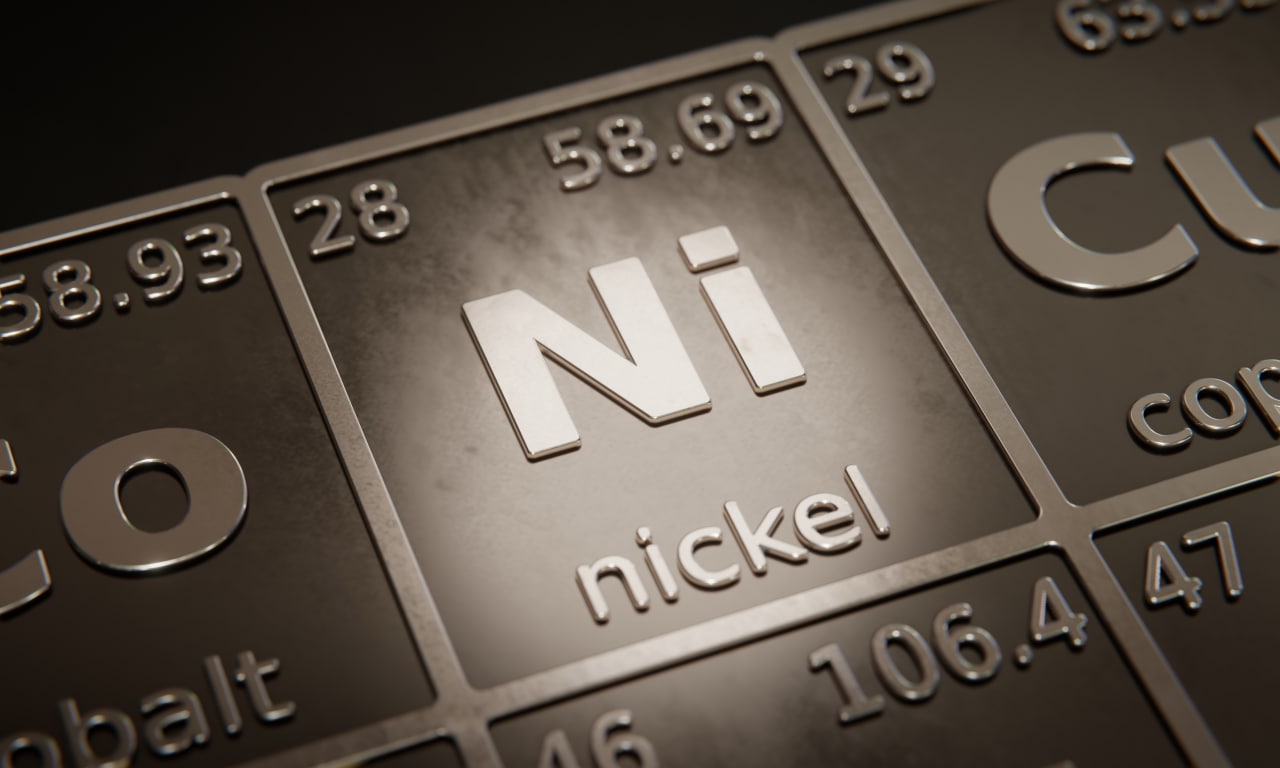
Nickel (Ni) is the 28th element of D. I. Mendeleev’s periodic system. It belongs to heavy metals. It has a melting temperature of 1,450°C and boiling temperature of 2,730…2,850°C. It is resistant to corrosion in aqueous, alkaline, and acid environments. When heated in air above 800°C Ni reacts with oxygen and is covered with a thin oxide film (NiO) that protects it from further oxidation. It is a ferromagnet, i.e. it has magnetization in the absence of an external magnetic field.
In nature nickel occurs in pure form in meteorites. In the Earth’s crust it is contained only in a bound state as sulfide, silicate, magnesium, arsenic, oxygen, and other compounds. Geologists estimate the total amount of Ni on the planet at 135 million tonnes, of which about 50 million tonnes are proven. Main deposits are concentrated in Russia, Canada, Indonesia, South Africa, Cuba, Greece, and New Caledonia.
The first mentions of nickel appear already in historical chronicles of ancient China (235 BCE). They speak of packfong — “white copper,” now known as cupronickel (an alloy of copper, nickel, and zinc). Chinese craftsmen used the alloy to make jewelry and luxury items. In Europe packfong became known only in the 13th century and was initially used for minting coins. Later it began to be used for finishing weapons and creating jewelry.
Officially the new metal was discovered in 1751 by Swedish chemist Axel Fredrik Cronstedt. When studying minerals the scientist obtained a green oxide from which, by chemical reduction, he isolated a previously unknown white metal with a silvery luster. Two decades later another Swede — Torbern Olof Bergman — published studies proving that the material obtained by Cronstedt was not a mixture of several metals but a new separate element. At the end of the 18th century German chemist Jeremiah Benjamin Richter drew a line under scientists’ research by obtaining pure metallic nickel from nickel vitriol.
Until the 1880s world nickel mining did not exceed several hundred tonnes per year. But everything changed after rich nickel ore deposits were discovered on the New Caledonian islands (southwestern Pacific) and in Sudbury (Canada). In the 1910s mining rose to 1.5 million tonnes of ore per year. At the same time huge demand for the metal arose in the military industry: nickel alloys began to be widely used to manufacture combat guns and shells for them, warships, portable shields, and other armor.
In modern industry nickel is used:
And this is only a small list of where pure metallic nickel or alloys from it are found.
Thanks to its high anti-corrosion, heat-resistant, electrical, and magnetic properties, nickel found wide use in jet technology, including in nuclear reactor designs. But due to its high cost pure nickel is used quite rarely: mainly it is used as an alloying addition in producing stainless steels (more than 65% of all mined Ni) and non-ferrous metals (15–20% of annual mining). In alloy compositions it makes it possible to obtain materials with various physical-mechanical properties:
Pure nickel is produced as cold-rolled strip, sheet, band, tube, bar, or round, as well as nickel foil, wire, thread, and powder. In addition, Ni is often used for nickel-plating other metals: with its help a special coating is created that protects the material from corrosion.