In the first part of the “Alphabet” we gave the main terms that help better understand metallurgical production; in the second we described two dozen of the most important metal properties. In this article we will talk about the processes that result in the required alloy.
Annealing — a thermal cycle including heating and holding the material at a certain temperature and then cooling at the required rate, to reduce hardness, improve machinability, facilitate cold forming, create the desired microstructure, or obtain needed mechanical or other properties.
Finishing — heat treatment, cooling, galvanizing, cutting to size to give steel certain qualities.
Heat treatment — heating and cooling a steel product to obtain desired characteristics or properties.
Thermomechanical treatment — a production method giving steel the desired strength and other properties through a careful combination of mechanical processing (rolling) and temperature control.
Galvanizing — protecting metal from corrosion onset and development by applying a coating to its surface whose chemical composition may contain up to 95% zinc. Performed by various technologies (hot, cold, galvanic, gas-thermal, thermodiffusion methods), each used in certain situations and having both advantages and disadvantages.
Galvanization — the process of applying a protective zinc coating to steel or iron to prevent rust or corrosion.
Slitting — a metalworking process usually used to cut a wide steel coil into one or more narrower ones.
Formatting — cutting steel plates or sheets to sizes required by the customer.
Tempering — heating to 200–700°C to make steel tougher and less brittle.
Shot blasting — cleaning and removing scale from metal with a jet of abrasive powder or shot. Shot may be sand, small steel balls of various diameters, silicon carbide granules, and other suitable particles.
Sintering — a process in which iron-bearing particles combine into small granules.
Microalloying — adding a small amount of alloying elements such as niobium, vanadium, or titanium to improve yield strength and tensile strength in advanced fine-grained steels.
Color coating (coil coating) — a process in which cold-rolled strip is additionally coated with organic paint to improve corrosion protection and obtain a decorative, pleasant appearance.
Refining — removing impurities from metals and alloys (usually while they are in liquid state) to raise quality. There are physical (liquation (seigeration), precipitation of intermetallic compounds, distillation or distillative refining (poling)), chemical (selective oxidation and sulfidation, chlorination), and electrochemical (electrolytic refining — electrolysis of aqueous solutions or melts) refining methods.
Vacuum degassing — a steel refining process using a unit that removes oxygen, hydrogen, and nitrogen under low pressure (in vacuum) to produce high-quality steel.
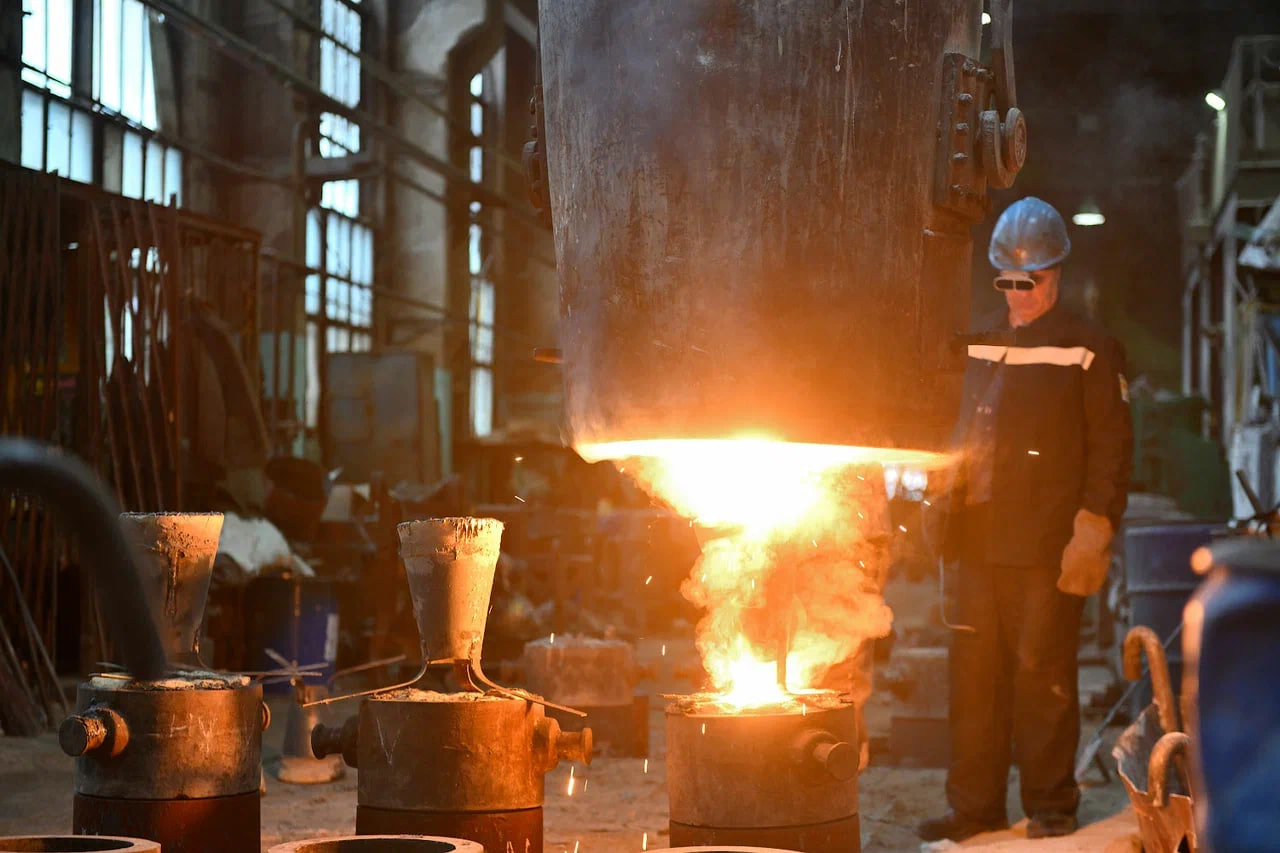
Continuous casting — a process in which molten metal solidifies into a semi-finished product, bloom (a steel billet of near-square section) or slab (a thick rectangular steel billet with a large width-to-height ratio (up to 15) for subsequent rolling.
In the next “Metallurgy Alphabet” article we will continue the topic and consider which machines and tools are used to carry out the described processes and obtain materials with the needed properties and high quality.
These and other terms from the metallurgical industry in alphabetical order are presented in the Metallurgy Alphabet section.