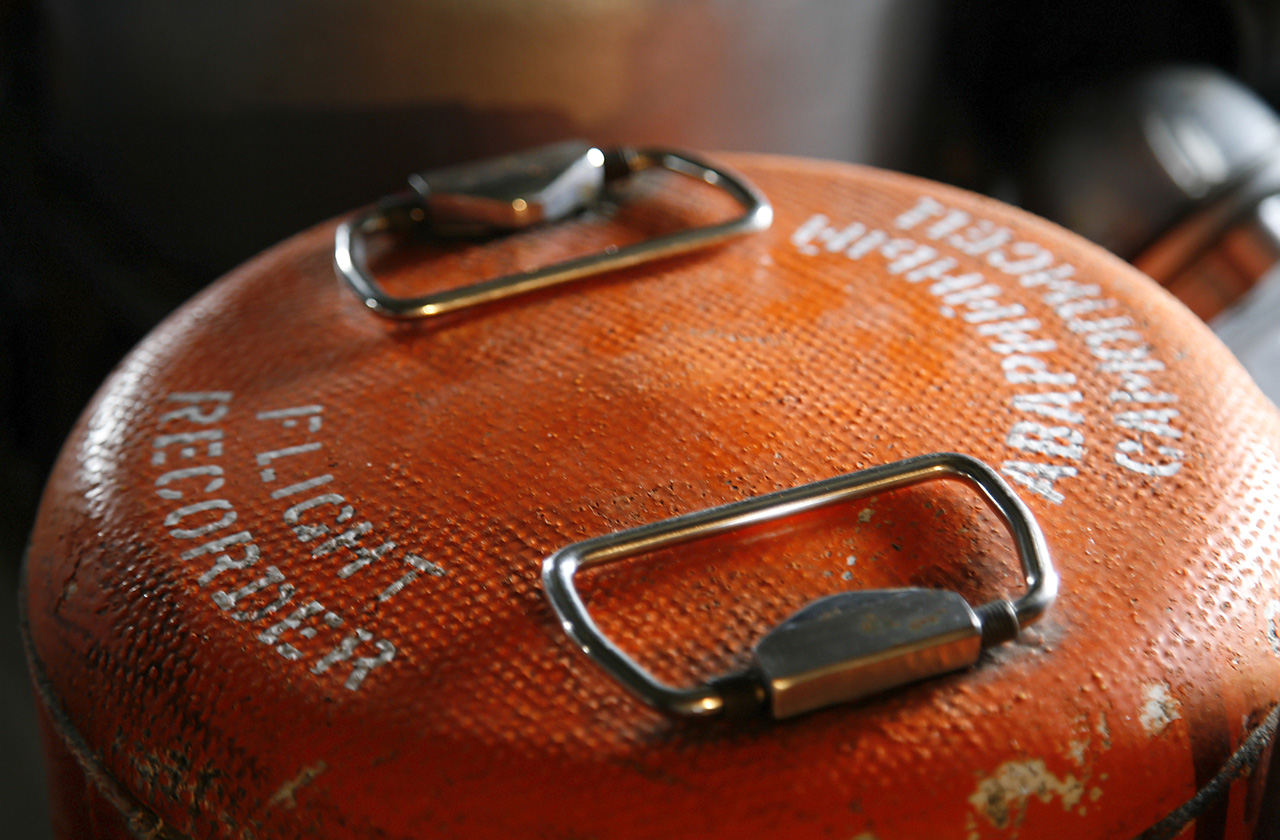
Most likely, the creators of the popular TV show borrowed the title idea from a real black box — a flight recorder that must be present on every aircraft. It is also called a flight data recorder because, by a set algorithm, all necessary flight information is written to the device. These instruments, resistant to the most extreme situations, are among the most important tools in aviation.
When a non-standard situation, accident, or disaster occurs, information that can clarify what happened is recovered specifically from the black box. In other words, aviation investigators will also unravel the causes of what happened and answer: what is in the black box?
The idea of a device for storing flight data belongs to Australian scientist David Warren. When David was 9 years old, his father died in an aviation accident on a flight from Tasmania to Melbourne. Some sources claim that this tragic event triggered development of the flight recorder.
But there is a more plausible version. From 1952 to 1983 Warren worked as a principal research scientist at the Aeronautical Research Laboratory of Australia’s Defence Science and Technology Organisation. In 1953 a disaster occurred involving the world’s first British jet passenger airliner, the De Havilland Comet. David Warren took part in investigating the tragedy as a chemist specializing in rocket and aviation fuel. While clarifying the circumstances of the disaster, the scientist visited an exhibition where he saw a pocket Dictaphone. That is when the inventor thought that recording crew communications in an emergency could greatly help in such investigations.
It should be said that devices that became forerunners of flight recorders began to be used in aviation around 1947. However, these instruments recorded only flight parameters and did not record crew communications. Recording was usually made on one-time photographic film, which was not very convenient. Warren proposed using magnetic tape suitable for repeated rewriting in recorders. This proved such a successful solution that metallized tape or special recording wire is still used today.
The introduction of sound recording played a major role in the quality of aircraft accident investigation. Investigators were helped especially not by listening to pilots’ and crew members’ conversations, but by recorded extraneous sounds. Circuit-breaker clicks, atypical engine hum, and much else became important clues in investigating many aviation incidents.
David Warren named his invention the “ARL Flight Memory Unit.” The first device prototype was presented in 1956. In 1960 the Australian government approved a rule requiring installation of emergency recorders on all passenger aircraft. Within a few years other countries followed this example.
The term “black box” was first used by the British during World War II and referred to a secret development — radars and radio and electronic navigation aids in British aircraft. These devices were placed in black boxes protected from external effects.
According to another version, a journalist coined the name after seeing a charred, half-melted object pulled from the wreckage of a crashed and burned aircraft. The notion appeared in one of the reports from the crash site and spread from there.
Aviation experts prefer another term instead of “black box” — “electronic flight data recorder.” In reality flight recorders are painted fluorescent orange (they may also be red or yellow). This makes them faster to find at a crash site.
Moreover, a black box is not a box at all. The device has a spherical or cylindrical housing.
A black box may consist of either two separate devices or one that contains:
1. The flight data recorder. This unit stores information on heading, altitude, fuel, speed, turbulence, cabin temperature, and other important parameters. In total about 100 different values can be recorded.
2. The cockpit voice recorder. It records pilots’ and crew members’ conversations, engine sound, emergency alarm activation, and other sounds.
In addition, flight recorders may be operational or emergency. The former are intended for ground specialists to monitor crew actions. For convenience they are installed in the cockpit; the housings are not specially protected, so in an accident such instruments are very often damaged. Emergency recorders are the very black boxes. They become the source of information for identifying the causes of an aircraft crash.
For many decades the key element of a traditional flight recorder has remained magnetic tape — it stores a recording of all flight parameters. Since the 1990s some companies began using more modern information storage tools in black boxes — solid-state drives (flash memory). However, modern drives also have a number of drawbacks, so recorders with magnetic tape continue to be produced, though not in the same numbers as before. In particular, domestic aviation still uses classic black boxes on aircraft such as the An-24, An-26, Su-25, Tu-95, Tu-134, Tu-154, and others.
In St. Petersburg there is one of the few enterprises that manufacture magnetic tape for classic-type black boxes — the St. Petersburg Precision Alloys Plant. The plant has modern equipment that enables a complete technological cycle of strip manufacture — from charge materials to a finished product several microns thick. The key element in a flight recorder is made of precision alloys, and manufacturing the tape requires meeting a number of quite stringent conditions and requirements. The success of investigation and prevention of aircraft accidents depends precisely on the quality and preservation of the information medium.
In 2014, after the MH370 Malaysia Airlines disaster (the aircraft disappeared from radar on a regular flight between Kuala Lumpur and Beijing, with 239 people on board), calls arose in expert and civil circles to develop a system that could send flight information to the ground in real time. In the case of Flight MH370, investigators would have known exactly where to look for the missing aircraft.
Perhaps in the near future such a transmission method will replace the traditional black box. For example, Aero Mechanical Services has already developed and uses the Flight Stream system, which sends flight data to the ground via satellites. However, for a number of reasons it has not yet become widespread.
Another possible development direction for flight data recorders is introducing video recording of what happens outside and in the cockpit. While the first approach is generally solvable, pilots themselves oppose recording inside, citing a right to privacy that would be violated in this case.
Until humanity invents a better way to travel long distances in a short time than by aircraft, flight recorders in one form or another will exist for a long time. One can only hope that these devices will be recovered by specialists for their intended use as rarely as possible.