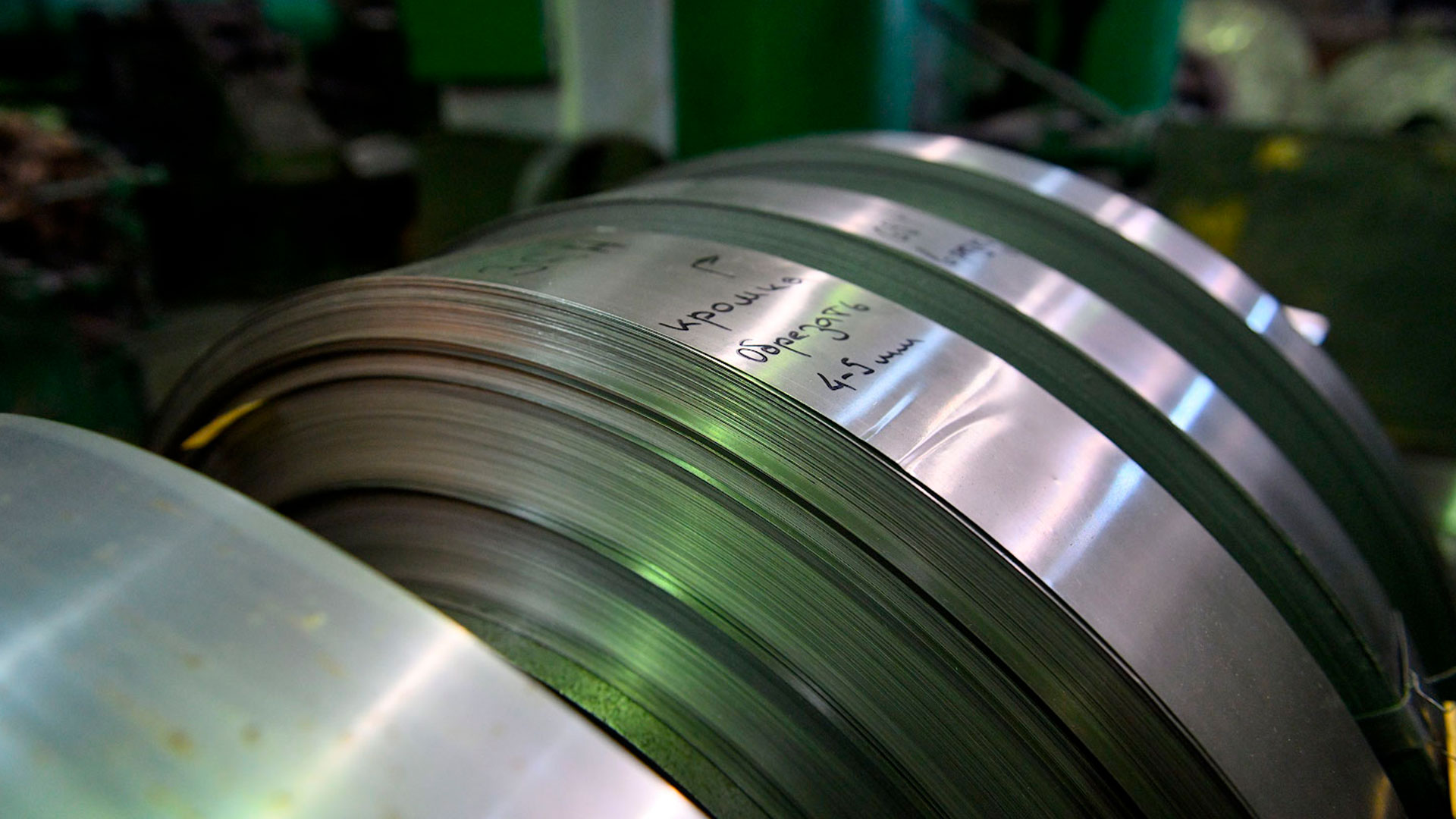
The World Steel Association names more than 3.5 thousand different grades, each possessing unique characteristics. Such diversity makes it possible to select the necessary material for a specific application area — construction, household appliance production, transport, and so on.
At the same time chemical composition of steel plays an important but not the only role. Even if grades and specifications are the same, production processing — cold or hot rolling — has a substantial influence on final products. Knowing which material to use will help avoid overconsumption of raw material and also save time and money on additional processing.
The difference between these two materials lies in the processing technology at production. Hot-rolled steel is obtained in the process of metal processing using high temperature. Cold rolling is conducted at a temperature close to room temperature. In essence this is the same hot-rolled steel that has undergone additional processing to obtain more precise dimensions and better surface quality. Instead of heat, mechanical stress is used to change the metal structure. Work hardening can increase metal strength by up to 20% and also improve surface quality.
Hot rolling is conducted at a temperature above 926°C — this value is above the recrystallization temperature of steel. Under such conditions the metal can easily be given shape, which facilitates work with the material.
The process occurs as follows. The blank — a large rectangular piece of metal — is heated, after which it is directed to preliminary processing. There the blank is flattened into a coil. It is held at high temperature, after which it is run at high speeds through a series of rollers to achieve final dimensions. For sheet metal the steel rolled product is coiled into rolls and cooled. For other shapes such as bars or plates, materials are sectioned and packaged.
This kind of metal has its advantages and disadvantages. Hot-rolled steel is as a rule cheaper than cold-rolled due to shorter duration and simplicity of the manufacturing process. At the same time when the material cools, the steel deforms slightly: slightly rounded edges and small distortions at corners appear (perfectly square ones will not work). Another minus is a rough, “scaly” surface (to remove it, additional processing is required — grinding or sandblasting).
Hot-rolled steel is used where precise shapes and tolerances are not required, for example in producing agricultural equipment, for manufacturing railway tracks, and so on.
Such products are usually harder and stronger than standard hot-rolled metals and have greater corrosion resistance. Cold rolling yields steel with smaller dimensional tolerances and a wider range of surface processing. The term “cold-rolled” is mistakenly used for all products, whereas in fact this name refers to rolling of flat sheets and coils.
Before the start of cold rolling the metal must first be “pickled” — scale formed during hot rolling is removed from the material surface in an acid bath. Then the steel is cooled to ambient temperature, after which it is passed through cold rolls at a temperature below the recrystallization temperature. After that annealing is conducted — a process that relieves steel stress and also raises hardness and yield strength.
At the exit from the cold rolling mill rolls the metal is checked using thickness gauges. Modern cold rolling mills are able, using an X-ray thickness gauge, to achieve high production speed of sheet steel meeting many thickness and uniformity requirements. Thickness gauges detect and correct thickness deviations in real time, which makes it possible to obtain high-quality steel strip.
Machines for manufacturing this kind of rolled product are designed so as to allow steel to turn and be pushed back through rolls that gradually come closer until the corresponding thickness is achieved. With sequential use of three to six pairs of rolls a multi-stand mill can reduce thickness by a specified amount until the desired one is achieved.
Usually the metal obtained has a thickness from 0.12 to 2.5 mm. On modern efficient cold rolling mills pickled sheets or strips can be rolled at a speed of up to 4 m/s, and continuously operating tandem mills can produce up to 2.5 million tonnes of cold-rolled product per year.
Like any material, this kind of rolled product has its pluses and minuses. Among the former one can include quality, well-processed, smooth surfaces with smaller tolerances. Cold-rolled bars come out of correct shape, have clearly outlined edges and corners, and tubes are distinguished by concentric uniformity and straightness. Cold rolling also makes it possible to bend finished materials very easily. The ability of materials to resist destruction makes them suitable for various applications where the material must be bent and formed.
Among disadvantages of cold rolling — steel cost is higher compared with hot rolling, as well as insufficient diversity of cold-rolled shapes (sheets, box-section shapes).
Cold-rolled stainless steel as raw material finds wide application in medical, aerospace, and automotive equipment. Household appliances and furniture are made from it; in construction it is used for erecting garages, steel canopies, and other industrial buildings.