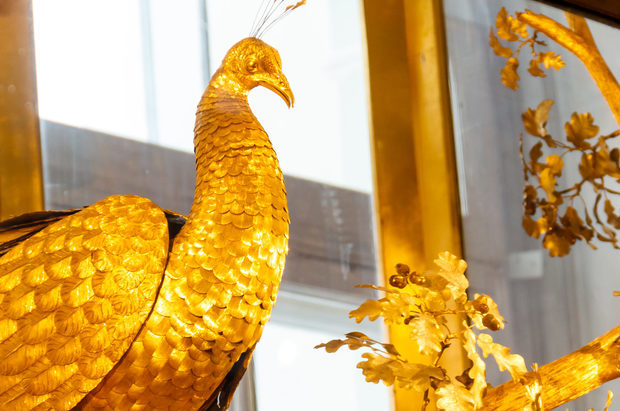
The Hermitage, one of the world’s greatest museums, is home to thousands of works of art. Its collection includes not only paintings and sculptures but also remarkable artistic objects, among which the Peacock Clock holds a special place. This unique automaton, created in the 18th century, is not merely a clock mechanism but a symbiosis of refined craftsmanship and technical genius.
In artistic objects the choice of each alloy is carefully considered, taking into account aesthetic and functional requirements of a specific project. But the materials most often used include:
True works of art must have not only aesthetic beauty but also durability and meet the functional requirements of a specific project. In the case of the Peacock at the Hermitage, precision alloys were used to achieve maximum reliability and accuracy of operation, in particular for making some spring elements of the clock mechanism.
The Peacock Clock is a true theater where each figure comes alive when the mechanism is wound. The process begins with the awakening of the symbol of night — the Owl. Its graceful movements in time with the ringing of bells located near the cage create a remarkable atmosphere.
Then the Peacock — symbol of the sun — takes center stage. Its exquisitely unfolding luxurious tail with golden plumage emphasizes the beauty of the artwork and the creators’ skill. Although the mechanism imitating the peacock’s cry does not work today, its outward beauty fascinates museum visitors no less.
The performance ends with the Rooster, symbolizing the beginning of a new day. Its crow, reproduced by a special organ, ends the clock performance, underscoring the character of each moment of time.
The composition runs for 4 minutes in total. The construction itself consists of 4 mechanisms, three of which drive the bird figures and the fourth is the clock.
The Peacock Clock was created in England in the 1770s by master James Cox. According to legend it was ordered by Count G. A. Potemkin for the Hermitage of Empress Catherine II. German master Friedrich Jury was responsible for the clock mechanism itself.
Interestingly, the Peacock survived not only evacuation during the Great Patriotic War but also subsequent restorations. It became the only large 18th-century automaton to reach our days in working condition without changes.
In 1994 it was decided to create a clock laboratory at the Hermitage to carefully preserve and maintain the rich heritage of clock art. The latest restoration of the Peacock in 1995 under Yury Petrovich Platonov underscored the importance of preserving this remarkable artwork for future generations.
The Peacock Clock at the Hermitage is not merely a mechanical device for measuring time — it is a true masterpiece of artistic art embodying the craftsmanship and magnificence of 18th-century technology.