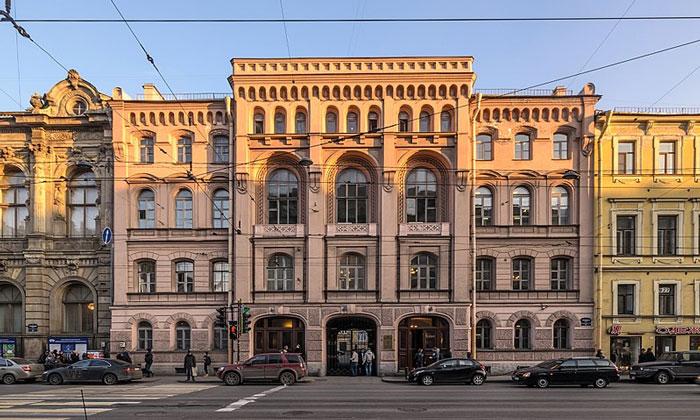
Rich in whimsical houses of the Art Nouveau era, like medieval castles, mixed with strict specimens of Soviet architecture — Liteyny today is used to hourly car jams, the hum of cars, shouts of pedestrians, endlessly replacing catering points, shops for every taste and wallet. Here there is a hospital and a library, a theater and a museum, a vodka bar and the “Big House” — the FSB administration building. Streets branching from the avenue are named after writers, poets, and Decembrist rebels. On them, as if by agreement, façades of foreign state consulates gathered together and look out, and nearby — old mansions full either of expensive hotel rooms or shabby communal apartments.
The Northern War was underway; the country needed armament. In 1711, in young and rapidly developing St. Petersburg, Peter I ordered organizing production of cannon guns and everything related to them. For this on the southern bank of the Neva, beyond Bezymyanny Erik (now called the Fontanka River), the Foundry (or Foundry-Cannon) Yard was arranged. Thus Liteyny Prospect got its name, which then was only a small clearing connecting the new enterprise with the “Great Perspective,” i.e. Nevsky Prospect.
Construction of the Foundry Yard was supervised by engineer V. I. de Gennin, and then by an even more famous associate of Peter — General Feldzeugmeister Jacob Bruce. Right there, for producing and storing artillery guns, ammunition, and kit, the Arsenal was established, which together with the Foundry-Cannon Yard quickly grew over with many technical buildings and eventually turned into the second largest industrial enterprise of St. Petersburg in the 18th century after the Admiralty.
Already in 1713 the Foundry Yard released the first copper cannons. At first they were cast with an already ready barrel opening, but imperfection of melting and casting metal in those years affected irregularities on the inner surface of cannon barrels, which influenced shooting quality. For this reason in the 1720s it was decided to first manufacture “blind” guns and then drill an opening in them with special machines driven by horse traction. But one cannot go on like that for long, as they say. And here, according to one version, the brilliant engineer in turning production Andrey Konstantinovich Nartov came to the aid of artillery. His machines were driven by water, for which the Oblique Dementyev Canal was dug from the Foundry Yard to the Fontanka. True, water pressure proved insufficient, and by 1765 the canal was filled. Today Gunsmith Fedorov Street runs in its place.
A “prosperous” locality
The Cannon Yard cast not only weapons but also, for example, church bells. Manufacturing various accompanying products required work of different specialists: carpenters, turners, blacksmiths, locksmiths, spinners, and even fuse welders worked at the enterprise. The territory grew, filling with auxiliary workshops, and workers settled right there, gradually forming the Foundry Sloboda around the clearing. Thus the entire locality soon began to be called the Foundry Part.
Residents of the Foundry Sloboda were working people, Moscow and Tula gunsmiths, captive Swedes, and convicts employed in production. At the end of Liteyny Prospect even a peculiar labor exchange formed, popularly nicknamed the “lousy exchange,” since mainly the poor seeking any side work gathered there.
Contingent usually determines the social and cultural environment; however the Foundry Part never bore the bad fame inherent to districts of Sennaya Square or Ligovsky Prospect.
Initially Peter I favored this locality for a property very useful for the local climate: in 1706 a strongest flood occurred in Petersburg, however the elevated section of the Neva east of the Fontanka remained untouched. Other catastrophic floods of subsequent centuries also did not damage the Foundry Part.
On this fortunate in all respects place, next to the Foundry Yard, Count Jacob Vilimovich Bruce built his own mansion, and after him Peter himself settled, ordering houses for his closest relatives to be placed here. Thus for some time the Foundry Part became a place of residence of the royal family.
In the era of palace coups the locality was transferred to needs of officials and employees of various chancelleries, as well as officers of the Life Guards Horse and Preobrazhensky Regiments.
In the second half of the 19th century production premises of the Arsenal were transferred to the Vyborg Side, and the rarest historical guns from its warehouses went to the Artillery Museum. The Cannon Yard also long disappeared, and with it wooden workers’ houses. Of foundry production in this district only the name remained. The Foundry Part turned into one of the most prosperous and well-appointed in the city. The prospect was built up with architectural solutions bold for those times in Art Nouveau and eclectic style, becoming a fashionable central street of Petersburg.
Liteyny was favored by aristocrats, intelligentsia, and book publishers. The flowering of this district’s popularity and a new chapter of its life is closely linked with the Silver Age of Russian literature. Here in the Fountain House Anna Akhmatova lived; in the famous Muruzi house Maxim Gorky, Alexander Blok, Nikolai Gumilev visited, and later Joseph Brodsky occupied his one and a half rooms.
With the advent of Soviet power Liteyny was renamed Volodarsky Prospect, however the name did not take root, and already in the blockade years it was decided to return its former name. It is worth noting that in the postwar period as well Liteyny Prospect remained famous for abundance of book and antiquarian shops, some of which still exist.