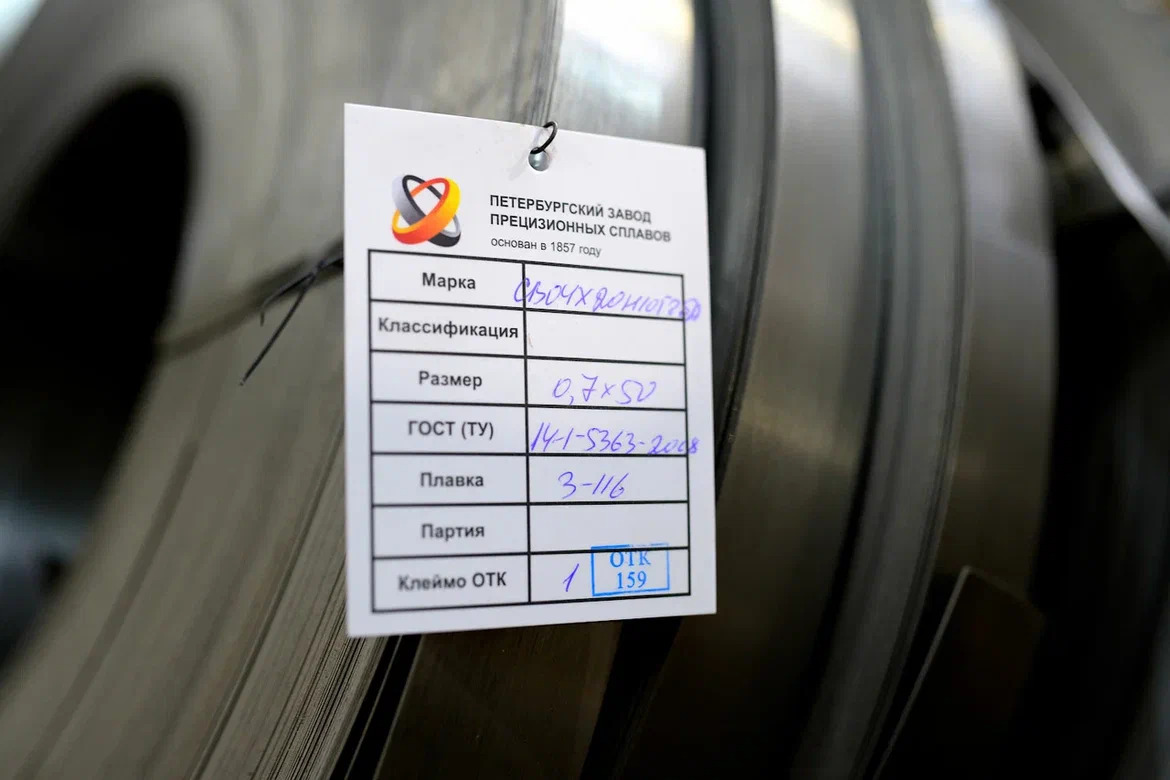
Marking of alloy steels in Russia is a strict, detailed system that makes it possible to quickly and accurately determine the key characteristics of metallic materials. It includes letter and number designations that reflect key chemical elements and their quantitative values, as well as alloy production methods, which simplifies material selection for specific tasks in various industries.
A unified marking system is important for several reasons:
Thus, a unified marking system is an important tool that promotes safe use of materials and more effective interaction among participants in the industrial market.
In the metallurgical industry of the Russian Federation, a special alphanumeric method is used for naming alloy steels. Marking reflects chemical composition, which determines the main properties of materials. This helps specialists quickly determine an alloy's purpose and service characteristics. The system includes several key rules and designations that are important to understand in order to navigate the classification of alloys and steels.
Each alloying element in the marking is designated by a Cyrillic letter. It is important to know the key values for correct understanding of an alloy grade (Table 1).
Table 1 — Alloying elements and their designations

Besides nitrogen, the letter A, when it stands at the end of a grade, indicates high material quality — a minimal amount of harmful impurities in its composition.
Marking of structural steels begins with an indication of carbon (C) content. The first two digits denote the percentage of C in hundredths of a percent. For example, steel 70 contains 0.70% carbon. This makes it possible to quickly assess strength and hardness levels.
For tool steels the marking approach is somewhat different. Here the digit before the letters denotes carbon content in tenths of a percent. If the amount of C is 1% or more, this digit is not indicated. Thus, tool steels can be immediately distinguished from structural steels.
When the content of a particular alloying element in alloys exceeds 1%, a digit denoting its percentage content is placed after the corresponding letter. If the percentage of the element is equal to or less than 1%, no digit is placed after the letter.
Thus, grade 12Kh18N10 contains 0.12% carbon, 18% chromium, and 10% nickel. If the amount of an alloying element is minimal (for example, chromium less than 1%), it is designated only by the letter Kh without digits after it. For example, 70S2KhA contains 0.7% carbon, approximately 2% silicon, and less than 1% chromium; the letter A at the end of the marking indicates a minimal amount of harmful impurities in the composition.
The average percentage of the main alloying elements in structural steels is presented in Table 2.
Table 2 — Main alloying elements of structural steels

In addition to chromium and nickel, structural steels often include elements such as molybdenum, tungsten, vanadium, and titanium. These additions improve strength, wear resistance, and thermal stability of the material. Using complex alloying elements makes steel more suitable for service under extreme conditions such as high temperatures or aggressive environments.
For some groups of materials there are special designations indicating their purpose and fields of application (Table 3).
Table 3 — Marking of special-purpose steels

Electrical steels have a more complex designation system. For example, in steel grades 20895, 20880, 20860, 20832, 21895, 21880, 21860, 21832, and similar ones, each digit in the marking carries specific information:
This system makes it possible to specify steel parameters precisely for particular tasks such as manufacturing transformers, electric motors, and other electrical devices.
High-quality steels may have additional letters at the end of the marking indicating remelting methods by which material characteristics were improved (Table 4).
Table 4 — Letter designations of remelting methods

These methods improve steel purity, increase its homogeneity and service characteristics, which is important when using materials under extreme conditions — for example in the aviation and space industries.
Individual steelmaking enterprises, such as the Electrostal plant, develop experimental alloys designated as EI (Electrostal research) or EP (Electrostal trial). After the letter designation, the serial number of the new alloy is indicated. These grades are developed for specific purposes, and after successful testing and introduction they receive generally accepted designations. For example, EI 814 was later converted into 17KhNGT — a precision alloy for elastic elements, and EP 414 into 12Kh18N9SMR — a corrosion-resistant steel.
Let us look at the marking of some steels produced by the Saint Petersburg Precision Alloys Plant:
Each grade has unique properties ensured by both chemical composition and processing and melting methods. PZPS produces high-quality products with accurate marking, which guarantees that materials meet all technical requirements and current GOST standards.
The plant's products are widely used in various industries thanks to reliability, durability, and compliance with international quality standards. For additional information on alloy grades produced by PZPS, and to place an order, contact our specialists. We are always ready to offer you high-quality products that meet the requirements of your production.