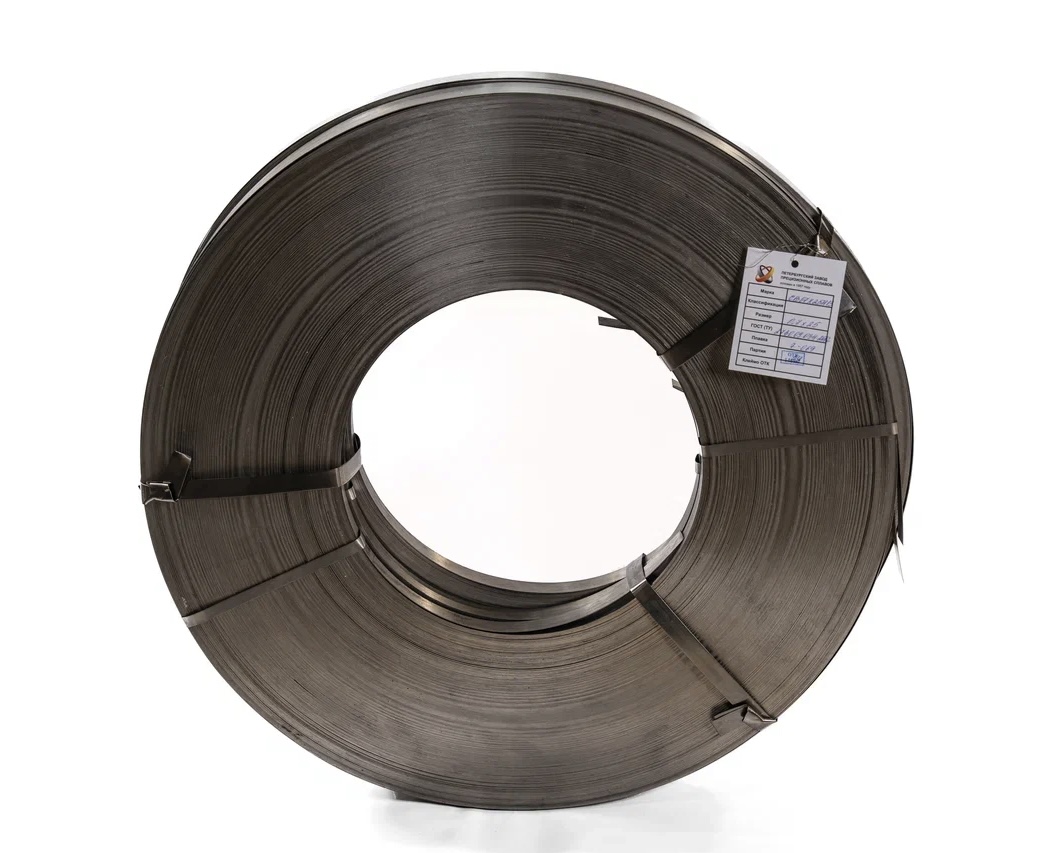
In the modern world of high technology there are materials without which it is impossible to imagine electronics, medicine, or the aerospace industry. They are unnoticed in everyday life, but exactly they determine the reliability of instruments. Such materials include the precision soft magnetic alloy 80NKhS, released at PZPS as cold-rolled strip.
A little history: from laboratories to space
Sometimes dry figures say more about a material than long descriptions.
- More than 70 years in production. The first industrial batches of 80NKhS began to be released back in the 1950s, when radio electronics and instrument engineering were actively developing.
- Geography of application — from the USSR to the USA. The alloy was exported and used in Europe, China, and a number of Asian countries for producing transformers and relays.
- Space as a testing ground. 80NKhS was part of equipment on Soviet satellites and space stations. Its ability to retain properties at −100°C and +150°C made it indispensable in the aerospace industry.
- Medicine and safety. According to estimates more than 40% of Soviet and Russian medical sensors for recording weak heart and brain signals were created exactly using this alloy.
- Stable demand. Despite appearance of new materials, demand for 80NKhS remains high. This is explained by its unique magnetic properties that have not yet been surpassed.
Interestingly, many modern developments in microelectronics still use 80NKhS — sometimes as thinnest strips only 0.02 mm thick.
Chemical composition: balance of elements
Alloy composition is regulated by GOST 10994-74.
- Nickel (Ni) — 79.0–81.5% — provides the alloy base.
- Iron (Fe) — 12.33–16.7% — in combination with nickel forms magnetic characteristics.
- Chromium (Cr) — 2.6–3.0%, silicon (Si) — 1.1–1.5%, manganese (Mn) — 0.6–1.1%.
- Copper (Cu) — up to 0.2%, titanium (Ti) — up to 0.15%, aluminum (Al) — up to 0.15%.
- Carbon (C) — up to 0.03%, sulfur (S) — up to 0.02%, phosphorus (P) — up to 0.02% — controlled in minimal amounts, since their excess worsens magnetic properties.
The combination of these elements makes the alloy both processable and exceptionally sensitive to weak magnetic fields.
Grade decoding
In the marking “80NKhS” are encoded:
- 80 — nickel content in percent;
- N — nickel;
- Kh — chromium;
- S — silicon.
The marking makes it possible to determine key alloy properties based on its composition.
Magnetic properties
80NKhS is classified as a soft magnetic alloy. It possesses:
- high magnetic permeability in weak fields — 20–50·10³ Gs/Oe;
- very low coercive force — 0.01–0.02 Oe.
Exactly thanks to these properties cores from 80NKhS began to be used in the first Soviet satellites. Today it is in demand in aerospace systems, communications, and navigation instruments.
Mechanical and physical properties
When considering physical-mechanical properties of the material it is important to take into account that its structure and behavior depend on processing.
- In the soft state:
- tensile strength (σb) — 540 MPa;
- yield strength (σt) — 145 MPa;
- relative elongation (δ) — 40%.
- In the work-hardened state:
- tensile strength (σb) — 930 MPa;
- yield strength (σt) — 885 MPa;
- relative elongation (δ) — 4%.
- Alloy melting temperature — about 1400°C.
- Alloy microstructure — γ solid solution.
- Magnetic properties differ for different material classes and different strip thicknesses and are regulated by GOST 10160-75.
Heat treatment
Properties of 80NKhS can be regulated by heat treatment. Annealing eliminates internal stresses and improves magnetic properties. Control of heat treatment regimes makes it possible to adapt the material to specific technical tasks.
Applications: from electronics to medicine
The application sphere of 80NKhS is wider than it may seem at first glance.
- Electronics and telecommunications — cores of small-size transformers, chokes, relays, magnetic shields.
- Medicine — sensors for recording weak biosignals, equipment for cardiac monitors and electroencephalographs.
- Aerospace technology — radar elements, navigation systems, and space instruments.
- Microelectronics — thin strips up to 0.02 mm thick for high-precision systems.
- Instrument engineering — magnetic heads, flaw detectors, contactless relays.
Each new application industry only confirms the versatility and high processability of the alloy.
Comparison with analogues
Although 80NKhS has no direct foreign analogues, alloys 1J79 and 1J85 are considered close in properties.
- Advantages of 80NKhS:
- Advantages of 80NKhS:
high magnetic permeability and saturation induction;
- stability of characteristics under different conditions;
- convenience in processing.
- Disadvantages:
- Disadvantages:
high cost due to large nickel content;
- limited production.
These features determine its competitiveness and strategic significance for domestic industry.
Production at PZPS
Petersburg Plant of Precision Alloys releases products from 80NKhS as cold-rolled strip with the following parameters:
- width up to 250 mm;
- thickness from 0.01 to 2.5 mm.
All products conform to GOST and undergo strict quality control. Besides 80NKhS, PZPS releases a wide range of other precision alloys.
For purchasing, contact the sales department or leave a request on the website. Our specialists will help select an optimal solution and answer all questions in detail.