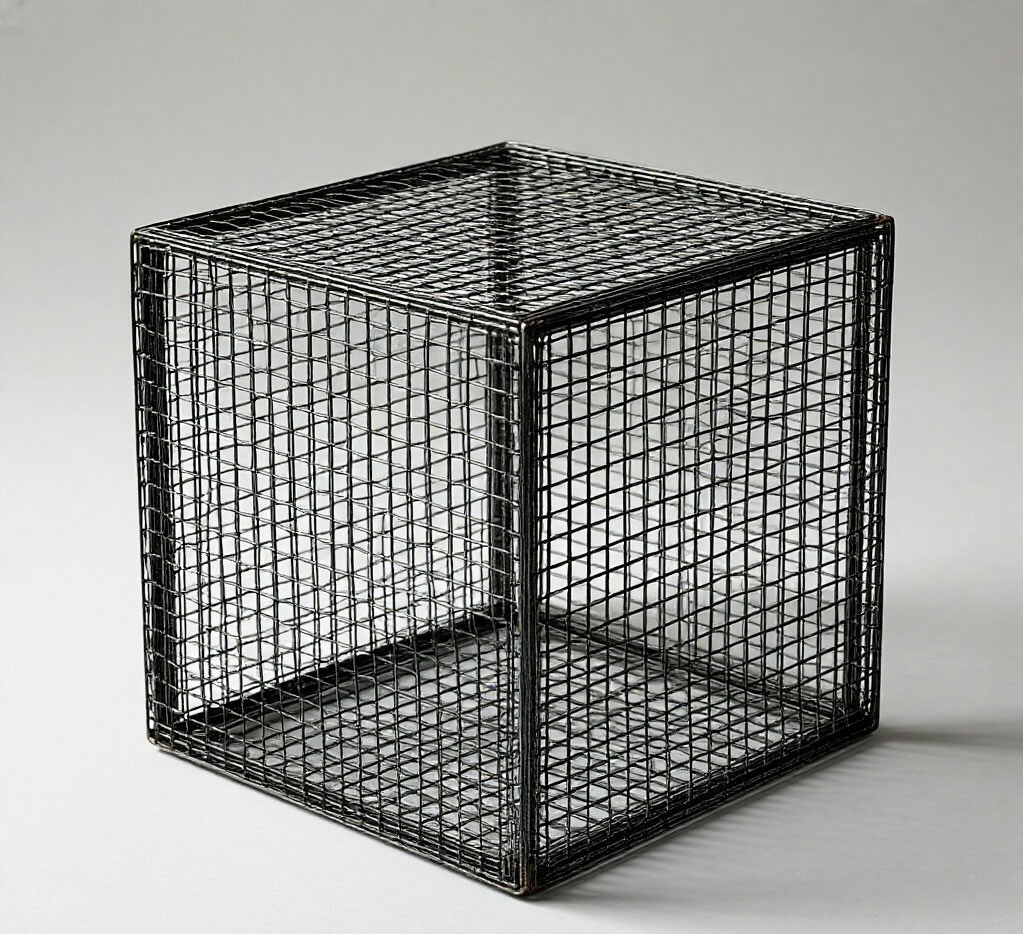
Have you ever noticed that your smartphone suddenly loses signal in an elevator or on board an aircraft, leaving you in digital isolation? This is not a “technical failure,” but a direct manifestation of one of the most elegant laws of physics, discovered nearly two centuries ago. A law that saves lives during thunderstorms, protects millions of devices, and guards the secret data of states and corporations.
In 1836 the British scientist Michael Faraday, knowing nothing about Wi-Fi or mobile communications, conducted an experiment that changed the world. He lined a room with metal foil and, using an electrostatic charge generator, proved that an external electric field does not penetrate inside a closed conductive enclosure. Charge distributes only over its outer surface, leaving the inner space “clean” of the influence. Thus the Faraday cage was born — a device that still works today.
This discovery became the basis of the most important principle of electrostatic shielding, which contributes to the stable operation of modern equipment and protects billions of people from hazardous electromagnetic radiation. Faraday’s invention is not merely a curious experiment, but a practical embodiment of the fundamental laws of electromagnetism that are decisive for twenty-first-century technology and security. From protecting bank cards against fraudsters to the operation of giant MRI scanners — the “invisible hand” of Faraday’s discovery continues to protect our increasingly complex world.
The operating principle of a Faraday cage is based on the ability of conductors to respond rapidly to an external electric field. When an electromagnetic wave acts on a metal shell, a chain of physical processes occurs:
Mobilization of electrons. Metal contains an enormous number of free electrons that can move easily. When an external field appears, these electrons immediately set into motion.
Creation of a counter-field. Electrons redistribute over the outer surface of the cage so as to create their own opposing electric field that fully compensates for the external influence.
Compensation of the influence. Inside the closed conductive volume the net electric field strength becomes zero. Waves simply cannot exist in this space.
Thus a Faraday cage creates inside itself a protected space into which electromagnetic influences cannot penetrate. It does not “absorb” the wave like a sponge, but acts as a smart redirecting screen. The electromagnetic field bends around it, sliding along the outer surface but not entering inside.
Grounding turns a Faraday cage from a passive screen that can itself become a dangerous voltage source into an active protection system.
Examples of grounding applications:
Static electricity (for example, a lightning strike). In this case grounding is desirable but not always strictly necessary for the shielding effect itself. As Faraday demonstrated, charge from lightning will distribute over the outer surface of the cage and will not harm anyone inside. Without grounding, however, the cage itself will remain at high voltage relative to ground, which can be dangerous on contact or in the event of a discharge elsewhere.
Alternating fields. Here grounding is critically important. The cage reflects an alternating field, but a reliable path is needed for its effective “drain” to ground. Grounding works as a giant “sink” or “lightning rod” for this unwanted energy, preventing its accumulation and possible penetration inside through parasitic capacitances or structural imperfections.
Thanks to grounding, a Faraday cage not only blocks electric fields but also safely dissipates hazardous energy.
Faraday’s invention has become part of our everyday life, though we often do not notice it.
Medicine
An MRI (magnetic resonance imaging) scanner is essentially a giant ideal Faraday cage. Its task is to pick up extremely weak radio signals from hydrogen atoms in our body. So that these signals are not “drowned out” by external radio interference (from radio stations, cellular networks), the scanning room is shielded with sheets or mesh. This provides the conditions needed for obtaining an accurate and clear image.
Electronics
Look inside the enclosure of your smartphone, laptop, or microwave oven. You will certainly see thin films or coatings on the plastic. These are miniature Faraday cages. They serve two purposes:
protection from external interference so that a ringing phone does not disrupt the processor;
prevention of interference leakage so that your laptop’s processor does not affect Wi-Fi reception, and powerful microwave radiation does not leave the microwave oven (the mesh on the door is also a Faraday cage).
Aviation
Aircraft regularly encounter zones of strong turbulence and electrical activity. When struck by lightning, a multi-ton airliner acts as an ideal Faraday cage. An enormous current instantly flows through the aluminum skin of the fuselage and dissipates safely into the atmosphere through special dischargers on the wing tips. Passengers and critically important onboard equipment inside the cabin are reliably protected.
Automobiles
For the same reason a car is one of the safest places during a thunderstorm. Its metal body effectively protects the cabin from electrical discharges. As with an aircraft, a lightning discharge flows along the body and through the tires into the ground (though this is not an ideal path, it is usually sufficient to protect people inside).
Military technology
Data centers and strategically important facilities are protected by metal screens against electromagnetic pulses (EMP) that can disable electronics. Faraday cages are part of a new generation of air-defense systems.
Everyday life and security
There are special wallets and cases for bank cards and smartphones that work as mini Faraday cages, protecting data from unauthorized reading. Miniature cages are also often used in museums to protect especially valuable exhibits from radio-frequency interference so that it does not affect sensors and security systems.
Science
In radio laboratories and communications centers, special “quiet rooms” are built — premises with ideal shielding where researchers can work without the slightest electromagnetic interference.
Each of these applications shows that a Faraday cage is not abstract physics but real everyday protection.
To protect against electromagnetic fields, a closed conductor alone is not enough. When weak or alternating magnetic fields are involved, specialty materials are used.
Precision soft magnetic alloys are iron- and nickel-based materials that have undergone special heat treatment to achieve particular magnetic properties. The best-known representatives are permalloys.
Key properties:
High magnetic permeability. The alloys readily “attract” the magnetic field to themselves, redirecting it.
Low losses. Thanks to low coercive force, the alloys magnetize and demagnetize quickly, making them ideal for protection against alternating fields.
Operating principle. These alloys act as a “magnetic bypass,” gathering field lines and diverting them aside, creating a protected space.
Limitations:
Saturation. The alloys cease to function effectively under excessively strong fields.
Mechanical sensitivity. Impacts and vibration impair magnetic properties. To restore them, materials undergo repeated heat treatment.
Medical instruments where sensitive sensors must be protected from weak magnetic interference.
Space technology, where equipment operates under strong radiation and magnetic interference.
High-quality audio equipment where a “clean” signal without background noise is required.
The defense industry — to protect critically important electronics from electromagnetic pulses.
It is precisely such materials that create zones of “magnetic quiet” — from laboratories to quantum computers. Cold-rolled strip for such applications can be purchased at PZPS.
Michael Faraday’s invention has turned from a laboratory curiosity into one of the cornerstones of modern civilization. Today Faraday cages and soft magnetic alloys ensure the safe operation of medical systems, vehicles, military equipment, and our everyday electronics.
And if the Faraday cage itself is a fundamental principle, then shielding materials are the tool for its practical implementation. They allow us to create “islands of quiet” in a turbulent ocean of electromagnetic interference.
At PZPS you can purchase cold-rolled strip for electromagnetic shielding made of precision alloys — materials with exact physical properties.
To place an order, submit a request or call +7 (812) 740–76–87.