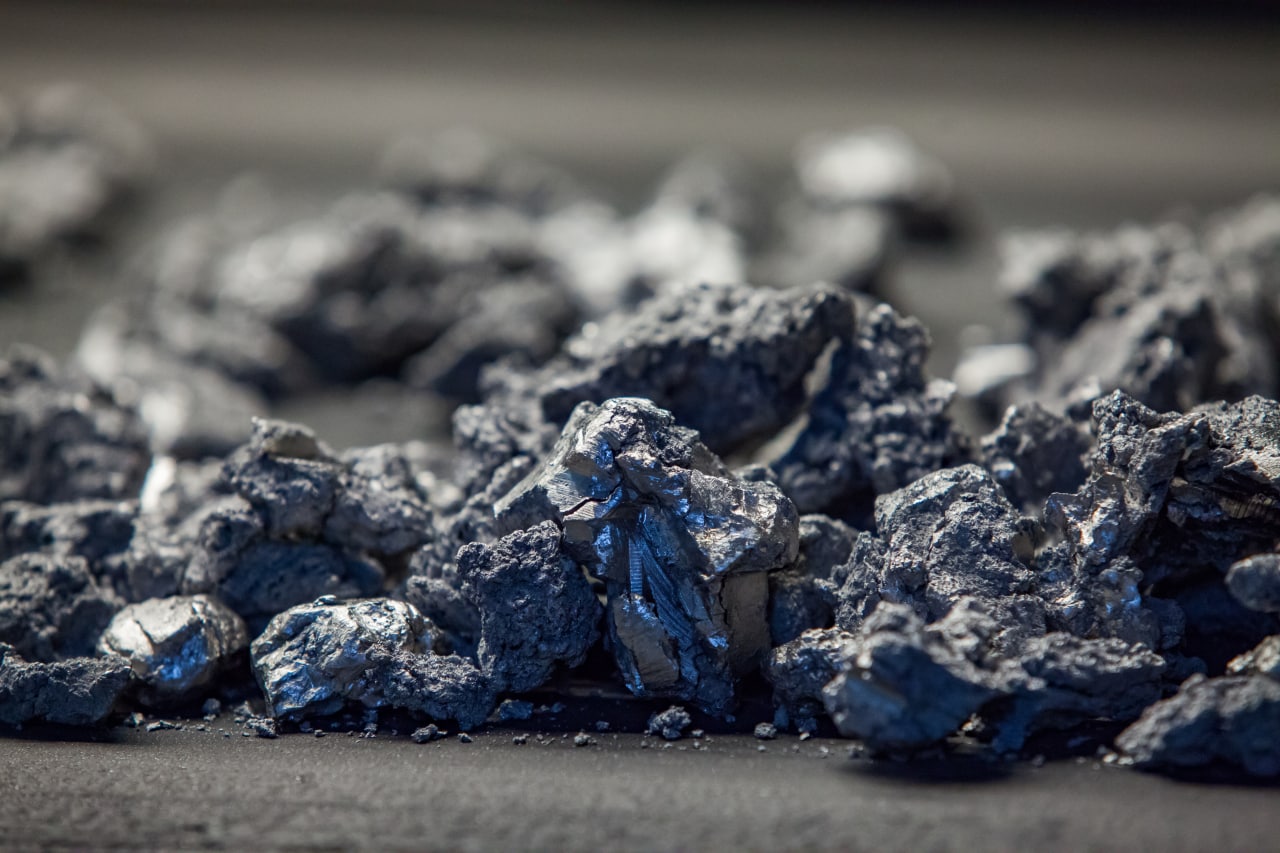
Chromium itself is not particularly practical, but thanks to its characteristic properties it is valuable when used together with other metals. It is one of the most important alloying elements, making it possible to obtain quality strong and corrosion-resistant materials. In addition, chromium is often used for decorative and protective metal coatings.
In nature a large amount of chromium is contained in two minerals. The more common — chromite — was discovered in 1798 and is a dark, dull stone that looks unremarkable from the outside.
The second mineral — crocoite, or lead chromate — is unusual in appearance but occurs extremely rarely. It was discovered in 1763 at the Berezovsky gold deposit and was first mentioned then in M. V. Lomonosov’s work “First Foundations of Metallurgy” as red lead ore.
The bright orange mineral was valued by stone collectors for its four-sided crystals. Artists loved crocoite fragments for the beautiful reddish-orange color. However, this ore is too rare for commercial use.
A year before chromite was discovered, in 1797, French chemist Louis Nicolas Vauquelin isolated a new refractory metal (chromium) with a carbide admixture. He calcined green chromium oxide with charcoal, and obtained the oxide itself by decomposing crocoite. The modern method of obtaining pure chromium was invented in 1894; it differs from Vauquelin’s method only in the type of reducing agent.
Chromium is a bluish-white metal. It is fairly widespread in the Earth’s crust. A chemical element of secondary subgroup of group 6, period 4 of D. I. Mendeleev’s periodic system of chemical elements.
Atomic number — 24, atomic mass — 51.99. Symbol — Cr (Latin “Chromium”). Boiling point — 2671°C, melting temperature — 1856°C, density — 7.19 g/cm³.
Starting from the mid-1800s cast iron producers discovered that adding chromium to steel makes it harder and more corrosion-resistant.
The point is that steel is an alloy of iron with a small amount of carbon — about 1%. In pure form iron can be heated and then bent, forged, and given many shapes. Iron objects made this way have moderate hardness and can bend in use. Melting iron and pouring it into molds yields “cast iron” products that become brittle after cooling. But adding carbon to iron changes its microstructure and properties. When this mixture is heated it reaches an extremely plastic stage and can be easily formed. As it cools steel gains strength and stiffness, becoming stronger than iron. This process is called tempering. Different amounts of carbon and cooling rate determine the final properties of steel.
Adding chromium to this mixture yields harder steel by slowing the transformation that occurs on cooling. Starting in 1865 steels with 3–5% chromium began to be produced.
Today using chromium in stainless steel production accounts for 60% of this metal’s consumption. Most stainless steel contains about 18% chromium; the “18-8” stamp on objects such as cutlery shows the alloy contains 18% chromium (for strength) and 8% nickel (for luster).
Because such steel does not rust and is easily sterilized, it is part of many objects we use in everyday life: kitchen appliances, food industry equipment, and medical and dental instruments.
Chromium in superalloys (alloys with high performance characteristics) allows jet engines to operate in a high-temperature, high-load environment. Chromite is used in blast furnaces and brick-firing molds because it retains strength at high temperature.
In addition, chromium as a chemical element is vital for good health. Insufficient content in the body leads to glucose intolerance. Offal, mushrooms, wheat germ, and broccoli are all good dietary sources of chromium.