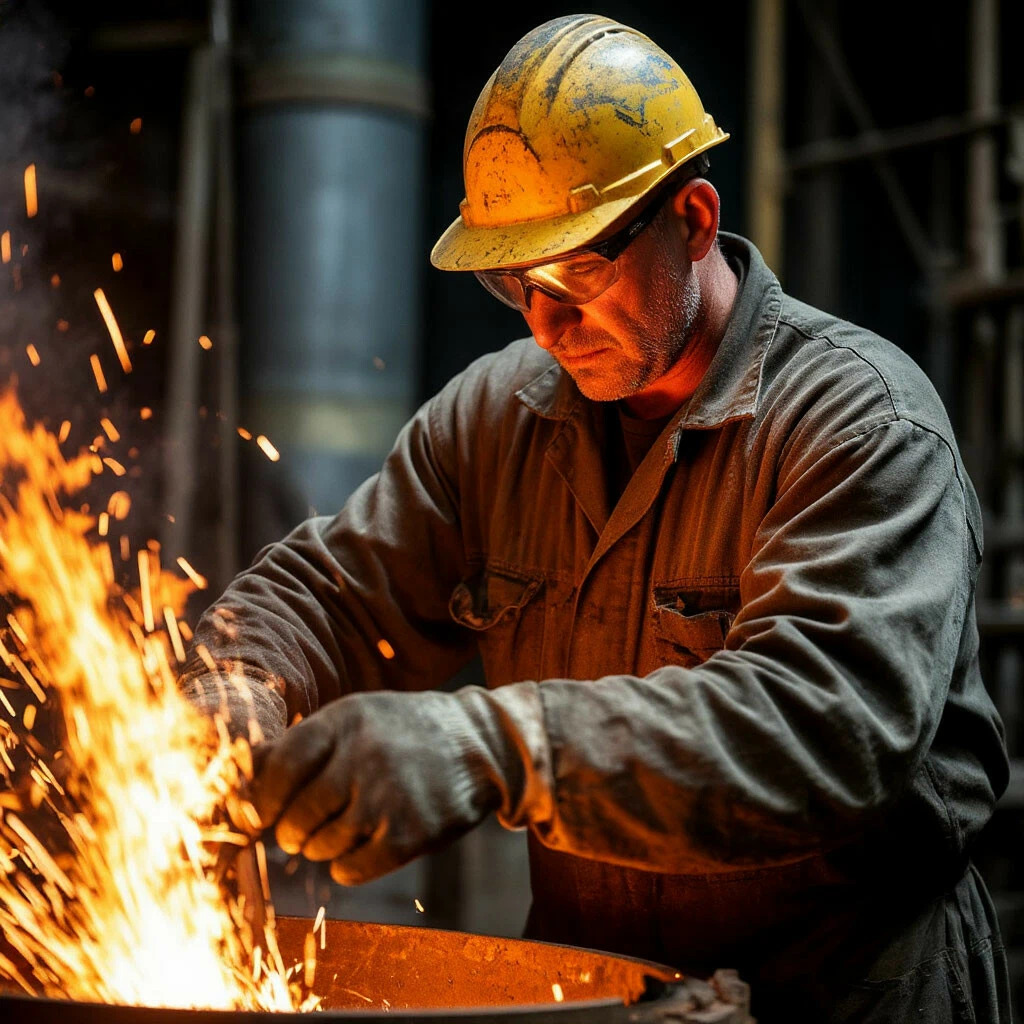
The world of metallurgy at first glance resembles a complex labyrinth of terms, physical quantities, and abbreviations. However exactly this language makes it possible to precisely describe material properties and control them. Without understanding it it is difficult to figure out what Petersburg Plant of Precision Alloys does and what our technological uniqueness consists in.
We have prepared a brief but substantive glossary that will help clients, partners, and everyone interested better understand the specifics of our work and speak with us in one professional language. Below are key concepts without which it is impossible to imagine modern production of precision materials.
Precision alloys are the basis of our specialization and the main subject of PZPS expertise. Simply put, this is not simply a metal but a material with pre-programmed properties.
Such strictly normalized characteristics include:
The key feature of precision alloys consists in reproducibility of properties from batch to batch, which is critically important for high-precision applications. Exactly therefore such materials are used where the highest accuracy and operating stability are required: in sensors, reference measuring instruments, microelectronics, telecommunications, and aerospace technology.
PZPS produces dozens of precision alloy grades whose properties precisely match customer requirements and industry standards.
For metal to acquire the needed properties, a base chemical composition is not enough. Here alloying comes on stage — one of the fundamental tools of metallurgy. The process consists in introducing into the base metal (iron, nickel, cobalt) strictly dosed alloying elements such as chromium, molybdenum, vanadium, manganese, silicon, and others.
Each element performs its “role”: raises strength, improves corrosion resistance, forms magnetic or electrical characteristics. Like the art of a cook, alloying requires precise calculation and deep understanding of element interaction. As a result the alloy acquires properties unattainable for pure metals, which makes creation of precision materials possible.
Among all thermal processes annealing occupies a special place and is one of the key stages of our production.
Annealing is a high-temperature heat treatment including:
The main purpose of the process is relieving internal stresses arising after cold deformation (for example rolling) and bringing the metal structure into an equilibrium, homogeneous state. Without correctly performed annealing it is impossible to ensure stability of precision alloy properties and thus reliability of the final product.
Cold rolling is a process of plastic deformation of metal between rolls at a temperature below the recrystallization temperature.
Exactly in this way PZPS produces its main product — cold-rolled strip in demand in high-tech industries. The process makes it possible to achieve:
Cold rolling is the basis for applying materials in microelectronics, instrument engineering, and sensor systems where even minimal defects are unacceptable.
Coercive force is one of the most important parameters of magnetic alloys. In simplified form this is the material’s ability to resist demagnetization.
Soft magnetic alloys that PZPS produces are characterized by low coercive force — they magnetize and demagnetize easily. This makes them indispensable for transformer cores, magnetic shields, sensors, and measuring systems. Thus coercive force directly determines the material application area.
Mechanical properties describe how a material reacts to external forces. For precision alloys they have not relative but strictly specified values.
Key parameters include:
For precision materials what matters is not simply achieving high indicators but their precise conformity to the customer’s technical assignment.
Microstructure is the “inner universe” of metal that can be seen only with a microscope. It includes:
Exactly microstructure determines most physical, mechanical, and magnetic properties of the material. Therefore control of microstructure at all production stages — from melting to rolling — is a mandatory element of the PZPS quality system.
Understanding these terms makes it possible to see behind complex formulations the essence of our work. PZPS is not simply a metallurgical plant but a competence center for creating materials with predictable, stable, and impeccable behavior. We do not simply produce metal — we form properties one can rely on.