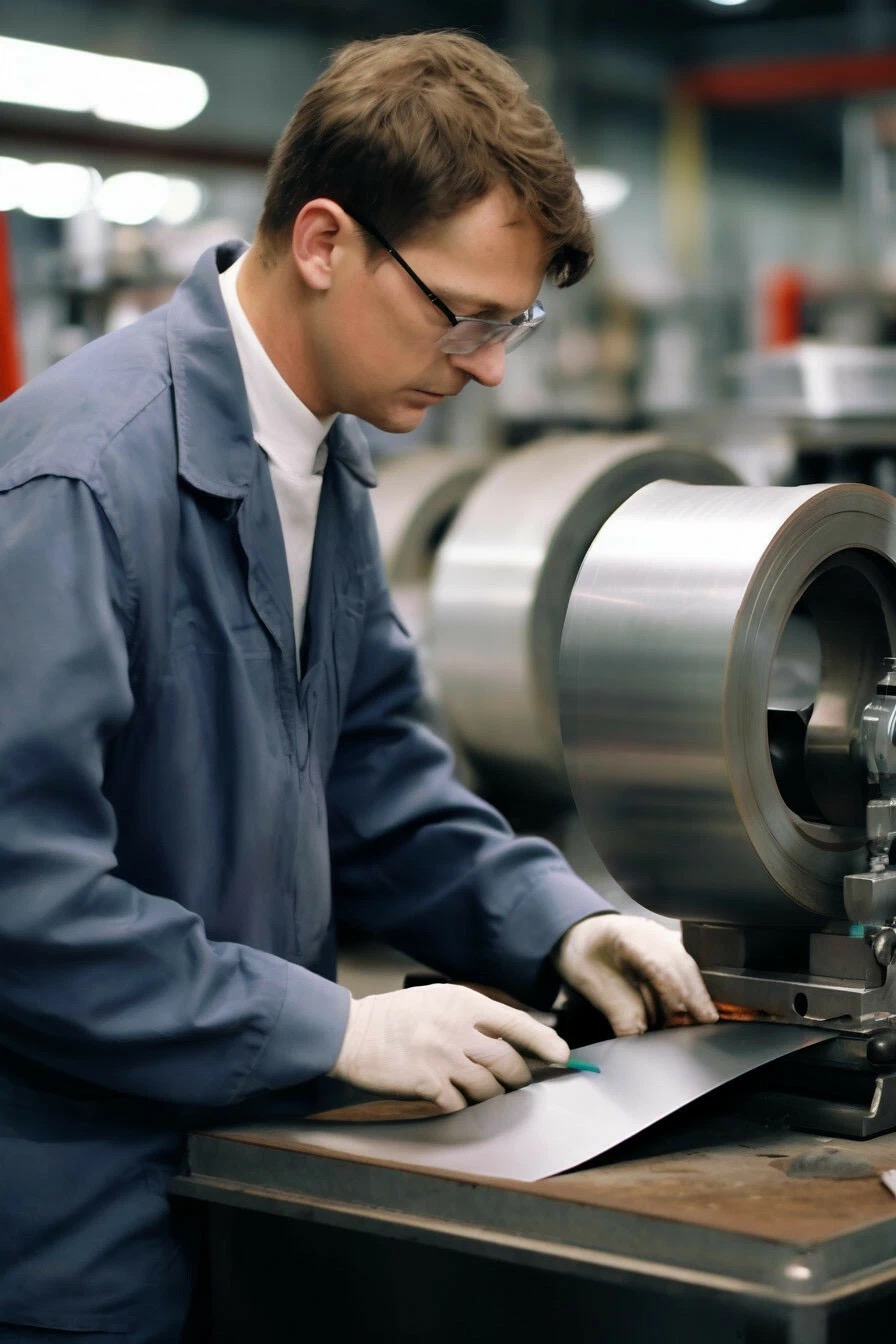
At PZPS a technology for quenching thin strip from quality structural steel 65G of thickness 80 micrometers has been successfully mastered. This strip, thanks to its unique properties, is widely used to manufacture parts working under load and precision instruments such as micrometers, watches, and other measuring tools.
Features of steel 65G
Steel grade 65G is one of the most widespread materials in machine building and industrial equipment production. Its main advantages include:
- Strength and elasticity. Thanks to elevated carbon and manganese content, steel 65G has an optimal ratio of strength and elasticity. This makes it possible to manufacture products able to withstand significant loads while retaining ductility and impact toughness even under dynamic alternating loads.
- Hardness. Steel 65G is characterized by hardness within 45–55 HRC. This ensures high wear resistance and ability to retain shape under external loads.
- Weldability. Steel 65G is welded with limitations. When welding one must take into account the possibility of crack formation and reduction of welded joint strength. This is linked to the fact that due to significant carbon content structural changes occur in the heat-affected zone.
- Machinability. Steel 65G readily undergoes cutting, which makes it an ideal material for manufacturing various parts.
To improve properties of spring steel 65G, heat treatment is widely applied that includes quenching and medium tempering. Quenching raises material strength and hardness, and medium tempering reduces internal stresses and increases impact toughness.
Thin strip heat treatment technology
Heat treatment of thin metal strip is a process requiring special attention to details and high accuracy of execution. Complexity of this process is due to several factors that may affect quality and properties of the final product.
- Non-uniformity of heating and cooling. Thin metal strip has high thermal conductivity, which may lead to rapid heating and cooling in different sections of the strip. This, in turn, may cause non-uniformity of strip properties along its entire length, which is unacceptable in manufacturing measuring instruments requiring high accuracy.
- Possibility of strip deformation under temperature and mechanical loads. Due to its thinness metal strip easily deforms, which may lead to loss of shape or appearance of surface defects, which in turn will significantly reduce final product quality and lead to non-conformity with quality standards.
- Complexity of controlling the heat treatment process. To ensure high product quality it is necessary to control temperature and processing time as precisely as possible. Even slight deviations may lead to undesirable changes in strip properties, which may negatively affect functionality of devices released.
Thanks to technologies developed by PZPS specialists, these difficulties were overcome: uniformity of heating and cooling was ensured, as well as strict observance of all technological parameters. As a result a high-quality strip is obtained without property deviations along the entire length, which is ideally suited for producing precision measuring instruments such as micrometers.
Precision alloys with specified elasticity properties
Besides carbon spring grades 65G, 60S2A, 70, 70S2KhA, PZPS pays special attention to producing precision materials with specified elasticity properties, including:
- 40KKhNM — a strong non-magnetic alloy with elevated corrosion resistance. Used in mainsprings of clock mechanisms, coiled cylindrical springs with working temperature up to +400°C, for cores of electrical measuring instruments and parts in surgery. Tensile strength in the work-hardened state is 1370–1770 MPa in accordance with GOST 14117-85.
- 36NKhTYu — a non-magnetic corrosion-resistant alloy with tensile strength 1180–1570 MPa. Used in producing elastic sensing elements of instruments and parts working at temperatures up to +250°C.
- 17KhNGT — a corrosion-resistant alloy with tensile strength 1470–1720 MPa. Retains its original characteristics in all climatic conditions and some aggressive environments. Used to manufacture spring elements and other elastic sensing parts ensuring stable operation at temperatures up to +250°C.
These precision materials are characterized by high strength, elasticity, and corrosion resistance, which makes them an excellent choice for producing precision measuring instruments and other devices where high reliability and dependability are required. To buy alloy steels and alloys, contact us at the listed phone or place an order. Our employees will call you back and help select an alloy meeting your project requirements. The enterprise also provides other production services and cooperates with startups and large companies in developing new materials and their production technologies.