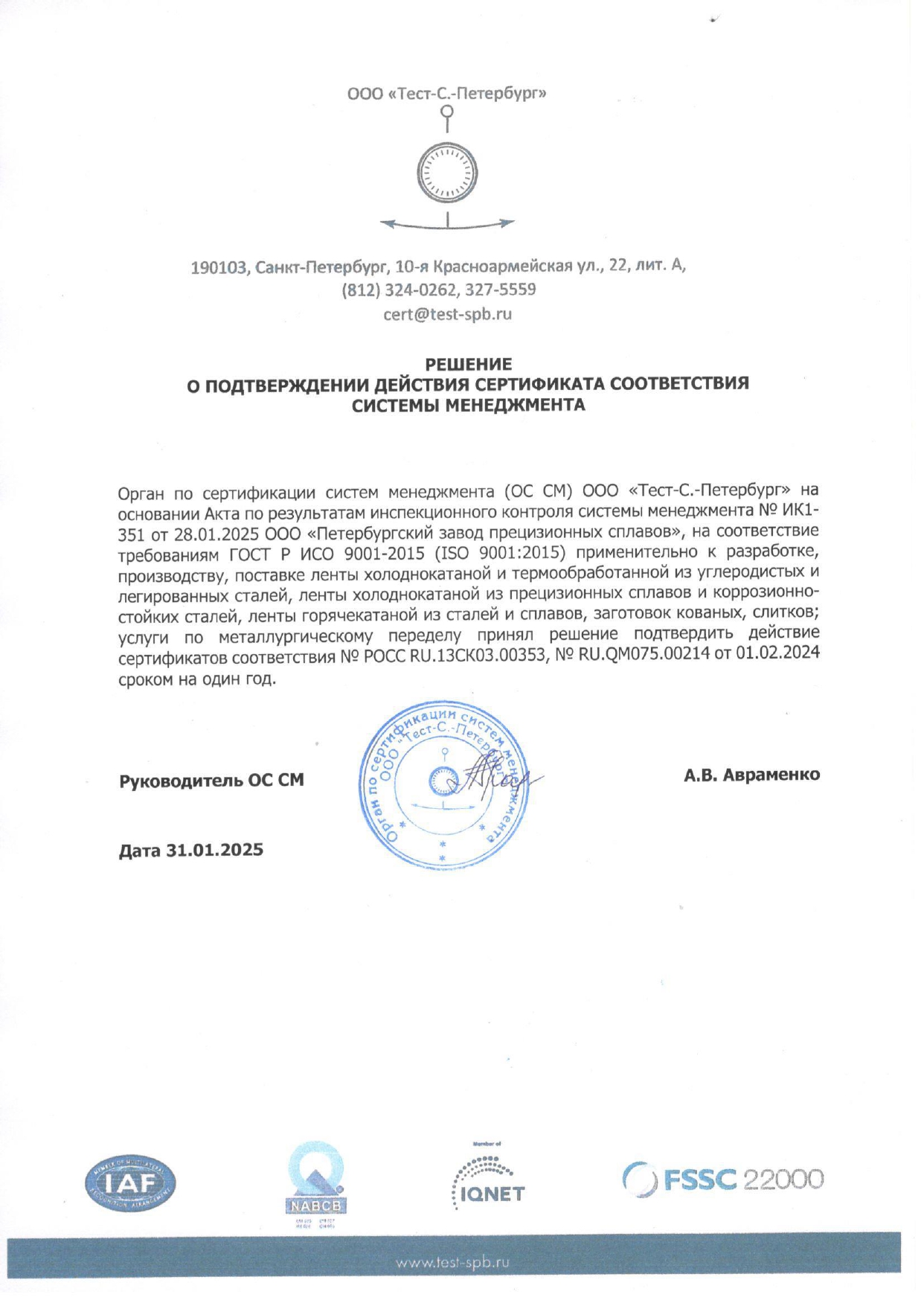
PZPS has successfully confirmed the validity of its Quality Management System (QMS) compliance certificate. This important achievement demonstrates the company's commitment to optimizing production processes and continuously improving the quality of its products and services, as well as its readiness to meet current requirements in the field of metallurgical production.
What Is a Quality Management System (QMS)?
A quality management system is a set of processes and tools aimed at continuously improving product quality throughout its entire life cycle — from development to sale. A QMS includes the planning, development, implementation, and monitoring of standards that define how production processes should be carried out in order to achieve the best results.
Why Is a Quality Management System Needed?
For companies such as PZPS, implementing a QMS not only ensures compliance with international standards, but also brings a number of practical benefits:
- Increased competitiveness. The QMS helps PZPS produce high-quality products, which strengthens its market position and attracts new customers. The ISO 9001 standards used at the enterprise confirm compliance with global requirements, opening new opportunities for entering international markets.
- Customer satisfaction. The main goal of the QMS is to ensure that products and services meet customer needs and expectations. This helps increase customer loyalty and build long-term, mutually beneficial relationships with partners.
- Cost reduction. Implementing a QMS helps optimize production processes, which avoids the costs of reworking or correcting defective products. Modern quality control and data analysis methods help identify and eliminate defects in a timely manner, minimizing losses.
- Development of corporate culture. The QMS influences the development of corporate culture, making it quality-oriented at all levels of the organization. Every employee understands their role in ensuring high quality, which fosters a drive to improve processes and work results.
Principles of a Quality Management System
An effective quality management system is based on several key principles that must be taken into account when implementing and operating it:
- Customer focus. Product quality should always be determined by customer needs. The QMS is aimed at identifying and meeting these requirements, with priority given not only to meeting but also exceeding customer expectations.
- Leadership. Effective leadership creates the conditions for involving all employees in the quality assurance process. Managers must maintain an organizational environment in which every employee actively participates in achieving the company's goals.
- Employee engagement. Employees at all levels of the organization must actively participate in the quality assurance process. This fosters an atmosphere of shared responsibility and a drive to improve work processes.
- Process approach. Product quality is achieved through clear process management at all stages of production. Every change in processes or technologies must be planned and controlled.
- Systems approach to management. A quality management system must view the organization as a set of interrelated processes. Understanding and managing these processes helps improve operations and increase overall efficiency.
- Continuous improvement. The continuous improvement of all processes within the company is a key goal of the QMS. Introducing innovations and optimizing work processes helps increase the enterprise's overall productivity.
- Fact-based decision-making. Effective decision-making is only possible with reliable data available. The QMS requires the use of objective facts and information analysis to make well-considered decisions.
Quality Standards: ISO 9001
The ISO 9001 standard is the foundation of most quality management systems in the world. It establishes requirements for the certification of organizations and confirmation of their compliance with international standards. To confirm compliance with ISO 9001 requirements, PZPS regularly conducts internal and external process audits and reviews its procedures to improve the quality of its work and products. This not only helps maintain standards, but also allows the company to quickly adapt to changes in the industry.
How Is the QMS Implemented at PZPS?
Implementing and maintaining a QMS at PZPS requires an integrated approach covering all stages of production and quality management.
Product Quality Management
At PZPS, product quality management begins with developing clear requirements for each unit of production. The following tools are used for this purpose:
- The PDCA methodology (Plan-Do-Check-Act) — a cyclical approach that allows processes ensuring product quality to be planned, implemented, checked, and improved.
- Risk and opportunity analysis — helps identify potential threats and opportunities for improvement at various stages of production.
- Change management — controlling any changes in the production process in order to minimize negative effects on product quality.
Quality Control
This includes checking products for compliance with established standards at all stages of production. The most important control methods are:
- Inspection and testing — help identify defects and nonconformities at every stage — from incoming raw material inspection to storage and shipment of finished products.
- Statistical control methods for analyzing quality data allow deviations to be identified in a timely manner and eliminated at early production stages.
Quality Audit
This is a systematic review of the enterprise's quality management processes and systems. It includes:
- Internal and external audits to verify compliance with all quality norms and standards.
- Employee interviews to assess their awareness of QMS requirements and level of training.
- Observation of production processes to verify compliance with established standards.
- Documentation review to confirm compliance with QMS requirements.
These measures allow PZPS not only to maintain ISO 9001 compliance, but also to identify weak points in the quality management system and develop strategies to address them.
Benefits PZPS Gains from Its Quality Management System
The QMS implemented at PZPS provides the company with several significant benefits:
- Guaranteed high product quality. Every stage of production is monitored using modern methods and tools, which guarantees consistency and high product quality.
- Increased customer trust. Confirmation of ISO 9001 compliance strengthens the company's reputation and increases its appeal to customers.
- Optimization of production processes. The QMS helps the company significantly reduce costs by improving process efficiency and reducing the amount of defective products.
- Continuous development and improvement. Implementing a QMS allows PZPS not only to meet current standards, but also to strive for continuous improvement at all levels, which is the key to long-term success on the market.
The quality management system at PZPS is a powerful tool that supports high production standards and drives continuous improvement of all business processes. If you need a reliable supplier of high-quality steels and alloys, contact our sales department. With PZPS, you can always be confident in the high quality of the products supplied and their strict conformity to stated specifications.