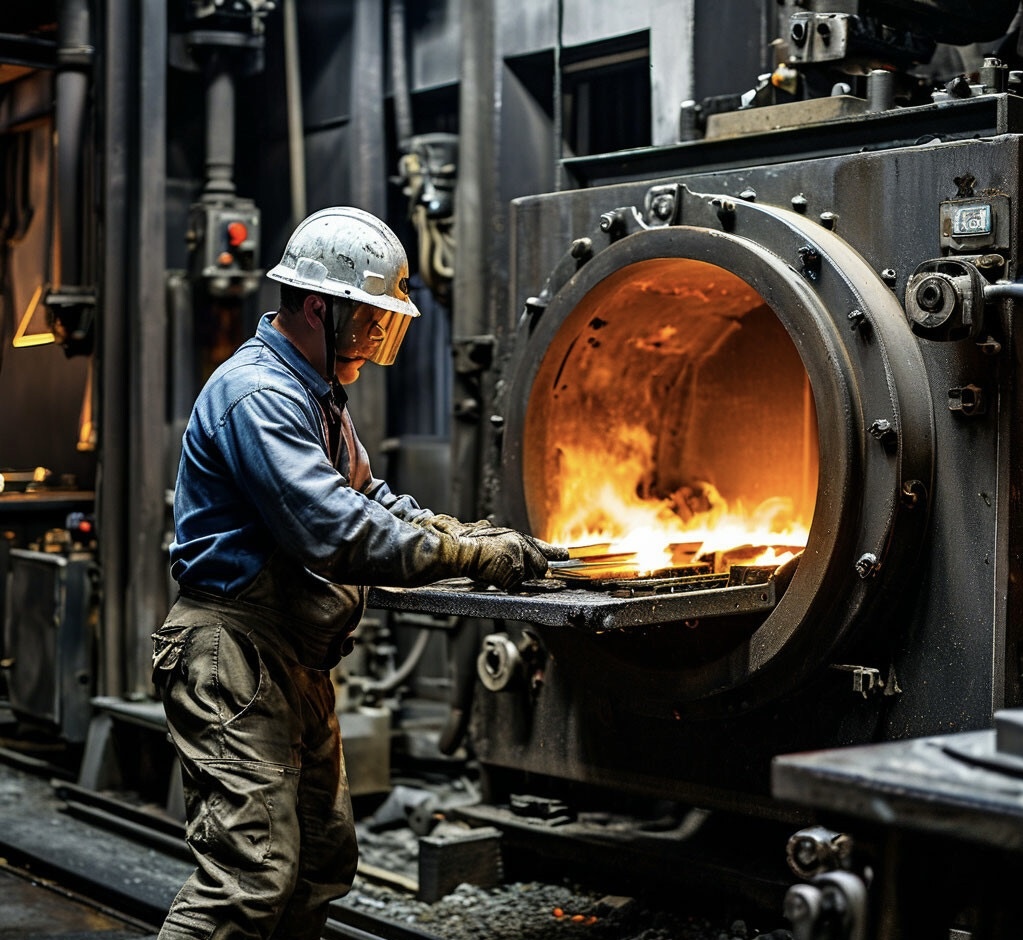
Hardenability and hardenability are fundamental characteristics that directly affect the performance properties of materials after heat treatment. Without understanding these properties, it is impossible to create reliable and durable steel products.
What is hardenability and hardenability?
Hardenability — the ability of a material to achieve high hardness and strength after hardening. This parameter is largely determined by the chemical composition of the alloy. For example, carbon increases hardness, but its excess can reduce ductility.
Hardenability characterizes the depth of penetration of hardening into steel. It depends on factors such as chemical composition, austenite grain size and cooling rate. High hardenability ensures uniform hardness throughout the entire volume of the product, which is especially important for large parts and structures of complex shape.
These properties are key in the production of steel for industries such as oil and gas industry, aviation, construction and mechanical engineering, where high demands on strength and durability of materials do not allow compromises.
Why is this important?
Hardenability and hardenability play a decisive role in ensuring the performance characteristics of products:
- Hardenability allows us to obtain products with the necessary wear resistance, ductility and strength. This is especially important for tools and parts operating under high loads.
- Hardenability guarantees that even massive structural elements will have uniform hardness. This reduces the risk of weak spots forming that could lead to product failure.
These characteristics determine success heat treatment and quality of finished products.
Steel hardening process
Hardening is a complex technological process that includes several stages:
- Heat. The heating temperature depends on the composition of the alloy. For hypoeutectoid steels (carbon up to 0.8%), the heating temperature should exceed the critical point Ac3 by 30–50°C. For hypereutectoid steels (carbon above 0.8%), the temperature is selected above the Acm point by the same 30–50°C.
- Excerpt. Heating time depends on the size of the part and the type of oven. Typically, the exposure is 1–2 minutes for each millimeter of product thickness.
- Cooling. Rapid cooling prevents the decomposition of austenite into ferrite and cementite, which increases the hardness of the material. Three cooling methods are used:
- In one cooler. Immersion of the part in water or oil. This method is suitable for carbon steels.
- Isothermal cooling. Ensures uniform distribution of hardness.
- Staged cooling. Reduces internal stresses, improving durability.
- Vacation. After hardening, the material is tempered to relieve internal stresses and increase ductility. Depending on the temperature, the holiday is divided into:
- low (150–200°C);
- medium (350–450°C);
- high (500–650°C).
Careful adherence to hardening technology allows you to achieve optimal steel characteristics.
Factors affecting hardenability and hardenability
Chemical composition
- Carbon. Increases hardness and strength, but with increased content it leads to the formation of carbides, which reduces the ductility of the material.
- Alloying elements. Chromium, nickel, manganese and molybdenum help improve the structure, increase the hardness and hardenability of alloys.
Cooling rate
Rapid cooling promotes the formation of a hard martensitic structure. Slow - leads to a decrease in hardness due to the decomposition of austenite into ferrite and cementite.
The cooling rate is selected in accordance with the chemical composition and required mechanical properties. For carbon steels, rapid cooling in water or oil is usually used, and for alloy steels, slower cooling is used.
Steel structure before hardening
The fine-grained structure ensures uniform hardening and high strength. Alloys with a coarse-grained structure may have reduced hardenability due to the uneven distribution of carbon and alloying additives. To improve the structure, preliminary heat treatment is carried out.
Defects
Pores, cracks and non-metallic inclusions reduce the quality of hardening and deteriorate the quality of hardening. Therefore, before processing steels and alloys, carefully check for defects.
Methods for assessing hardenability
Hardenability reflects the ability of a steel to achieve high hardness and strength after quenching. The following methods are used to evaluate it:
Hardness measurement
This is one of the most accessible and simple methods for assessing hardenability. The process includes:
- Quenching the sample.
- Hardness measurement after hardening using HRC (Rockwell hardness) or HV (Vickers hardness) scales.
The higher the hardness after quenching, the better the hardenability of the steel.
Tensile test
This method involves performing mechanical tests on stretchingto define the following parameters:
- Tensile strength - the maximum stress that leads to the destruction of a material.
- Yield strength - the stress at which the strain continues to increase without increasing the load.
High values of these characteristics indicate good hardenability.
Differential scanning calorimetry (DSC)
DSC is based on the measurement of heat fluxes released or absorbed by a material during phase transitions:
- Allows you to determine the temperature of the beginning and end of the martensitic transformation.
- Helps evaluate the effectiveness of hardening and identify optimal heat treatment conditions.
Microstructural analysis
The method includes study of structure steel after hardening using a microscope. Focuses on:
- The grain size of austenite before hardening, which affects the uniformity of hardenability.
- The presence and distribution of phases (martensite, ferrite, carbides) in hardened steel.
The method is especially effective for the analysis of alloys with the addition of alloying elements that affect the phase composition.
Influence of chemical composition on hardenability
Chromium (Cr)
- Increases hardenability by increasing the stability of the austenitic structure.
- Increases hardness and strength.
- Improves corrosion resistance, which makes chromium-containing steels popular in aggressive environments.
Nickel (Ni)
- Improves plasticity and toughness, which reduces the risk of brittle fracture.
- Promotes uniform distribution of carbides.
- Increases impact strength and fatigue strength, which is important for critical structures.
Manganese (Mn)
- Reduces oxidation steel during melting and heat treatment.
- Forms solid solutions with carbon, increasing hardenability.
- Improves wear resistance and weldability.
Molybdenum (Mo)
- Forms stable carbides, increasing the hardness of the alloy.
- Increases heat resistance and strength at high temperatures.
- Reduces the risk of hardening cracks due to uniform stress distribution.
Carbon (C)
- It is the main element that increases the hardness and strength of steel.
- High carbon content improves hardenability, but excess may reduce ductility.
Optimal combination of elements
The balance between the content of carbon and alloying elements allows one to achieve the required depth of hardenability and ensure high performance properties of steel.
Methods for determining hardenability
Hardenability is especially important for large-sized or complex-shaped products.
End hardening method (GOST 5657-69)
Key steps include:
- Sample preparation. A cylindrical sample is made from the material under study, usually of standard size.
- Heat. The sample is heated to a temperature characteristic of hardening a particular grade (usually above the critical point in order to completely transform the material into the austenitic state).
- Cooling. A stream of water or oil is directed at the end of the heated sample. This creates a cooling gradient, where the end is cooled as quickly as possible, and as you move away from it, the cooling rate decreases.
- Hardness measurement. After hardening, the hardness of the material is measured at various points along the axis of the sample.
- Building a graph. Based on the measurements, a curve of hardness versus distance to the end of the sample is constructed. This allows you to determine the depth of hardenability of steel.
Using test bars
To assess hardenability, special samples are used - test bars. This method involves the following steps:
- Making bars. Blanks of standard shape and size are made from the steel under study.
- Hardening. The samples are subjected to a standard quenching process involving heating and cooling.
- Analysis of structure and hardness. After hardening, the change in hardness across the cross section of the sample is studied. The deeper the high hardness is maintained, the better the hardenability.
Products and capabilities of the PZPS plant
Correctly selected heat treatment modes make it possible to produce products with the required mechanical properties, which is especially important for carbon steels 60S2A, 65G, 70, 70S2KhA, U8A, U10A.
Also strict control at all stages of heat treatment it is necessary during production:
Thanks to modern equipment and high employee qualifications PZPS guarantees product compliance with modern quality standards. With us you can buy cold rolled soft magnetic alloy strip 27KKh, as well as other special steels and precision alloys necessary for the successful implementation of the most complex projects.