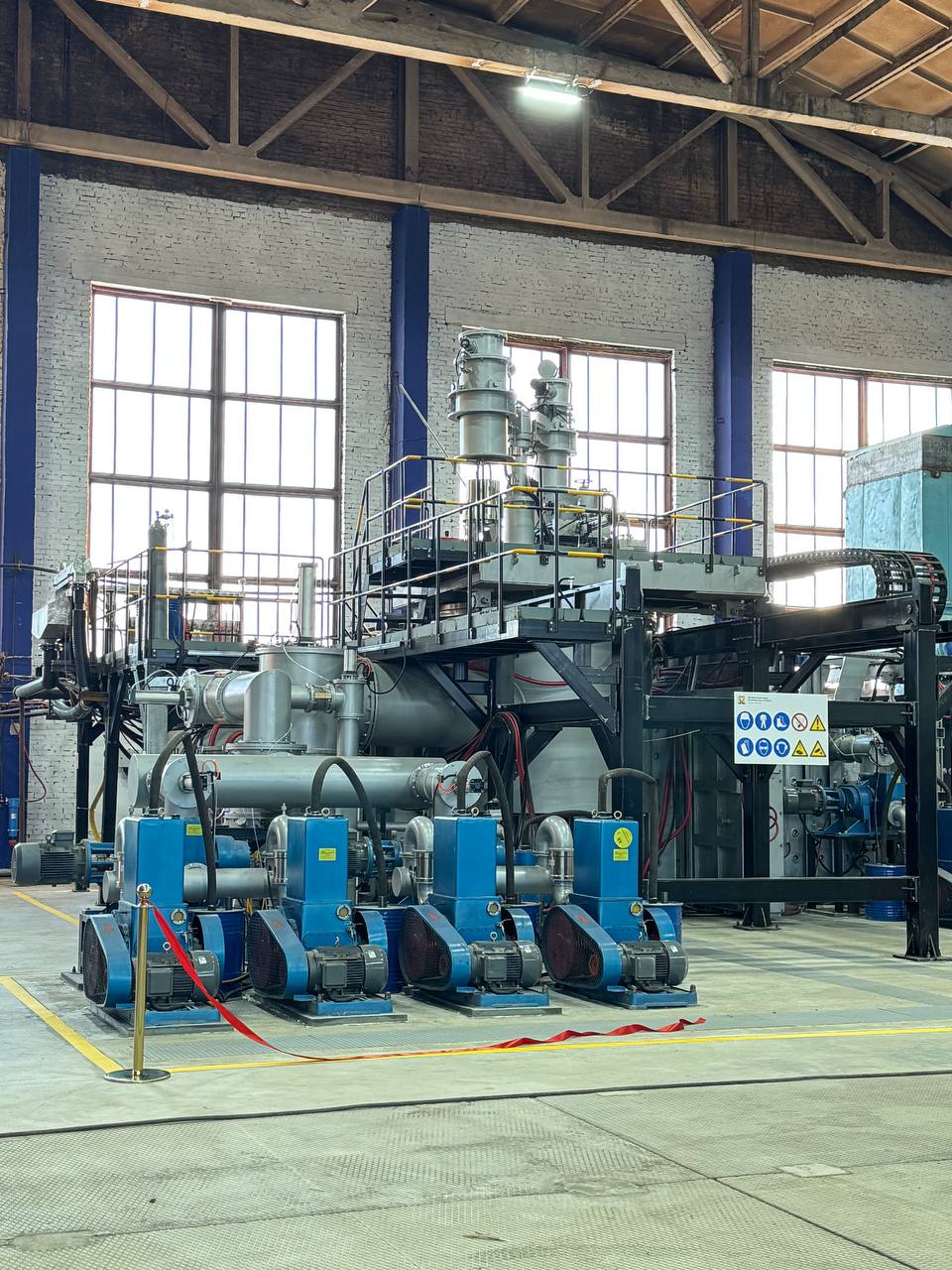
On 17 December an important event took place at Petersburg Plant of Precision Alloys (PZPS) — commissioning of a new vacuum furnace. This is a significant stage in the enterprise’s development aimed at improving production processes and raising product quality. The new furnace is located on a new modern plant site, which not only expands capacity but also makes it possible to introduce advanced metallurgical production methods.
Advantages of vacuum melting: quality without compromise
Vacuum melting of steels and alloys is a technology that takes metallurgy to a new level, providing unique advantages:
- Minimizing gas content. The vacuum environment virtually completely eliminates oxygen, nitrogen, and hydrogen, which negatively affect metals’ mechanical and physical properties. This is especially important when producing alloys for medical and aerospace industries.
- Higher composition purity. Melting under vacuum excludes contact of the melt with the environment, substantially reducing impurities such as oxides and sulfides. As a result, mechanical properties of alloys improve.
- Improved structure. Absence of gases and impurities promotes formation of a uniform alloy microstructure, especially important for materials used in high-precision mechanisms.
- Process accuracy. Modern vacuum furnaces are equipped with intelligent control systems that regulate temperature, pressure, and process duration to within fractions of a percent. This ensures stability and reproducibility of results.
- Resource savings. Vacuum melting reduces metal losses by decreasing evaporation and oxidation.
- Environmental safety. The technology cuts harmful emissions, making the process safer for the environment.
These advantages make vacuum furnaces indispensable in producing high-quality steels and precision alloys used in critical industrial areas.
Range of alloys produced
A wide spectrum of specialized alloys will be melted in the new vacuum furnace at PZPS:
- Soft magnetic alloys: 49K2FA-VI, 27Kh, 50N, 50NP, 79NM, 80NM, 81NMA. Widely used in electrical engineering thanks to high magnetic permeability and low coercivity.
- Hard magnetic alloys: EP-298, 13NKhM. In demand for permanent magnet production.
- Alloys with specified TCLE: 29NK, 36N, 42N. Used in industries that require elevated thermal stability, for example aerospace technology and instrument making.
Thanks to vacuum melting these materials acquire improved service characteristics, making them competitive on the world market.
Prospects of the new production site
The new vacuum furnace is only part of a larger plant modernization project. On the new site it is planned to place:
- Electroslag and electron-beam remelting furnaces, expanding capabilities for working with highly alloyed and hard-to-process materials.
- A hot-rolling mill able to produce metal strip 1 to 4 mm thick and up to 450 mm wide.
- Cold-rolling mills that will ensure production of high-precision thin sheet products.
Commissioning the new vacuum furnace was an important step toward technological leadership. Introducing new technologies will allow the plant to increase output volumes, master production of new material grades, and strengthen its position on the metallurgy market.